China aims 27 mirrors at frozen mountainside to speed up world's tallest dam
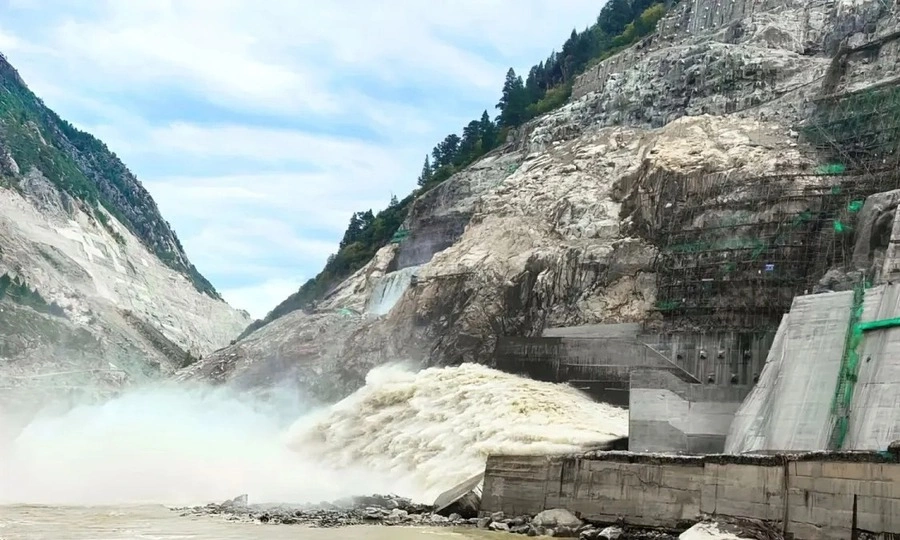
China has brought a third generating unit online at the Shuangjiangkou hydropower station in Sichuan Province, lifting output to 1.5 GW while the record-breaking dam above the turbines is still being built.
China Energy Investment Corp said that the third of the plant's four 500 MW Francis turbines had entered service, Global Times reported, citing China Media Group.
The operator describes the station on the upper reaches of the Dadu River, in Aba Tibetan and Qiang Autonomous Prefecture, as home to the world's tallest dam at 315 m.
The embankment had reached roughly 260 m of placed fill in early July, according to a detailed National Energy Administration release cited by the German engineering journal ingenieur.de.
The 315 m figure is the design height and the crest is not scheduled until 2027.
Guinness World Records still lists the 305 m Jinping-I arch dam, also in Sichuan, as the world's highest completed dam.
Shuangjiangkou would surpass it by 10 m on completion, though Water Power Magazine has noted the title would not last long: Tajikistan's Rogun dam is designed to reach 335 m, with completion projected for the 2030s.
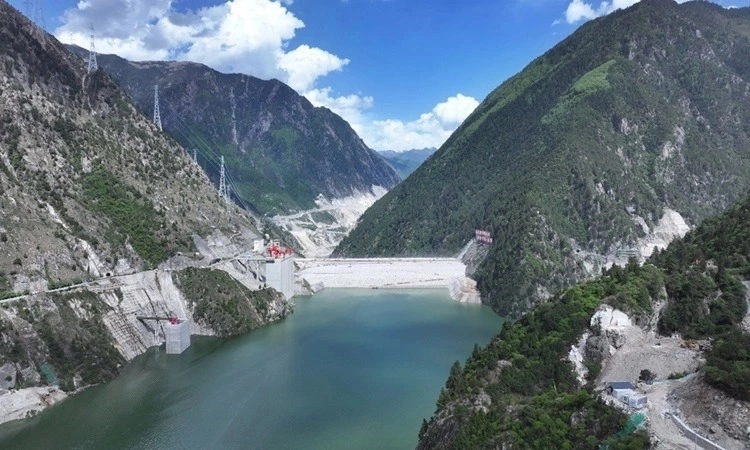
The station has a total installed capacity of 2 GW and a reservoir designed to hold 2.9 billion cubic meters of water, according to China News Service, which reported that the fourth unit has yet to be commissioned. Full capacity is expected by the end of 2026.
Shuangjiangkou completed a second impoundment stage before the first turbine started, reaching a water level high enough to run it while the embankment continued rising, ingenieur.de reported.
The variation in hydraulic head runs to about 80 m by the operator's figures, forcing the turbines to work efficiently across sharply different conditions.
Since June the station has delivered 500 million kilowatt-hours, Global Times reported, feeding peak summer demand in the Chengdu-Chongqing economic circle.
Once all four units run, annual output is projected at about 7.7 billion kilowatt-hours.
Chinese state media has also credited the project with adding 6.6 billion kilowatt-hours a year at downstream cascade stations, though ingenieur.de noted this is an operator calculation reflecting water released on a different schedule rather than new generation at Shuangjiangkou itself.
 |
|
The Shuangjiangkou hydropower dam in Sichuan Province, China. Photo courtesy of PowerChina |
Lin Boqiang, director of the China Center for Energy Economics Research at Xiamen University, told Global Times that the project's significance goes beyond clean power because the reservoir allows water to be stored when inflows are strong and released when demand climbs or during dry spells.
That flexibility becomes more valuable as wind and solar capacity expands, he said, since reservoir hydropower can absorb the swings of intermittent sources and keep the grid stable.
The site sits in a narrow mountain valley at roughly 2,200 m, where winter temperatures fall to about minus 20 C and frozen material cannot be compacted to the required density, leaving under six months a year for some work, ingenieur.de reported.
Engineers installed 27 heliostats that track the sun and direct light onto the clay core, raising temperatures there by around 3 C and buying roughly three additional working hours on suitable days. More than 46 million cubic meters of material is to go into the rockfill embankment.
Chinese experts cited by Global Times said the commissioning shows a domestic capability to build the world's highest-grade rockfill dams and high-head flood discharge systems without foreign technology.
The project's environmental assessment flagged altered flows and water temperatures, damage to aquatic habitats and fish stocks, flooded vegetation including protected plant species, and the resettlement of residents, ingenieur.de reported.
China added 6.03 GW of hydropower capacity in the first half of the year, the National Energy Administration said on July 30, split between 3.03 GW of conventional hydropower and 3 GW of pumped storage.
Total installed hydropower capacity reached 454 GW at the end of June, a figure corroborated by Carbon Brief's analysis of China's latest five-year renewables plan, with major producers generating 588.6 billion kilowatt-hours over the six months.
KioskNews shows a cleaned-up reading view extracted from the publisher’s page — the original always lives on their site, not ours.