Bears get closer to human settlements than thought, trackers show
RARE PEEK: The footage released showed one of the bears staying in a cave for as long as 70 days, providing the first record of Formosan black bear’s overwintering
By Yang Yuan-ting and Esme Yeh / Staff reporter, with staff writer and CNA


The Forestry and Nature Conservation Agency yesterday released tracking records of released Formosan black bears for the first time, showing that they get much closer to human settlements than previously thought.
The agency said it had captured two bears, Da Qu-ali (達古阿里) and Aziman (阿里曼), in indigenous villages in Hualien County and began to track them with a camera-mounted satellite collar after releasing them back into the wild.
The results confirmed that the bears have moved from deep mountain areas into lowland hills closer to human communities, leading to an increase in human-bear conflicts, it said.
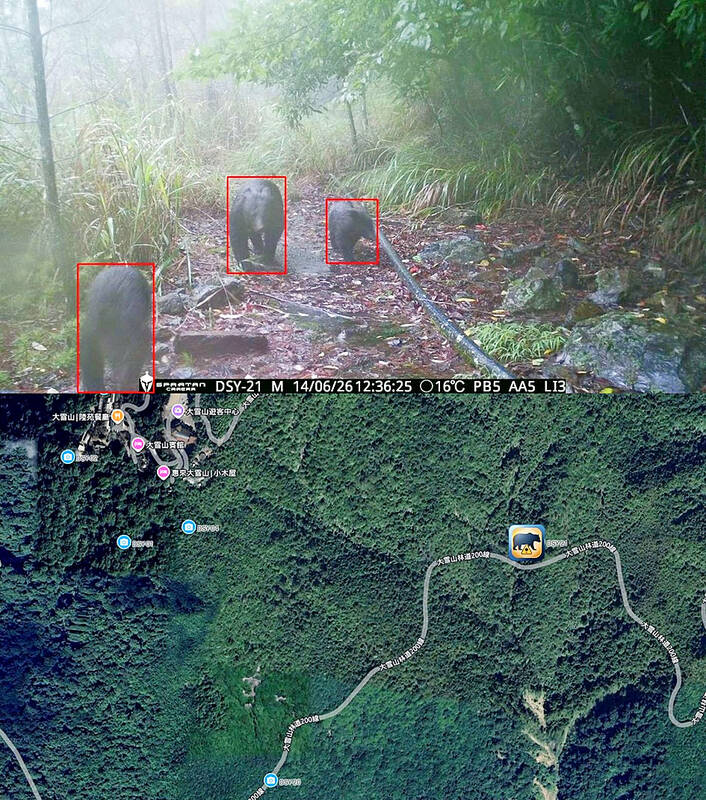
Formosan black bears are detected by an early warning system in a photograph released yesterday.
Photo courtesy of the Forestry and Nature Conservation Agency
The agency has introduced artificial intelligence-assisted early warning and monitoring systems in high-risk areas to predict bear intrusions, including Taitung County’s Jiaming Lake Lodge (嘉明湖山屋) and Siangyang Cabin (向陽山屋), and Taichung’s Dasyueshan National Forest Recreation Area (大雪山森林遊樂區), agency Director-General Lin Hwa-ching (林華慶) said.
The system would issue alerts within two minutes after detecting bear activity, he said.
Bear-resistant trash cans and electric fences have also been set up around human communities in mountainous areas, Lin said.
To help people address potential bear encounters, the agency would distribute guidelines to communities and schools around hot spots for bear activity, he said.
The footage showed Da Qu-ali eating a sambar deer carcass and leg remains of a Formosan serow, and rummaging through garbage, eating lunchbox leftovers and roaming around betel nut gardens, work sheds and orchards.
Lin urged people visiting mountainous areas to manage their garbage, especially food scraps and kitchen waste, to prevent attracting bears.
Bear sightings used to be concentrated in areas governed by the agency’s Hualien, Taitung and Taichung branches, but they have extended to the Hsinchu branch area, Lin said, adding that the frequency of sightings has also increased.
Some people mistakenly believe that human-bear conflicts are driven by indigenous people intruding into bear habitats, he said.
However, indigenous people help conserve the primary and secondary forests that serve as bear habitats, he said.
Another clip released by the agency showed Aziman after he was released in December 2024 entering a cave and remaining there for as long as 70 days.
It was the first record of a Formosan black bear’s overwintering behavior, the agency said, adding that Da Qu-ali did not engage in similar seasonal activities.
Formosan Wild Sound Conservation Science Center founder Chiang Po-jen (姜博仁), who was in charge of the bear tracking efforts, said that bears are smart enough to learn where to easily find food.
The center recorded a black bear catching a chicken from a large coop within a minute after it entered, he said, adding that the bear stayed around the coop over the following 15 days.
Black bears also have good navigational capabilities and spatial memory, Chiang said.
For example, Aziman traveled a long distance after being released, but later returned to its original area of activity, he said.
This was especially likely when food was available, he said, adding that it is crucial to sever bears’ association with human food sources.
Tunghai University life science professor Lin Liang-kong (林良恭) cited Japanese research as showing that if a bear approaches human settlements, it would take three generations for its descendants to distance themselves from humans again.
Japan’s annual budget for addressing bear conflicts has been boosted from ¥100 million to ¥6 billion (US$646,600 to US$38.8 million), he said, calling on the government to invest more in bear research and conflict prevention.
The agency in March estimated that Taiwan has about 1,200 Formosan black bears, but said it would announce a more precise figure by the end of the year.
According to the agency’s guidelines, human-bear encounters can be categorized into three types: sightings, nuisances and physical attacks.
Graded response measures include recording and tracking, protection and monitoring, active deterrence and trapping, the guidelines state.
KioskNews shows a cleaned-up reading view extracted from the publisher’s page — the original always lives on their site, not ours.