Deity-inscribed tombstones, sarcophagi unearthed at ancient Egyptian burial site

Some 20 limestone tombstones, several sarcophagi, and a collection of funerary amulets were discovered during excavations at the Tell El Deir archaeological site, Egypt’s Tourism and Antiquities Ministry announced two weeks ago.
The sides and backs of the tombstones are decorated with religious symbols and godly imagery, including that of a griffin, Agathodaemon, and Isis-Thermouthis.
Agathodaemon is a lesser serpent demon in ancient Graeco-Egyptian religion, as well as in classical Greek mythology. Isis-Thermouthis is a combination of the Egyptian goddess Isis, the sister and wife of Osiris, and Renenutet (Thermuthis), the Egyptian goddess of grain.
The appearance of the two dieties on the tombstones points to joint Greek and Roman influence on ancient Egyptian heritage and funerary practices.
Further, the decorations allow archaeologists to identify the social status of the tombstones’ owners.
Not only a burial place
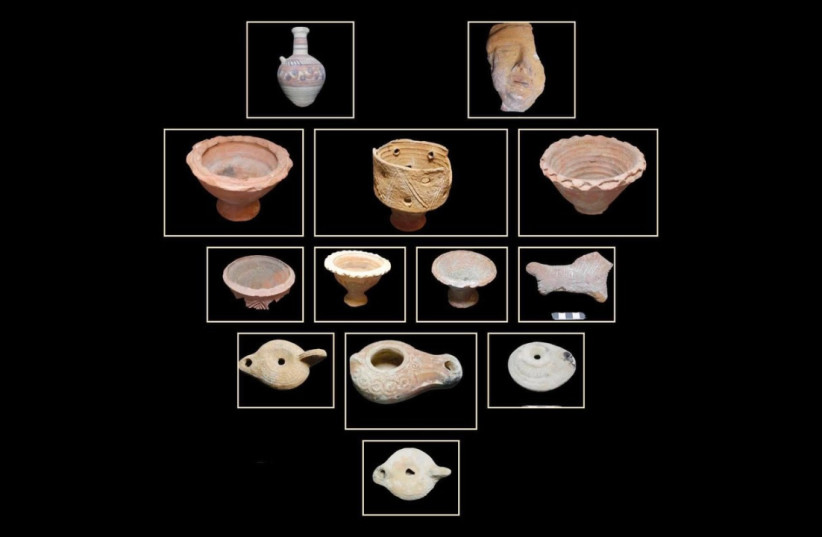
Additionally, the Egyptian archaeological mission operating at the site uncovered a collection of pottery incense burners, decorated lamps, and funerary amulets, as well as several barrel-shaped style anthropoid ceramic coffins.
Secretary-General of the Supreme Council of Antiquities Dr. Hisham El-Leithy explained that the discovery “opens new horizons for understanding the development of cemeteries in the Nile Delta."
He also said that the finds show that Tell El Deir as “not merely a burial place, but was an integrated funerary center.”
According to Leithy, the finds provide extensive insight into ancient Egypt’s funerary and burial customs from the Late Period (664 BCE until 332 BCE) and through the end of the Roman era.
Egypt unearths underground tombs in ancient coastal city
In early July, a collection of 18 tombs and numerous artifacts were unearthed during archaeological excavations ahead of construction of a visitor’s center in Egypt’s ancient city of Marina El Alamein.
Marina El Alamein, which flourished between the Hellenistic period until the Byzantine era, is located on Egypt’s northwestern coast, about 100 kilometers west of Alexandria. It is believed to be the city of Leukaspis mentioned by the Greek geographer Strabo.
The site was discovered in 1986 during construction work in the Marina area. Since then, extensive archaeological excavations and studies have uncovered one of the best preserved ancient coastal cities in Egypt.
Of the 18 tombs discovered in July, 11 are carved entirely into the rock, a style of tomb known as a hypogeum, explained Mohamed Abdel Badie, head of the Egyptian Antiquities Sector at the Supreme Council of Antiquities, while the other seven are made of limestone aboveground.
Some of the tombs are also very well preserved, with chamber entrances sealed by stone slabs that had not been opened since ancient times.
Eman Abdel Khalek, leader of the archaeological mission, added that a 2.5 meter long granite sarcophagus had been uncovered with its original lid still in place.
The skeletal remains found inside are currently being studied.
KioskNews shows a cleaned-up reading view extracted from the publisher’s page — the original always lives on their site, not ours.