‘I have to sell my bum on OnlyFans to go on tour’: Kate Nash on fame, feminism and fighting the music business

Kate Nash was standing on a fire truck in a showgirl outfit complete with white tights and pink G-string, shouting through a loudhailer about the music industry’s failure to pay artists fairly, when she wondered if she’d gone too far. It was 2024 and the truck, which made pit stops outside the London offices of Spotify and Live Nation, had a large black-and-white picture of Nash’s bum on the back along with the words “Butts for Tour Buses” – a reference to her newly launched OnlyFans account, which she was using to fund her tour.
That afternoon, she called her manager Kat. “I told her: ‘I’ve thrown a brick through the window at Spotify.’ She went: ‘What, literally?’ and I said: ‘No, but I’ve been standing outside their offices with a megaphone, so that relationship is over. I don’t think we’ll be making their New Music Friday feature.’ And we didn’t.”
Nash, the Brit award-winning singer and actor who rose to fame 20 years ago in the Myspace era, is not one to run away from a fight. Frustration and fury burned early in her career when she spoke up about the trolling from the tabloid press, which ran derogatory pieces about her appearance, and from strangers on the internet. She recalls receiving a message shortly before her chart-topping debut album Made of Bricks came out in 2007. “The title of the message was, ‘You are …’ and I opened it wondering: ‘Ooh, what am I?’ I thought it was fanmail. And this person said: ‘You are everything that’s wrong with music distilled into one slag.’ So it’s been a journey. It takes a long time to get to a place of ‘I don’t give a fuck’.”
It’s a crisp October day when Nash and I meet in a cafe near her home in north London. She is nursing a cold, though that hasn’t diluted her fervour when talking about the plight of working musicians. In the last 12 months, she has appeared before a parliamentary select committee to talk about the financial impact of Brexit on touring artists. “I’m in a position of privilege because I am making money from my catalogue,” she tells me. “But I still need to sell my bum on OnlyFans to go on tour. I’ve got friends who are selling all their instruments and furniture to tour, or they’re not going on tour and they’re depressed.”
Nash bangs the table. “It makes me so mad!” she continues. “Where will we be in 20 years when we only have stadium acts? I’m not dissing those who do it, but I don’t want everything to be mainstream. I also want to see mid-level and small gigs. Without that, there’s no culture and no fanbase. It’s a broken system and I don’t think it’s fair.” She stops, and laughs. “Sorry, I get a bit passionate.”
To understand the roots of Nash’s fighting spirit, her forthcoming album offers some clues. Recorded in Spiddal on the west coast of Ireland, Cailín – it means “girl” in Irish – sees her exploring her Irish heritage through music that blends uilleann pipes, flutes and the tin whistle (Nash has played it since childhood) with punk and hip-hop. “I came in wanting to mess with trad Irish music and do something with it that hadn’t been done before,” she says.
Nash, whose mother is Irish, grew up in an Irish-Catholic community in north-west London, though she came to realise that “being half-English, I didn’t know about my own history, and I wanted to learn. It’s all quite emotional for me.” It wasn’t until she began recording, for instance, that she learned her grandfather was part of a group of men who tried to travel to Spain to fight Franco, though were intercepted en route and imprisoned at Curragh Camp in County Kildare. “We have a family motto: ‘I’m not looking for a fight, but if you’ve got one, I’m your man,’” Nash says.
Among the most arresting tracks on Cailín is her cover of Famine, Sinéad O’Connor’s song about the Great Hunger in Ireland that left a million dead. The lyrics tell how it was not a natural disaster, but a human-made catastrophe created by British rulers who shipped vital food supplies out of the country while the potato crop failed.
O’Connor, I note, was another singer who refused to be quiet about injustice. After she ripped up a picture of the pope live on US TV, she was told she had blown up her career, yet pop stardom wasn’t something she ever wanted. “I love that and I feel a connection to that,” Nash replies. “I’m not as pure as Sinéad in that sense as I have wanted success and, when I was 16, I was like: ‘I want to be famous.’ But as soon as that happened, I thought: ‘Ooh no, I don’t like this.’ I love being able to do creative work, but fame is slimy and gross.”
Nash says that at the height of her success after her first album came out, she sold out London’s Hammersmith Apollo and “felt nothing”. After her second album, My Best Friend Is You, came out she was dropped by her label via text. She took it as an opportunity to start doing things her way. In 2012, she released a punky single, Under-Estimate the Girl, which prompted the NME to declare: “Kate Nash has committed career suicide – and it sounds amazing.” She put out her next album independently and went on a tour, during which she worked almost exclusively with women behind the scenes and on stage. “That tour made me the woman I am. It was like being on a train with no driver, but it was fun and chaotic and wild. We played Shepherd’s Bush Empire, which was a big drop [in audience capacity from the Apollo], and it was the best night of my life because I was with a band I loved and we all cared about what we were doing,” she says proudly.
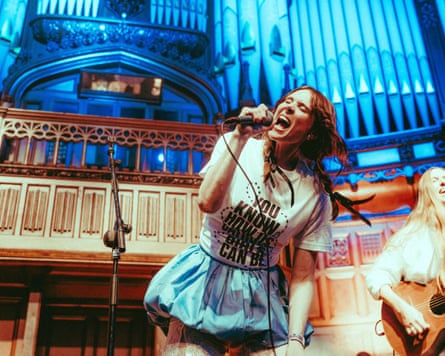
Since then, her career has been marked by ups and downs. In 2015, she discovered that her former manager had been misappropriating her money (after a protracted legal battle, they reached an out-of-court settlement). Nash ended up moving to the US – “I needed someone to smile at me and tell me to have a nice day” – where she auditioned for acting roles and took a job in a comic shop to help pay the bills (“I was saved by the nerds,” she grins). Then she landed the role of a lifetime in Glow, the hit Netflix series based on the real-life story of a group of female wrestlers in the 1980s. “It came at just the right time. I got strong, I learned how to throw people over my shoulder, and I laughed so hard my stomach hurt every day. With all those girls, there was a real camaraderie. We’re still in a WhatsApp group now.”
Glow was cancelled during the pandemic after three series – “I think it will come back one day, when we’re old and can’t fit into our leotards,” Nash laughs – and then came the actors’ and writers’ strikes, during which she didn’t work and “my mental health took a bit of a dive. I got obsessed with someone’s lost dog, which triggered my OCD. I was literally walking along railway tracks in LA looking for this dog, which, by the way, I found.” In late 2023, she decided it was time to come back to London and focus on her music.
Now, despite the precariousness of her business, Nash is content with where she is professionally. “I’m not for the masses and I’m aware of that and I’m comfortable with it. I don’t want to be palatable for everybody.” She says she has received as much support as criticism over her decision to go on OnlyFans to fund her music. “People say to me: ‘Sex sells.’ Music fucking sells! It contributes millions to the economy. It’s just not being distributed fairly.” But she remains hopeful for a future in which art wins out and performers are paid fairly.
“The music industry will not change itself, but the law will [force it to],” she says. “I see myself as the guy in The Shawshank Redemption. I’m doing these tiny scratches behind the scenes that people can’t see, and I’ll be doing that until I’m in a coffin. With these little scratches we will build the tunnel that will take us through the sewage and out to the other side.”
KioskNews shows a cleaned-up reading view extracted from the publisher’s page — the original always lives on their site, not ours.