‘I spat in Sean Connery’s face 16 times’: Ron Perlman on making The Name of the Rose
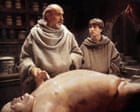
I read an article about a curious book that had great reviews in Italy, a murder mystery about monks in the middle ages fighting for the fictional missing part of Aristotle’s Poetics. I said: “This is for me.” Since childhood, I had been fascinated with medieval and religious architecture, and Aristotle’s Poetics is my favourite literary work.
I learned that Umberto Eco, the author, was going to be in France for one night and agreed to meet me at his hotel and that I would drive him to Charles de Gaulle airport. The first thing I saw was his shadow on the hotel staircase, which looked like the silhouette of Sherlock Holmes – Umberto was a man of great humour, and he met me wearing a deerstalker, with a pipe in his mouth. In the car, I asked questions: what sort of shoes would the Franciscans have been wearing? Would the monks have had beards? What colour would the pigs have been? He said: “I don’t know, I didn’t have to write any of that.” I ended up hiring medievalist Jacques Le Goff and seven of his colleagues to make sure we got all the details right – costumes, architecture, liturgy and so on.
I wanted an unknown to play William of Baskerville, the friar who investigates the deaths, and travelled the world to watch plays featuring great actors in their 50s. Meanwhile, agent Mike Ovitz kept calling, saying: “Sean Connery would love to make this movie.” Eventually, there was a knock on my door and I opened it to find Sean with the screenplay under his arm. He said, “Listen, boy …” and started reading. I had goose bumps. The way he said the dialogue was exactly what I’d been hearing in my head while reading the book.
I flew to Vienna to look at paintings by Bruegel the Elder. I wanted to be inspired by the real people of the period, people who had no dentists or doctors, but I did cast some good-looking monks, too. Christian Slater turned up to audition for the young novice, Adso, and said: “I didn’t learn the lines, I got drunk.” The casting director, Mary Jo, was furious and tried to send him away, but he was the one I wanted. He was only 16, but looked 14. It turned out he was Mary Jo’s son. I had three women selected to audition for the part of the nameless girl from the village, but Christian fell in love with the first, Valentina Vargas, as soon as he did a screen test with her, so I never saw the other two.
We built a vast set on a hilltop near Rome for the monastery and village. During the scene at the end where the library tower burns, Sean’s cowl briefly caught fire, and a big piece of real timber fell on Feodor Chaliapin Jr, who played the blind monk, knocking him to the ground. “I’m 80 years old,” he said, “I don’t mind dying. Was the take good?” He went to hospital and we had to change the schedule because he then had a scar.
After four months in Rome, I went back to my production office in Munich and couldn’t find it. I discovered the film’s producer, Bernd Eichinger, in the cellar with his feet on a table. He said, “JJ, I didn’t want to disturb you during the shoot, but I sold the building to help pay for the movie.”
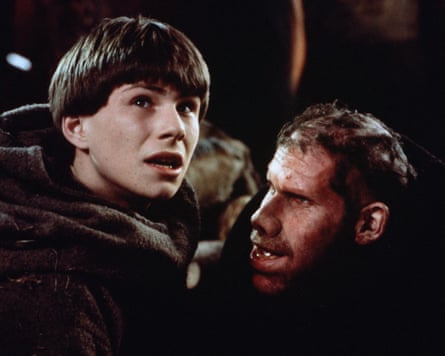
Ron Perlman, played Salvatore
My very first film, Quest for Fire, was directed by Jean-Jacques. I played a caveman. Transforming myself into something completely foreign was an incredibly rewarding exercise and a phenomenal introduction to the world of cinema, so when I read that Jean-Jacques had attached himself to The Name of the Rose, I went through the book and found a character named Salvatore – an intellectually challenged hunchback who spoke in a jumble of seven languages – who would embody a similar challenge. I told Jean-Jacques that this part would be a dream come true.
Jean-Jacques gave me complete freedom to figure out my dialogue. The Name of the Rose had been published in 80 languages, so I got copies in the seven that Umberto Eco has Salvatore referencing, and circled every time Salvatore spoke. Then I just went, “Eenie, meenie, miny, moe – OK, this word is Latin, this word is Spanish, this word is Italian …” and so on. That was the genesis of Salvatore’s communicative skills.
I worked with a dialect coach who was also a historian with particular knowledge of the period. He suggested the lullaby that Salvatore sings when he’s burned at the stake. Jean-Jacques had this idea that Salvatore was so out of touch with reality that he was initially amused to be in that situation. The lullaby gave a sense of childlike wonder at the fact he’s involved in this ceremony, but doesn’t realise he’s about to lose his life.
I only had to wear the prosthetic hump once, filming the scene where Salvatore is about to be tortured by F Murray Abraham as the inquisitor, Bernardo Gui. I was in the makeup chair for more than 13 hours and by the time I got to set, they had almost run out of time. My hair was shaved so it looked like I had mange. They said: “Good luck with your personal life, my friend.”
I spent every moment I could with Sean Connery, watching him act and listening to his stories. He was my hero, the real deal. When it came to the scene where I had to spit in his eye, I just couldn’t do it. Sean took me aside, and said: “Ron, if you don’t actually spit in my face, we’ll be here all fucking day.” So I finally just let one fly. The problem was, you don’t film from just one angle, you have to recreate in profile, medium shot, closeup, over-the-shoulder … I must have spat in Sean Connery’s face 16 times that day.
KioskNews shows a cleaned-up reading view extracted from the publisher’s page — the original always lives on their site, not ours.