Parties outline agendas with legislature to restart
HANDOUTS, WELFARE, DEATH: The KMT said that it would focus on the budget and cash handouts, while the DPP emphasized business, and the TPP euthanasia
By Sam Garcia / Staff writer, with CNA


The new legislative session is to begin on Tuesday next week, with the Chinese Nationalist Party (KMT) prioritizing cash handouts and the central government budget, the Democratic Progressive Party (DPP) focusing on business support, family policies and welfare, and the Taiwan People’s Party (TPP) pushing measures on people’s livelihoods, transportation, childbirth and end-of-life rights.
Premier Cho Jung-tai (卓榮泰) is scheduled to deliver a policy address on the first day of the sixth session of the 11th Legislative Yuan, expected to be accompanied by ministers and agency heads.
No question-and-answer session is planned.
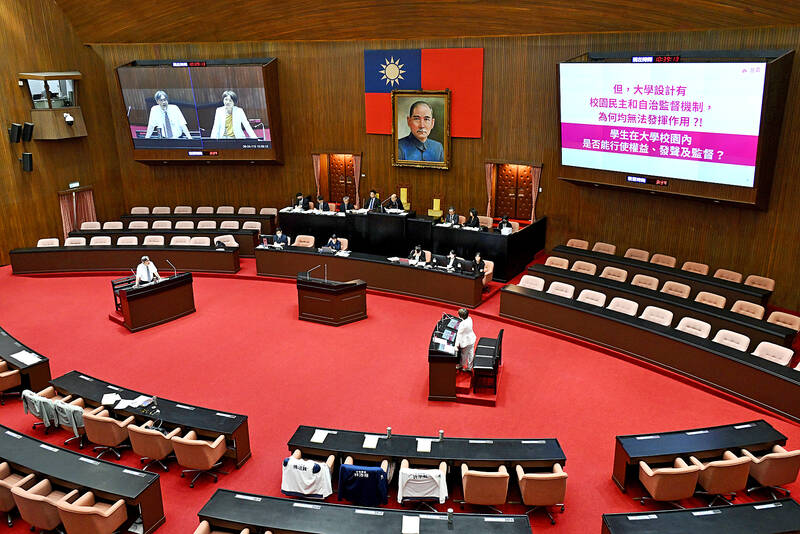
Lawmakers attend a meeting of the Legislative Yuan in Taipei on Aug. 24.
Photo: Chen Yi-kuan, Taipei Times
A roll-call vote on Control Yuan nominations is scheduled shortly afterward at 10am.
The new session would focus on next year’s central government budget, which includes a proposal to issue cash handouts, as well as a supplementary budget for this year, a KMT caucus member said yesterday.
If the cash handouts are to be issued in the Lunar New Year period, the Legislative Yuan could approve the funds separately, leaving lawmakers to review the rest of the government budget as usual, the KMT source said, speaking on condition of anonymity.
The proposal has yet to be finalized and would need approval from the KMT caucus and coordination with the TPP caucus, they said.
KMT lawmakers are still discussing whether to include the funds in a special budget or use another approach, the source added.
The KMT has proposed cash payments of NT$20,000 to NT$30,000 per person, while the government has planned NT$10,000 payments.
DPP caucus secretary-general Fan Yun (范雲) said that the Executive Yuan has prepared more than 40 priority bills focusing on three main areas: helping businesses, supporting families and expanding welfare.
The bills include a Small, Medium and Micro Enterprise Transformation and Upgrading Development Act, as well as amendments to the Gender Equality in Employment Act (性別平等工作法) and the Employment Insurance Act (就業保險法), which are being negotiated by the caucuses in the Legislative Yuan, Fan said.
Other priorities include allowances for elderly farmers, national pensions, protections for people with disabilities, and preventing the sexual exploitation of children and adolescents, she added.
The TPP caucus said its priority bills would be centered around four themes: supporting livelihoods, improving transportation, boosting the birthrate and upholding dignity.
That would include amendments to the Income Tax Act (所得稅法) to expand tax breaks for tenants and parents, the TPP said.
Proposed amendments to the Gender Equality in Employment Act and the Employment Insurance Act would expand parental leave, add an allowance for family caregiving leave and flexible working hours, and extend maternity leave to 14 weeks, it said.
The TPP also hopes to legalize surrogacy through amendments to the Assisted Reproduction Act (人工生殖法), increase the monthly allowance for elderly farmers and amend the Senior Citizens Welfare Act (老人福利法) so that the central government can fully subsidize health insurance premiums for elderly people, it said.
It would continue pushing to legalize euthanasia, it said, adding proposed amendments to the Road Traffic Management and Penalty Act (道路交通管理處罰條例) would ensure that traffic fines are earmarked for specific purposes.
KioskNews shows a cleaned-up reading view extracted from the publisher’s page — the original always lives on their site, not ours.