After half a century in space, one light-day milestone in sight: What makes Voyager 1’s journey a feat of humankind
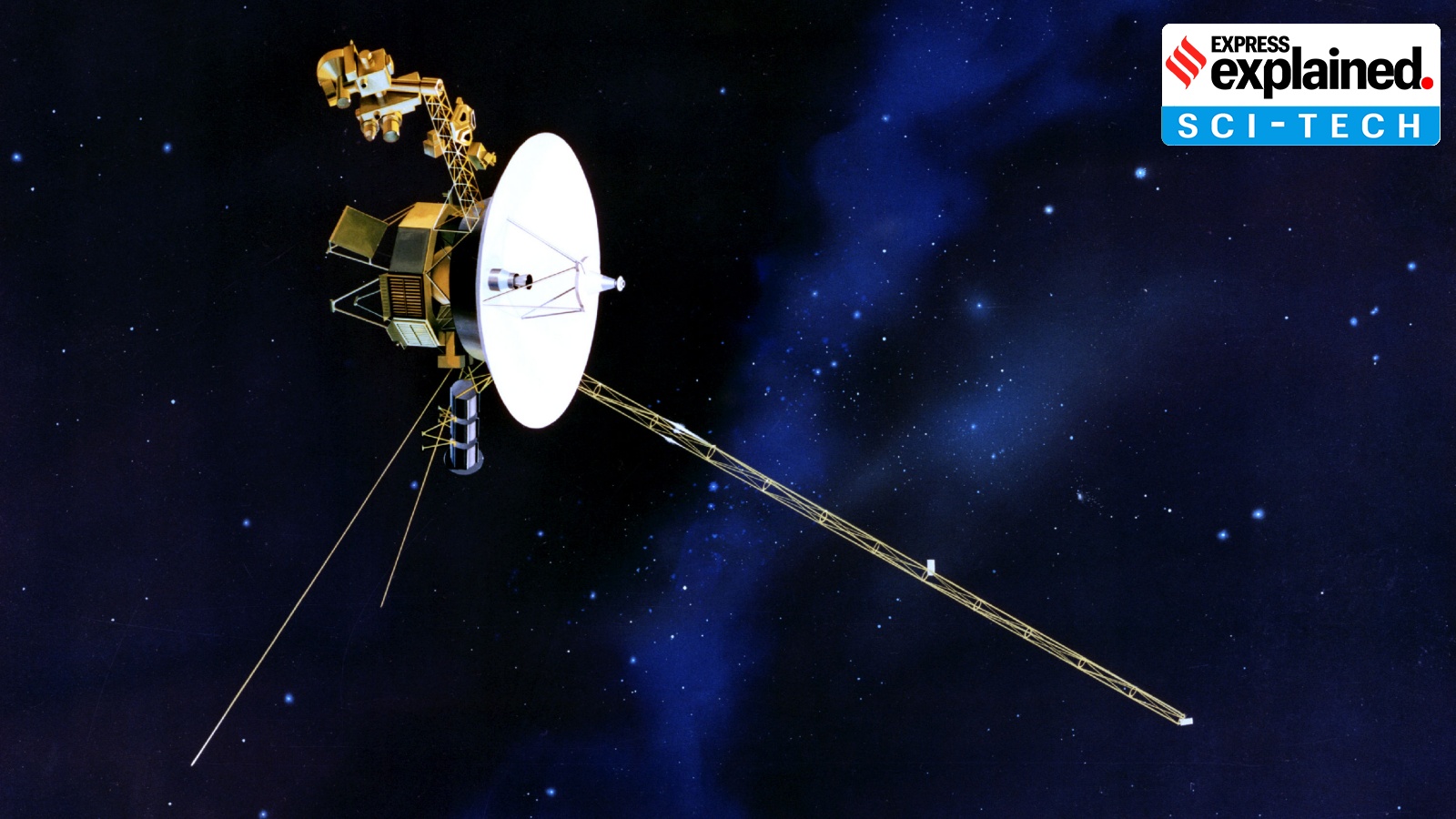
NASA’s Voyager 1 spacecraft is set to become the first human-made object to reach the milestone distance of “one light-day” from Earth on Wednesday. Having travelled for nearly 50 years, it will have covered the distance that a particle of light travels in 24 hours — about 26 billion kilometres.
Through its continued journey, the spacecraft has enriched what humans know about space.
NASA launched two Voyager Interstellar Missions: Voyager 1 (September 5, 1977) and Voyager 2 (August 20, 1977), as fly-by interplanetary missions.
Both spacecraft were chartered with different routes and designated to collect scientific data en route. The information was aimed at improving the characterisation of the outer solar system environment and the search for the heliopause. The latter marks the outer edge of the heliosphere, which NASA describes as “The protective bubble of particles and magnetic fields, generated by the Sun.” Interstellar space, or the space between galaxies, begins at the heliopause.
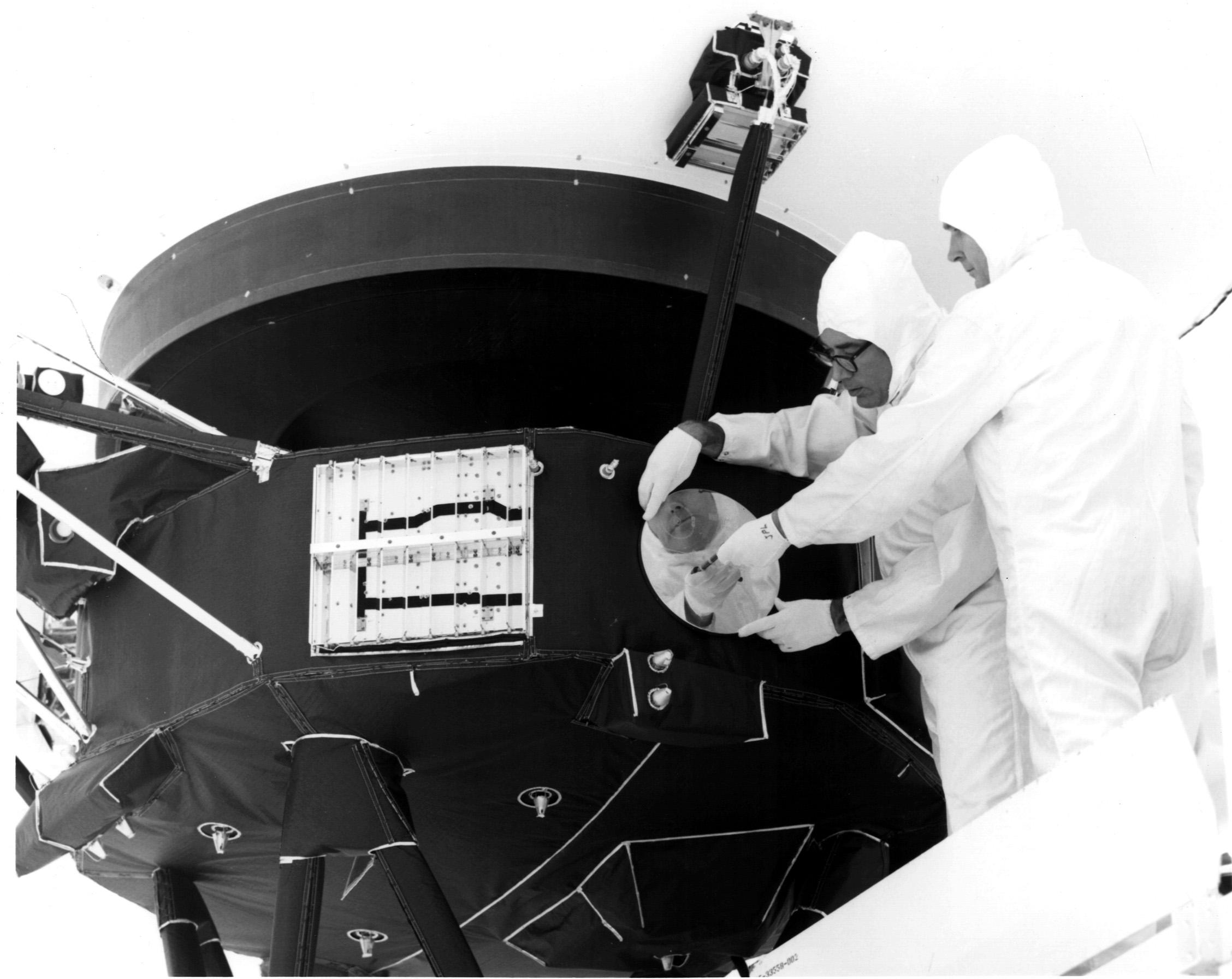 Engineers installing the golden record with sounds from Earth onboard Voyager-1 in 1977. ( NASA)
Onboard were slow-scan colour TV cameras for imaging the planets and their moons, and a suite of instruments to record magnetic, atmospheric, and other data about the planetary systems. Both Voyagers have continued cruising beyond their stipulated mission life of about four years.
Voyager 1: The spacecraft exited the solar system faster than Voyager 2, crossing interstellar space in 2012. Its observations led to the discovery that Jupiter’s atmosphere was far more turbulent than previously known. It also found a thin ring around it and many of its moons.
In its flyby around Saturn, it discovered five new moons and closely captured the ring structures. Voyager 1 has been travelling at a velocity of 38,026.79 m/h (or 17.0 km/second) relative to the Sun.
Story continues below this ad
Voyager 2: The spacecraft has flown by Jupiter and Saturn, and was the maiden spacecraft to fly by Uranus and Neptune. It crossed interstellar space in 2018. It discovered 10 new moons around Uranus, along with two new rings.
Though Voyager 2 was launched first, its different route means that it will take longer to reach the milestone. If it remains operational over the coming years, it could hit the mark in November 2035.
Both spacecraft are also carrying messages for extraterrestrial beings in case of potential contact. They have identical gold-plated copper discs measuring 30cm in diameter, inscribed with the Earth’s location relative to well-known pulsars, or rapidly rotating neutron stars. The discs also contain audio greetings in 55 languages and about 35 sounds from Earth.
The spacecraft remain scientifically active, relaying back data to Earth, with Voyager 1 expected to remain operational for a few more years. However, its ageing attitude control thrusters have been degrading and may eventually lead it to lose contact with Earth.
Story continues below this ad
How has communication been maintained?
The Deep Space Network is the backbone of interplanetary communication. It is a sensitive telecommunications network consisting of an array of radio antennas — large parabolic dish antennas equipped with ultra-sensitive receiver systems, tuned to detect faint radio signals. Tracking such signals is akin to searching for a needle in a haystack.
Managed by NASA’s Jet Propulsion Laboratory, the network is strategically spread across three continents: California in the US, Madrid in Spain and Canberra in Australia. This is to retain continuous communication with spacecraft even as the Earth rotates.
It collectively sends commands and tracks spacecraft cruising in interstellar space. Of the 11 scientific instruments onboard Voyager 1, four — the cosmic ray telescope (to measure high-energy particles), the low-energy charged particles experiment, the magnetometer (for measurements of magnetic fields) and the plasma waves experiment continue to operate and relay back data.
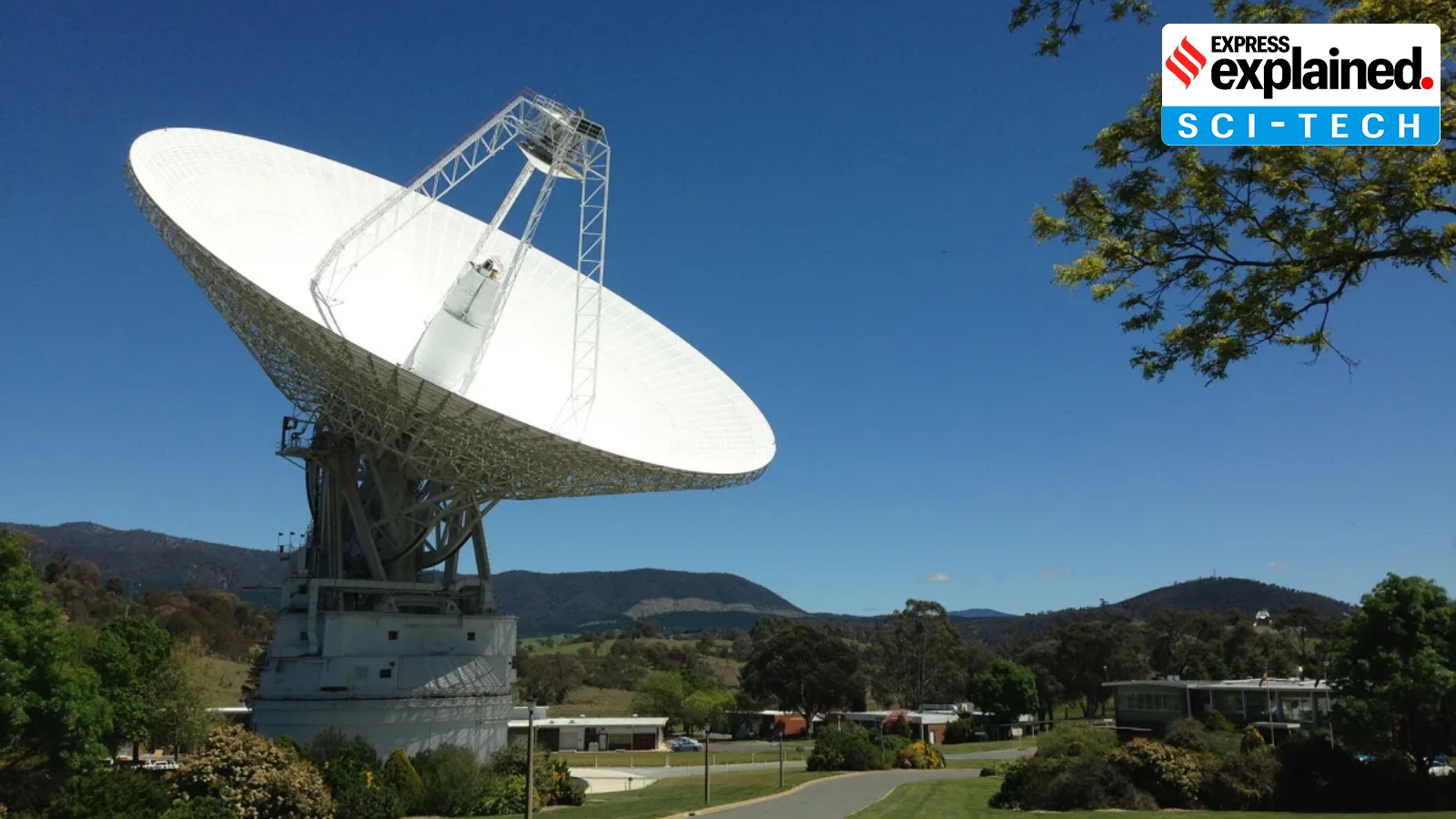 The Deep Space Network’s radio antenna in Canberra, Australia. (NASA)
Why is Voyager 1’s milestone significant?
Voyager 1 is set to become the first spacecraft to reach the farthest distance from Earth, and NASA has described the feat as “a celebration of humanity’s farthest reach.”
Story continues below this ad
Since light travels the fastest within the known universe, it is used to measure vast distances. At one light-day, any light originating from Earth would take 24 hours to travel and reach Voyager 1. Its destination now is the star Gliese 445, located more than 17 light-years away from Earth.
Apart from their scientific significance, the Voyager missions have also helped symbolise human excellence and, somewhat ironically, the species’ smallness in relation to the vastness of the universe.
Famed American astronomer Carl Sagan, who was also a member of the Voyager Imaging Team, suggested using cameras on one of the two Voyager spacecraft to image Earth. “He realized that because the spacecraft were so far away the images might not show much. This was precisely why Sagan and other members of the Voyager team felt the images were needed — they wanted humanity to see Earth’s vulnerability, and that our home world is just a tiny, fragile speck in the cosmic ocean,” the NASA website says.
The image then captured, called the Pale Blue Dot, showed just that. “There is perhaps no better demonstration of the folly of human conceits than this distant image of our tiny world,” Sagan said. “To me, it underscores our responsibility to deal more kindly with one another, and to preserve and cherish the pale blue dot, the only home we’ve ever known.”
KioskNews shows a cleaned-up reading view extracted from the publisher’s page — the original always lives on their site, not ours.