In Manila, PM Modi And Trump Give Quad New Strategic Direction
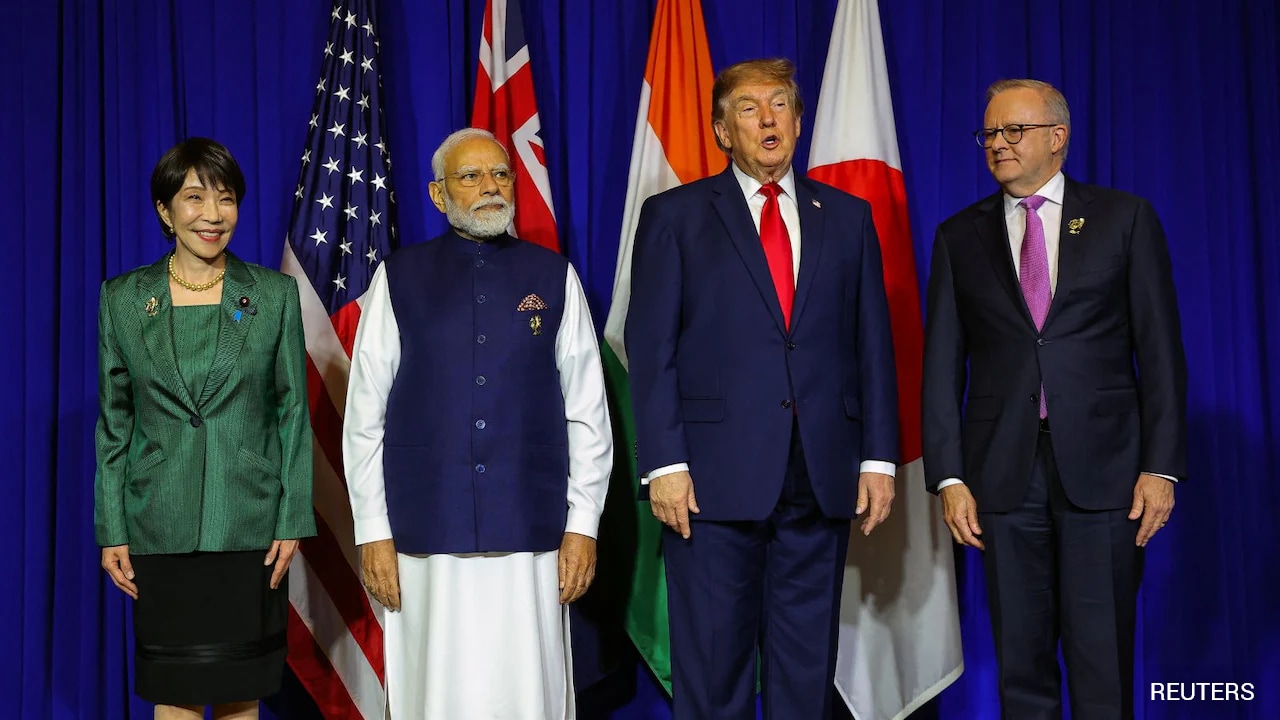
India, the United States, Japan and Australia have launched a host of initiatives aimed at boosting maritime security, securing critical mineral supply chains and deepening cooperation on artificial intelligence as the four-nation Quad grouping looks to enhance its strategic footprint across the Indo-Pacific.
At their first leaders' meeting in over two years, Prime Minister Narendra Modi, US President Donald Trump, Australian Prime Minister Anthony Albanese and Japanese Prime Minister Sanae Takaichi agreed to increase cooperation on maritime surveillance, cybersecurity, emerging technologies and economic security.
The Quad Leaders Summit was held Tuesday in Manila on the sidelines of the ASEAN Summit. Key announcements included a joint maritime exercise in 2027 to involve P-8 and P-3C maritime patrol aircraft from the four countries. The leaders also announced the inaugural Quad Business Leaders Forum and backed new initiatives on AI and cybersecurity.
For India, the summit was an opportunity to reassert the importance of the grouping at a time of rising geopolitical competition and fears of economic reliance on China.
"For India, the Quad is a constructive and trusted partnership. From maritime security to trusted supply chains, from new technologies to disaster response, it has been our endeavour that the Quad provides trusted solutions across the Indo-Pacific," PM Modi said.
"I am certain that our meeting today will help us set concrete goals for the next phase of our cooperation," he added.
Quad Leaders' Business Forum
The four leaders announced plans for an inaugural Quad Business Leaders' Forum in early 2027 to turn strategic cooperation into commercial partnerships. India will host the summit.
The forum will bring together business leaders, government representatives and policy experts from the four countries to encourage investment, commercial partnerships and greater private sector participation.
The shift is viewed as an effort to expand Quad beyond its traditional emphasis on maritime security and regional stability. Its agenda is increasingly geared to economic resilience, technology, infrastructure and private-sector partnerships.
Trump reveals $85-million AI drive
The Quad countries had worked together to launch a new AI accelerator and were investing more than $85 million to expand access to trusted AI ecosystems around the region, Trump said.
"We want to make sure that the future of critical technology is led by nations that share our values and our shared interests. We want to make sure that it turns out to be as good as it can," he said.
The effort aims to boost access to standard artificial intelligence systems, their use, and technical assistance throughout the Indo-Pacific.
The leaders also announced enhanced Quad cooperation on cybersecurity, citing the increasing number of cyber incidents around the region.
The four countries also welcomed progress under the Quad Partnership for Cable Connectivity and Resilience to expand safe communication infrastructure. Australia will boost its contribution to cover electricity cables and undersea cable projects in the Indian Ocean as part of the wider effort.
PM Modi On Manila
The summit also had historical importance for the four countries. The officials from India, the United States, Japan and Australia first met in Manila in 2007. The dialogue resumed in 2017, also in the Philippine capital, after a decade-long hiatus.
"Manila and Quad have had a long-standing and special bond. The four countries' officials met here for the first time in 2007. Ten years later, in 2017, it was here in this city that we started our dialogue again," PM Modi said.
Trump called the four countries some of the most important partnerships in the world.
"Our countries represent the four corners of a free, open, stable and prosperous Indo-Pacific," he said.
Quad's Maritime Drive And The China Factor
The planned joint maritime exercise is one of the most significant security outcomes of the Manila summit, aimed at improving information-sharing and maritime domain awareness under the Indo-Pacific Maritime Surveillance Collaboration.
The four nations' respective P-8 and P-3C patrol aircraft are slated to participate in a joint exercise in 2027, the first such exercise in a Quad context.
The Quad has said it is not a formal military alliance aimed at any country, but its growing security cooperation is taking place amid concerns about China's expanding military footprint and influence in the Indo-Pacific.
The four leaders, in a joint statement, did not oppose attempts to change the regional status quo by force or coercion.
The leaders also expressed concern about economic coercion, including arbitrary export restrictions, and reaffirmed their commitment to protect freedom of navigation and safe maritime transit corridors.
"Stability in the region is dependent on cooperation between the four countries," Albanese said.
The grouping would help shape the future of the region, Takaichi said.
Critical Minerals At Centre
Another priority was critical minerals and rare earth elements, with the four nations seeking to reduce their dependence on concentrated global supply chains.
The four nations have signed new agreements to protect their supply chains, Trump said. "We have also made several new, important, critical mineral agreements to secure our supply chains and ensure that none of our nations is vulnerable to coercion by any single foreign supplier," he said.
For New Delhi, cooperation in this sector could help strengthen domestic manufacturing and reduce vulnerabilities in industries that are critical to national security.
Trump also said the US is on track to catch up to China in rare earth production within 10 months and that Australia, Japan and India are also making strides.
KioskNews shows a cleaned-up reading view extracted from the publisher’s page — the original always lives on their site, not ours.