Colby Cosh: Failure was inevitable for Alberta separatists
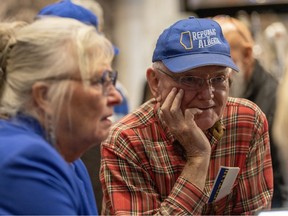
It looks as though Monday’s Alberta independence referendum, which asked voters whether the provincial government should begin secession negotiations and prepare for a second binding vote, will end up with 76 per cent of the electorate going “Remain” (Option 1 on the ballot) and just 24 per cent “Let the games begin” (Option 2). So too begins the process of the separatists talking out of both sides of their mouths about the outcome.
Sign In or Create an Account
“Both sides”: boy, this is an English idiom whose full import never struck me with the thunderous impact it has had this week. In the runup to the vote, many separatists emphasized that you didn’t, in fact, have to favour secession to vote for Option 2/ “(Another) Referendum.” Option 2 was (they said, hours ago) the right way to vote if you just wanted Alberta to be taken more seriously within Confederation, or to receive more advantageous treatment from it.

Columnist Jesse Kline keeps you up to date with what’s happening in Israel and the effects of antisemitism on life here in Canada. Friday mornings.
By signing up you consent to receive the above newsletter from Postmedia Network Inc.
A welcome email is on its way. If you don't see it, please check your junk folder.
The next issue of Channel Israel will soon be in your inbox.
We encountered an issue signing you up. Please try again
If any Albertan had a sincere belief that this was the issue really on the ballot, Option 2 getting less than a quarter of the vote is an obvious disaster — a landslide for masochism. Treat us worse! Sneer at us harder! Skim more of our earnings!
Come the sunrise on the morning after Referendum Day, and the separatists are claiming victory. Almost one-quarter of us voted for separation! An obviously excellent base for more separatist intrigue and electoral struggle! Listen, I’m impressed that “Referendum” got its 24 per cent, a figure I expected to be more like 21 or 22, but I’m afraid that the most logical interpretation of this outcome is just what the plain reading of the ballot language suggests.
Which is: an overwhelming majority of Albertans do not want any further entertainment of secession by their government. They don’t want a vote, and they don’t want a top-level intergovernmental negotiation. How would the “Referendum” side go about doing better in a binding referendum that only a quarter of us want at all? How many Albertans would actually press a magic button marked “Immediately secede without any political process or resistance from the federation”? 24 per cent is not the point estimate: it’s an absolute upper bound.
I can accommodate the retort that there are real, dedicated Alberta separatists, perhaps too many of them to be referred to as a “fringe.” That’s just a term of abuse we can leave out of the discussion. My guess, and it is as informed as any individual’s guess can conceivably be, is that about one-sixth of Albertans would jab the magic button.
It’s a funny thing: when I went down to the church to vote on Monday, I did have a certain narcissistic feeling of pleasure, of receiving welcome attention. How many people around the world can say that they have had the opportunity to cast such a vote — to sit in judgment on one’s country? It will only happen once in my lifetime, I imagine. There were news photographers darting about at the polling station: you could imagine yourself popping up later in the day on a screen in New Brunswick or Germany or Vietnam. And, of course, I couldn’t help slightly regretting a missed opportunity to give a black eye to the nation-state. Lord knows I was not there to express faith in or affection for Ottawa.
The referendum was a novel, unprecedented event for Albertans — but if you follow that thought to its conclusion, it raises more questions that nobody is really asking. If Alberta had been consulted in this way at any other time, would the outcome have been different? I think the soft-separatist position would have done much better in 1981, when the motivation for separatism was a catastrophic economic shock rather than a mere sense of offended noblesse, and Alberta’s claims were predicated on genuine suffering that the survivors can never forget. There was a period of 10 or 20 months in which a “Referendum” victory was absolutely possible.
But for most of the time between 1982 and now, I am convinced that a referendum like this would be likely to have led to almost exactly the same three-to-one outcome. That’s a pure counterfactual, of course, but everyone in Alberta must have noticed that there was a certain stagnant quality to the deliberative “campaign” on Ballot Question 10. There was no widely trusted leader who could shift public opinion very much; Carney and Smith and Kenney and Notley and Nenshi all made their appeals for Canada, and the separatists churned out their slopaganda, but I defy you to identify one mind they changed between them, at least with pure rhetoric.
We just don’t know. We don’t know how 2026 Alberta would compare with the Alberta of 1990 or 2015 or 2045. This brings us to the point that most of the other provinces have never held separatism-related referendums, and that we absolutely do not know the degree to which Alberta does differ from other Anglo provinces in its attitude toward the centre. Could British Columbia separatists get 20 per cent of the vote, given the benefit of an ambiguous ballot question? Could Manitobans do it? Could Nova Scotians? Nobody’s having a referendum in Newfoundland: would you want to bet that the separatist sympathizers and strategic voters would get less than 24 per cent? You’d be a fool to do it: I strongly suspect they would start at about 30 and work upward.
National Post
Join the Conversation
This website uses cookies to personalize your content (including ads), and allows us to analyze our traffic. Read more about cookies here. By continuing to use our site, you agree to our Terms of Use and Privacy Policy.
KioskNews shows a cleaned-up reading view extracted from the publisher’s page — the original always lives on their site, not ours.