MKs Medan and Kahana: Who can personify the idea of national unity? - opinion
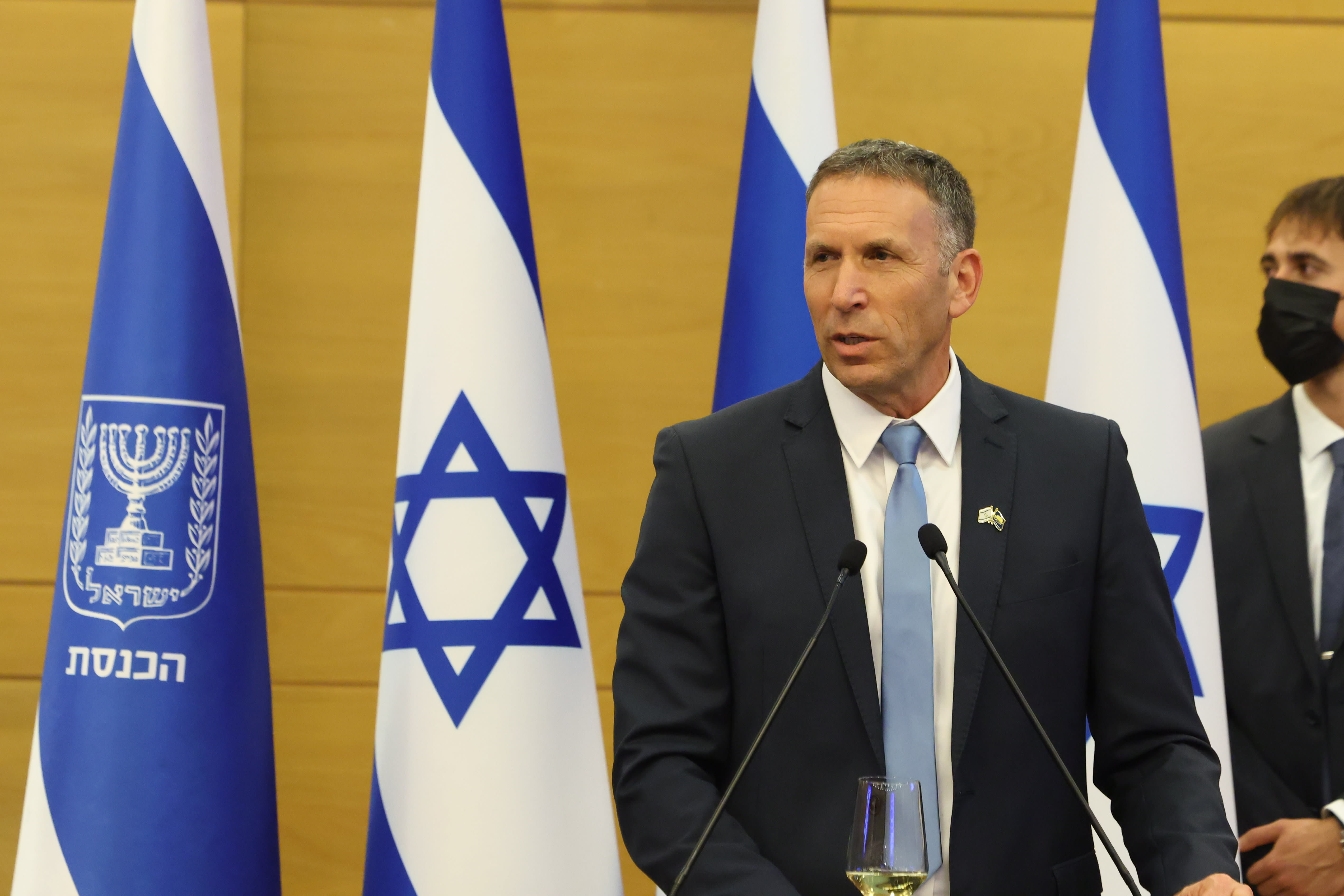
Since he took his oath of affirmation in the Knesset on November 10 and set up a tent outside the Knesset compound four days later, from which he calls for national unity and the establishment of a national unity government, MK Elisha Medan (Likud) seems to personify the idea of national unity.
As I mentioned last week, Medan lost both his legs in the recent war with Gaza, and received a standing ovation as he stood up on his two prostheses while taking his oath.
I have no problem accepting Medan, and others like him, who fought bravely in the war that followed the massacre of October 7, 2023, and were severely wounded in its course, as national heroes. However, the fact that he has come out in favor of national unity, apparently at the behest of the one who chose him to represent the Likud in the 26th Knesset – Prime Minister Benjamin Netanyahu – does not automatically turn him into a symbol of authentic unity.
In the last three and a half weeks, Netanyahu has indeed called on numerous occasions for the establishment of a national unity government, if for no other reason than that he has no chance of establishing any other sort of government in the current political constellation.

However, from what we know about how he views this “unity government,” what he has in mind is a government that includes the parties that made up Israel’s 37th government – Likud, Otzma Yehudit, Religious Zionist Party, and the two haredi (ultra-Orthodox) parties, and any of the Jewish bloc of change willing to join his all-right/religious bloc as flower pots.
One might take this proposal seriously if it would at least offer equal status to the two blocs, rotation between the leaders of the two blocs, and an agreed agenda of national recovery. But Netanyahu seems to offer nothing of the sort, and Medan has so far failed to offer any specific ideas of his own.
Another problem concerns Medan’s past. In 2001, he was one of the founders of the unauthorized outpost of Avigayil in the Hebron Hills, whose status was finally settled in September 2023 as an official settlement.
Over the years, numerous confrontations took place between the Jewish settlers of Avigayil and other outposts and local Palestinian residents of the area.
On one such occasion, in 2012, Medan was filmed and recorded on video yelling obscenities at a radical left-wing Israeli demonstrator, Ezra Nawi. Besides being one of the founders of the organization Ta’ayush, he was also a homosexual who had been convicted in 1997 of having committed an act of sodomy on a 15-year-old Palestinian.
In the 2012 video clip, Medan is seen and heard asking Nawi whether he had recently “fed someone in the a** hole,” adding, “all that you bring to this world is AIDS.”
Many who saw the video clip assumed Medan was referring to all left-wingers. Having seen the clip, I believe he was referring to homosexuals only, and that what he said, besides being insulting to all homosexuals, was also inciting, and the exact opposite of what one would expect of someone claiming to promote national unity.
Last Thursday, MK Israel Zari (Yashar), who is a declared homosexual, invited Medan for a conversation about the incident. According to Zari, Medan said: “My mouth was filthy; I said disgusting things. I love deeply the LGBTs, who fought side by side with me. ... First of all, I wish to apologize, and ask forgiveness from anyone who was hurt.”
I do not know whether his serious injuries mellowed and changed Medan’s outlook on life, or whether his new political status, or the Likud, dictated this turnabout. Nevertheless, before he can assume the title of “Mr. Unity,” perhaps Medan ought to work out for himself what the true substance of the national unity he promotes is.
Changing circumstances
When I read the speech delivered last Tuesday by MK Matan Kahana (Yashar) after he was elected as the speaker of the 26th Knesset, and observed the restraint with which he reacted to accusations by members of the outgoing coalition that he had been elected with the help of the votes of the Arab MKs who are allegedly supporters of terror, I concluded that perhaps it is Kahana who should personify the concept of national unity.
I say this even though Yashar is opposed to the establishment of a national unity government under Netanyahu.
Kahana chose not to react harshly to the abuse poured on him because, as he said in his speech, he has “inscribed stateliness on my banner, and have always treated the state institutions and office holders, including those who are my political rivals, with respect. ... I promise a Knesset in which this principle will be part of its lifeline. ...
“The Knesset of Israel is the home of all the citizens of the State of Israel, and I intend to be everyone’s speaker, irrespective of religion, race, and gender. I shall protect the right of all MKs to represent any position that they were elected to bring to this house, as long as they obey the law, even if I have strong reservations about what they say.
“I hope wholeheartedly that the government, which will be established, will act to bring about the repairs required in the system of checks and balances among the three government authorities, and will do so based on wide agreement. Until this happens, as long as I am speaker, the Knesset of Israel will abide by all the rulings of the Court.”
Kahana then described the origin of his positions:
“The habitat in which I grew up, and the stations in my life [referring to his military career in which he served as a fighter in Sayeret Matkal, then as a combat pilot, and finally as the commander of an F-16 squadron in the IAF, with the rank of colonel], led me to a place where I observe the Torah and the commandments, and hold right-wing positions.
“On the other hand, with every one of my 248 limbs and 365 sinews, I can understand and sense what my close friends from the other side of the political map feel. My life’s mission is to connect my friends in the synagogue and my friends from the squadron. As Knesset speaker, the home of Israel’s citizens, I shall do everything in my power to promote this sacred goal.”
Many observers have commented that Kahana’s concept of unity does not include Israel’s Arab citizens, and that in the not-so-distant past, he too rejected political cooperation with the Arab parties, and referred to the Arab MKs as supporters of terror.
I believe that just like Medan, for better or worse, he too has adapted to the changing circumstances of his life.
The writer has written journalistic and academic articles, as well as several books, on international relations, Zionism, Israeli politics, and parliamentarism. From 1994 to 2010, she worked at the Knesset Library and the Knesset Research and Information Center.
KioskNews shows a cleaned-up reading view extracted from the publisher’s page — the original always lives on their site, not ours.