Scammed? Blamed? Linguistics is the shield — Tamilhiile Manggai G Mohgan
OCTOBER 9 — By shifting our focus from victim-blaming to conversational analysis, we can dismantle the coercive scripts behind financial fraud.
“You should have been more careful.” “Foolish people lose money like that.” “Uneducated.” “Greedy.” “Use your brain.” These are the harsh words scam victims often hear after losing their money. Instead of receiving sympathy and support, they are frequently blamed for what happened to them.
But before we point a finger at a scam victim, we should pause and ask: Was the victim really making decisions in a neutral state of mind? In almost every case, the answer is no. A scam phone call suddenly confronts a person with intense fear, artificial urgency, aggressive authority, and uncertainty. Under severe emotional pressure, critical thinking degrades. By the time the victim realizes something is wrong, the money is already gone leaving behind deep financial loss, embarrassment, and trauma.
Telling a victim “You should have known better” does not recover lost funds. Calling someone “stupid” does not prevent the next crime. Victim blaming simply silences people, keeping critical scam patterns hidden.
This brings us to a far more important question: Why do even educated, careful, and experienced people fall for scams? To answer this, we must look beyond the victim and examine what the scammer is actually doing. Scammers are not merely people who lie, they deliberately construct conversations engineered to manipulate how a person thinks, feels, and responds. In other words, scams are linguistic events. And if scammers know how to weaponize language against us, we can use linguistic analysis to recognise and break their tactics.
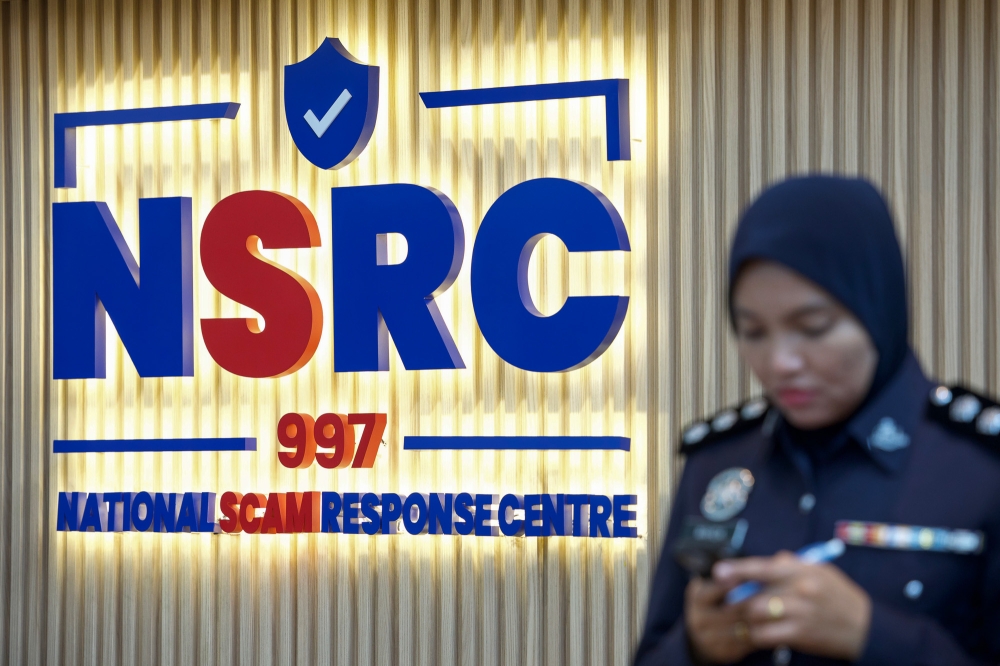
A police officer stands beside the National Scam Response Centre logo at Menara 2 MCMC in Cyberjaya, Selangor on March 3, 2026. — Picture by Yusof Isa
How scammers weaponize language
- Simulated authority (impersonation): Scammers frequently impersonate police officers, government officials, bank managers, or tax agents. By adopting formal language, precise administrative titles, and local details, such as “I’m Aida, inspector from IPD Muar, Johor, and we need your address and IC to double-confirm your information,” they exploit our natural tendency to respect authority. The formal phrases and explicit local references make the call sound authentic, even though sounding official is not the same as being official.
- Manufactured urgency: Scammers want victims to act before they have time to verify facts or consult family. When a scammer claims that “…SKMM is to bar all your lines and might blacklist you,” the conversation shifts from a standard inquiry to an immediate crisis. Driven by fear of severe disruption, victims focus on solving the perceived threat rather than checking if the threat is genuine.
- Enforced isolation: A critical instruction in many scam scripts is “Do not discuss this matter with anyone.” While framed as official confidentiality, its real objective is isolation. A third party, a colleague, relative, or friend, can easily interrupt the scammer’s narrative by asking simple, objective questions. Secrecy keeps the victim trapped in the scammer’s psychological grip.
- Weaponized fear: Scammers use legal threats to induce panic. Statements like “This enquiry could cause actions to be taken against you legally under the Official Secrets Act,” are delivered not to inform, but to terrify. Words like legal action, blacklist, arrest, and penalty carry heavy psychological weight. Delivered in a calm, authoritative tone, they effectively paralyze critical judgment.
Reframing the public response
When a victim loses money, they lose far more than a figure on a bank statement. They lose months or years of hard work, time, and security saved for retirement, education, or healthcare. Preventing these losses requires a fundamental shift in how society responds.
Instead of asking victim-blaming questions like “How could you be so foolish?” or “Why didn’t you use your brain?”, we must start asking diagnostic questions: “What did the scammer say?” and “How did they make you feel?”
Sharing scam experiences provides crucial intelligence. When victims report hearing similar phrases, threats, and instructions, those linguistic patterns become public knowledge that can protect others. Recognizing the warning signs, demands for immediate action, threats of legal arrest, instructions for secrecy, and hyper-formal language allows potential victims to pause, verify, and stay safe.
The fight against financial fraud is not only about banking security or legal enforcement, but also about language. Scammers weaponize language; by analyzing it, we break their code.
* Tamilhiile Manggai G Mohgan is a language lecturer at the Faculty of Languages and Linguistics, Universiti Malaya, and may be reached at [email protected]
** This is the personal opinion of the writer or publication and does not necessarily represent the views of Malay Mail.
KioskNews shows a cleaned-up reading view extracted from the publisher’s page — the original always lives on their site, not ours.