China reveals plan to map the entire surface of Mars by 2028 amid race with US
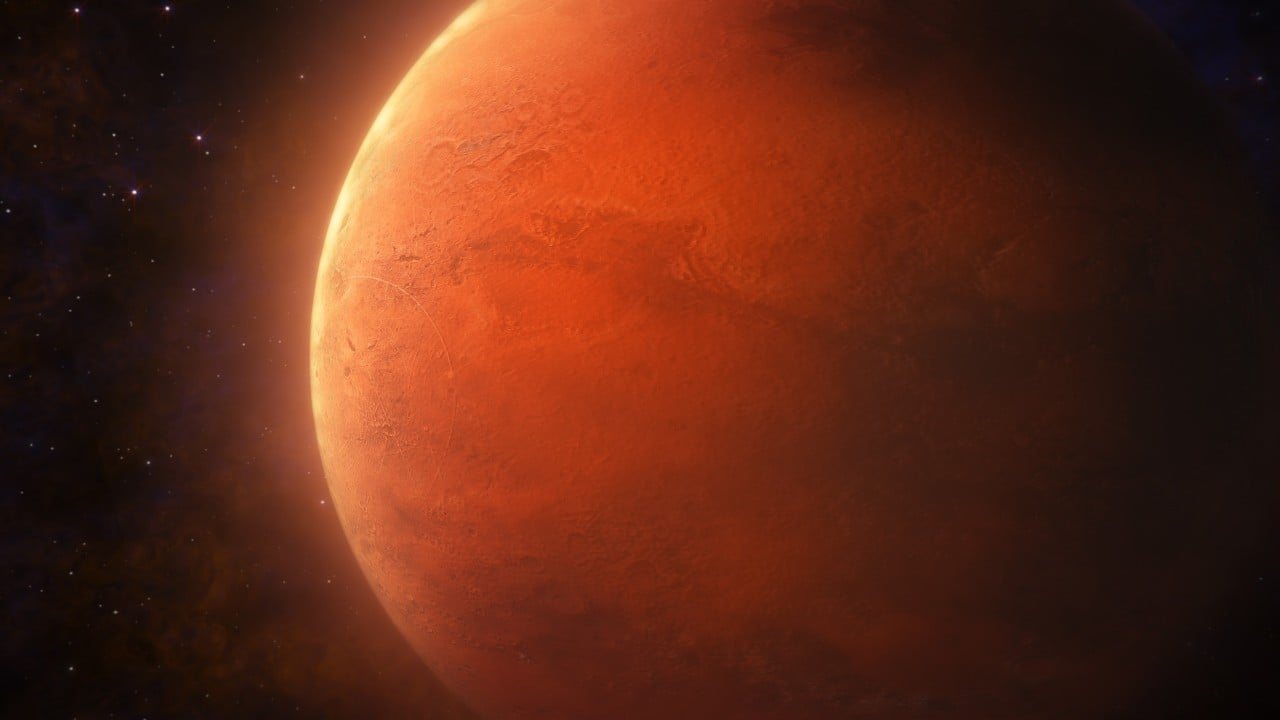
China plans to complete a geological map of Mars by the end of 2028, as the red planet increasingly features in its space rivalry with the United States.
Hou Zengqian, chief scientist of China’s next Mars mission known as Tianwen-3, on Monday said the map would cover the entire surface of the planet and it aimed to be the global standard for the Martian geological ages.
State news agency Xinhua reported that the map would be the first AI-driven geological map of Mars and would be an important part of preparations for the Tianwen-3 mission.
Hou said the map would incorporate findings from Zhu Rong, the first rover China sent to Mars.
Those findings include evidence that Mars may have had an intercontinental-scale ancient ocean about 3.5 billion years ago and possible short-term flooding about 1.6 billion years ago.
01:08
China’s Zhu Rong rover discovers evidence of an ancient sea on Mars
Zhu Rong touched down on the planet in May 2021 as part of the Tianwen-1 mission, making China the second country after the United States to land a rover on Mars. It operated on the Martian surface for nearly a year and travelled over 1.9km (1.18 miles).
China’s map project will also produce a detailed 1:50,000 geological map of the Tianwen-3 landing zone and an atlas series, according to the Xinhua report.
“It will provide a model for future geological mapping of the moon, Venus and asteroids too,” the report said.
China plans to launch the Tianwen-3 mission in late 2028, aiming to collect and return at least 500 grams (1.1 pounds) of Martian samples to Earth by around 2031. If successful, that would make China the first country to complete a Mars sample-return mission.
It will involve two launches, with one spacecraft carrying a lander and an ascent vehicle to collect Martian material and another carrying an orbiter and return module to transport the samples back to Earth.
02:49
Nasa releases first video of dramatic Mars landing by Perseverance rover
Meanwhile, a joint Nasa and European Space Agency Mars sample-return mission has been hit by soaring costs and repeated delays.
The Perseverance rover – which has been operating on Mars since February 2021 – has collected and cached several dozen rock and soil samples.
Under the original plan, these samples would be retrieved and ferried back to Earth in the 2030s. But Nasa estimated in 2024 that the programme could cost up to US$11 billion and return samples no earlier than 2040.
In January, the US Congress effectively terminated the existing programme by cutting its funding due to its hefty price tag and repeated delays.
That has resulted in some funds being diverted to a new Mars Future Missions initiative aimed at developing lower-cost technologies, while the architecture and timetable for any future Mars sample-return mission remain uncertain.
The US completed its first Mars mission during the Cold War space race with the Soviet Union. Nasa’s Mariner 4 became the first spacecraft to conduct a fly-by of the planet and it sent back close-up images in 1965. That was followed by Nasa’s first Mars landing craft Viking 1 touching down on Mars in 1976.
Since the first robotic rover, the Sojourner, reached Mars in 1997, five American rovers have explored the Martian surface, with Curiosity and Perseverance still operating today.
03:08
China joins elite club of countries that have reached Mars
China’s inaugural Mars mission, Tianwen-1, was launched in July 2020 and deployed the Zhu Rong rover.
Zhu Rong completed its planned 90-Martian-day primary mission and continued operating through May 2022. It then went into a planned winter hibernation but failed to resume operations afterwards. Reports attributed the failure mainly to the heavy dust accumulation on its solar panels that prevented the vehicle from generating enough power.
KioskNews shows a cleaned-up reading view extracted from the publisher’s page — the original always lives on their site, not ours.