China-led team hits 83% success rate anticipating earthquakes in ‘seismo-ripples’ study

A China-led international team has reported a new pre-earthquake phenomenon that has shown strong predictive potential for major earthquakes since 2022 with minimal failures.
The anomalous seismic, magnetic and ionospheric resonance signals they observed – termed “seismo-ripples” by the researchers – are ringlike disturbance patterns triggered before earthquakes happen.
Their findings challenge the long-standing scientific belief that these events are unpredictable, opening up a promising new path to earthquake prediction.
“Historically, earthquake prediction has been considered nearly infeasible,” said the team from institutes in mainland China and Taiwan, along with Brazil and Japan, in a paper published in the peer-reviewed journal NPJ Natural Hazards on Sunday.
Using data collected from seismometers, magnetometers and ground-based Global Navigation Satellite System receivers, the anomalous patterns were verified against 12 major earthquakes in China between 2022 and 2024.
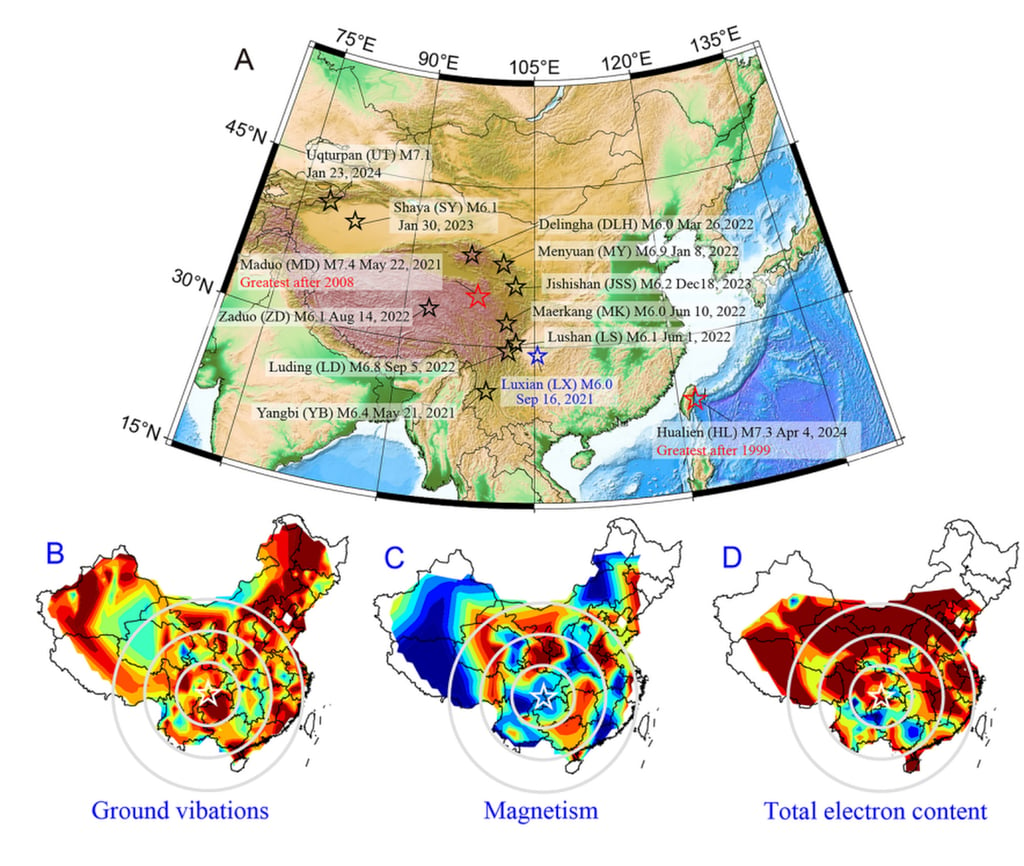
“Since June 2022, prospective anomaly based on seismo-ripples has demonstrated a strong predictive capability for numerous earthquakes with a magnitude [greater than or equal to] six, with remarkably minimal to no failure,” the researchers wrote.
Of the 12 sites they proposed could be associated with future earthquakes, 83 per cent experienced a corresponding earthquake within three months of the seismo-ripple patterns emerging.
The average distance between predicted and actual epicentres was about 280km (174 miles) and the estimated magnitudes ran about 0.5 units larger than the final seismic readings.
“In essence, the core argument of our paper is that earthquakes are not inherently unpredictable,” said Chen Chieh-Hung, a lead author of the study and a professor at the Chengdu University of Technology.
Chen noted that prediction could mean different things to different people, with some expecting precision down to the exact minute or accuracy within a margin of a few kilometres, which he said would not be feasible at this stage.
“Nevertheless, we have opened a door. Earthquakes are not beyond the realm of prediction,” he said on Wednesday. “There is a possibility that they can be predicted. The next step is for the scientific community to work on refining this precision.”
Asia is one of the world’s most seismically active regions, with China experiencing roughly a third of all continental earthquakes despite having only about 7 per cent of the global land area.
Estimating long-term seismic probabilities – such as Japan’s assessment of a high probability for a major earthquake along the Nankai Trough in the next three decades – is an accepted scientific approach.
However, for decades, short-term earthquake prediction has been elusive and controversial.
According to the United States Geological Survey, a true earthquake prediction must specify three parameters: the date and time, the location and the magnitude of the incoming event.
This differs from earthquake forecasting, which calculates the probability of an earthquake occurring within a given area and time window.
02:32
Search and recovery work continues a week since China-Nepal disaster, with over 100 rescued
Chen said the scientific consensus that earthquakes could not be predicted stemmed in part from papers published in the top journals Nature and Science in the 1990s. From then on, he said, this belief “effectively became an established rule”.
“Within the scientific community, the prevailing view is that earthquakes are unpredictable, and most researchers prefer not to wade into such controversial waters,” he added.
Chen pointed to other milestones once thought impossible, such as accurate weather forecasting and aircraft breaking the sound barrier.
“A more accurate way to frame it would be to say that we have yet to discover a sound, rationally valid or scientifically grounded method for predicting the occurrence of earthquakes,” he said.
Chen said that if the bar for prediction were set extremely high, then it would indeed be impossible. Instead, he argued that scientific efforts should focus on shifting from long-term forecasts to short-to-medium-term predictions.
Researchers from around the world have sought to identify earthquake precursors or signals occurring before seismic events that could be used for more reliable forecasting or even predictions.
In their paper, the China-led team explored a phenomenon of ringlike disturbances called seismo-circles or seismo-ripples that appear to propagate outwards from future earthquake epicentres.
“What’s particularly interesting about this phenomenon is that, initially, we did not know whether it was real or false,” Chen said.
To verify their findings, the team investigated past earthquake cases. They found that separate ripple-like anomalies had formed for two earthquakes that struck China within a day of each other in 2021.
Chen said this revelation gave the team the confidence to pursue the research further, and over the following two years they documented the anomalous occurrences and submitted formal reports.
In April 2022, after detecting anomalous ripple patterns in southwestern China, the researchers submitted a formal document to the China Earthquake Networks Centre – the country’s official body for earthquake monitoring and prediction evaluation – declaring a possible magnitude 6.3 event within two months.

On June 1, 2022, a magnitude 6.1 earthquake struck China’s southwestern Sichuan province, occurring 399km from the team’s predicted epicentre.
They then launched an effort between 2022 and 2024 to challenge the idea that earthquakes were inherently unpredictable, routinely monitoring seismo-ripples and submitting formal reports to authorities.
The team said its investigation highlighted a correlation between seismo-ripples and forthcoming seismic events, allowing for “reliable estimation of earthquake magnitude, location and timing”.
They noted there were still challenges to address, including ambiguous ripple signals that complicated exact estimates and the need for deeper understanding of the physics behind these anomalies.
In addition, seismo-ripple detection remains limited by instrument density and spatial network coverage.
To improve precision, an upgraded ground-based observation system is under construction in China. Looking ahead, the team plans to incorporate satellite data and artificial intelligence to enhance monitoring capabilities.
While their study focused on China’s North-South Seismic Belt, the researchers said the seismo-ripple phenomenon held potential for global application.
Chen said the main goal of their paper was not to claim that earthquakes could already be predicted but rather that they were not inherently unpredictable.
“At this stage, we are already able to distinguish between signals that are likely related to earthquakes and those that are not – a distinction we could not make previously,” he said.
“The next challenge is to improve precision, particularly regarding the location and timing of seismic events.”
Chen acknowledged that there was a long way to go before earthquake prediction would become a fully functional reality. But he said his team was committed to the task and invited other scientists to put their seismo-ripples model to the test.
KioskNews shows a cleaned-up reading view extracted from the publisher’s page — the original always lives on their site, not ours.