Pope Leo begins South America 'homecoming' tour with appeal for regional unity
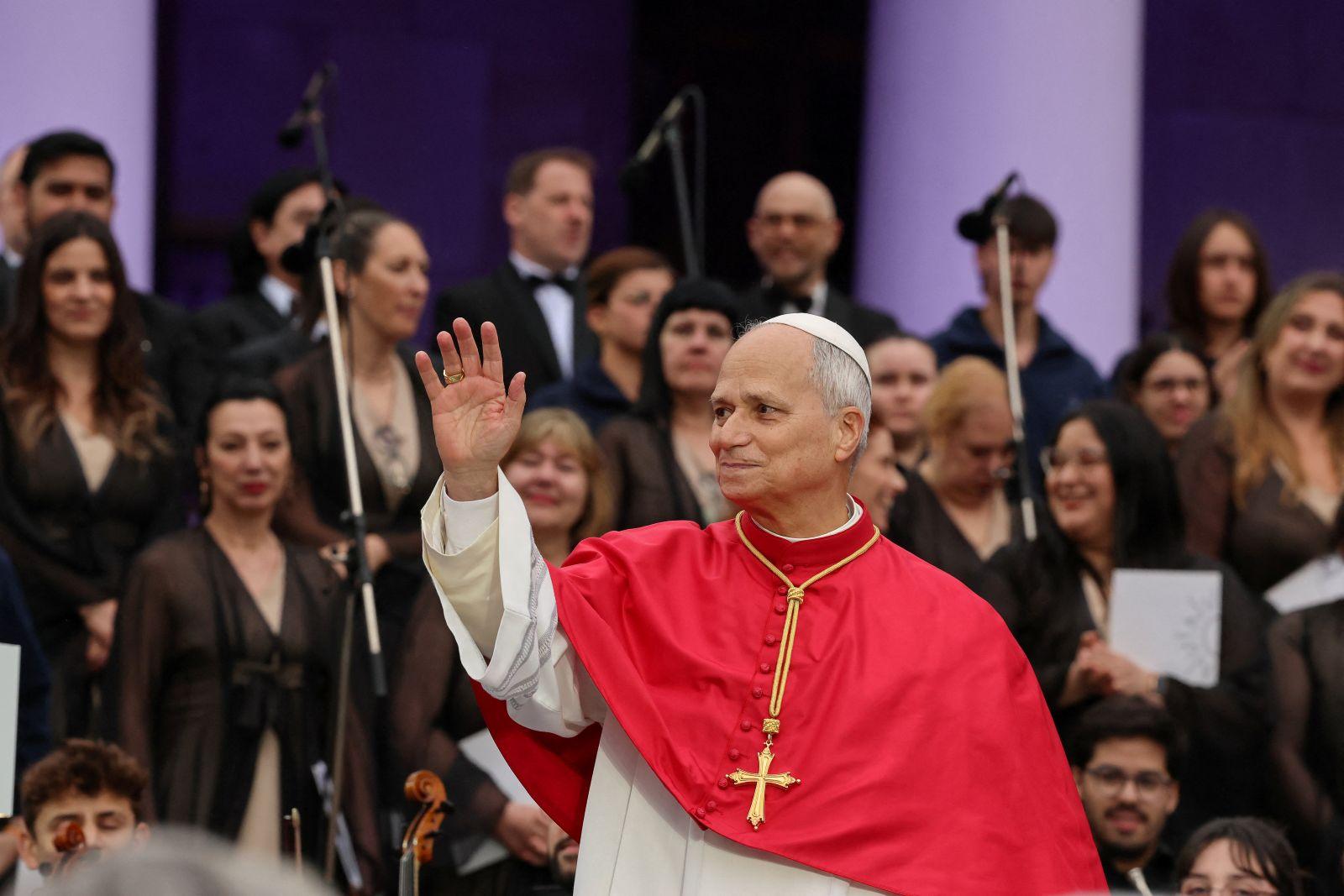
MONTEVIDEO - Pope Leo urged South American countries to tackle regional issues together on Friday as he began a 12-day trip expected to draw millions across a Catholic stronghold region facing sharp political divisions.
The pontiff arrived in Uruguay, one of Latin America's more stable democracies, for the first stop of a tour that will also take him to Argentina and Peru, in one of the most demanding overseas trips by a Catholic leader in decades.
Pope Leo was greeted by President Yamandu Orsi and two children bearing flowers after landing at Montevideo's Carrasco airport under partly cloudy skies. Later, addressing crowds the Vatican estimated numbered at least 30,000 people in Independence Square, he urged South American countries to set an example of international cooperation.
"In an age when differences can easily become a source of conflict, persevering in respect for the law, negotiation and the patient search for agreements is a service that Uruguay can continue to offer its neighbors," said Leo, who will visit three cities in Uruguay.
Leo, who is 71 and underwent lung cancer surgery last month, will take part in dozens of events across the three countries. The Vatican said this week the pope had completely healed from his operation and no special precautions were being taken for the tour, on which Leo will travel 31,000 km (19,300 miles) across 10 cities and give 36 speeches.
The pope, who was born in Chicago but spent decades in Peru, considers the tour a "homecoming to places where he spent a long time and to which he feels closely connected," said Vatican spokesperson Matteo Bruni.
AI warning
In his first address, the pontiff called for a global economy that serves everyone, not just the world's richest, and renewed his warnings about the rapid development of AI, saying new technologies must not reduce workers “to a mere expendable cog in the production process.”
People from across Latin America waved flags from their countries in Montevideo’s main square, where vendors sold key rings and other merchandise bearing images of the pope alongside Uruguay’s blue and white colors.
Pamela Gonzalez, 37, a lawyer who came with her mother and planned to attend Saturday’s Mass, said Leo’s visit carried particular weight in deeply secular Uruguay.
“He’s an important political figure globally,” she said. “It made me emotional that he’s coming to a very secular country like Uruguay. It is important we are tolerant of everyone even if you don’t practice the faith.”
Leo told journalists on his flight that he wished to share "God's message of peace (and) goodwill for all people" during the trip.
He also said he had voted by mail in the US midterm elections because he is proud to be a US citizen.
Pope visits amid regional instability
Leo, who has decried the direction of global leadership in recent months, will address governments in each of the three countries. He will also lead outdoor Masses at major local sites, visit a prison in Argentina and head to remote Andean communities in Peru by helicopter.
Bruni said the pope's speeches during the tour would address a range of issues facing the continent, including environmental destruction, arms trafficking and regional political instability.
In Brazil, which Leo flew over on his way to Uruguay, political tensions have deepened since President Luiz Inácio Lula da Silva won reelection last month. Defeated challenger Flávio Bolsonaro left for the US and accused Lula's government of plotting a coup against him.
The fallout has strained relations with Argentina, Leo's next destination. President Javier Milei has refused to recognize Lula's victory, putting him at odds with other regional governments and widening an already deep ideological divide between the two leaders. On Sunday, Leo will meet Milei, a libertarian seen as a close ally of US President Donald Trump, who lambasted Leo earlier this year after the pope criticized the Iran war.
Peru, Leo's final destination, has cycled through eight presidents since 2016 amid impeachments, resignations and social unrest.
Against that backdrop, Uruguayan officials have portrayed Leo's arrival as an opportunity to emphasize the country's tradition of democratic coexistence and institutional stability.
The late Pope Francis, who was Leo's predecessor and from Argentina, visited Peru in 2018 but never returned home. A pope has not visited Argentina or Uruguay since the late 1980s.
Argentine officials have said some 7 million people will attend events with Leo.
Vatican not taking additional medical precautions
Latin America has long been the world's largest Catholic region in absolute numbers, but the Church has been losing ground recently to fast-growing evangelical denominations and has struggled to respond to progressive social attitudes and individualized forms of worship.
Local Catholic leaders hope Leo's visit can reenergize the faith across the region and also help repair the Church's standing after abuse scandals tarnished its reputation.
Leo will hold several meetings with survivors of sexual abuse by Catholic clergy during the trip, the Vatican has said, without yet providing further details.
The pope was treated in October for lung adenocarcinoma, the most common form of lung cancer. His doctors have said the disease was localized and he would not require any further treatments.
Medical experts said the decision by Leo's doctors to clear him to fly should indicate the risk of complications from his surgery was low, that his operated lung had fully expanded and any surgical wounds were healing without signs of infection.
They suggested, however, that Leo might need to take rest breaks to deal with the trip's intense itinerary and consider using supplemental oxygen as needed, especially during his high-altitude visits in the Peruvian Andes.
Leo, however, told journalists aboard his flight to Montevideo that he feels "in fairly good shape" and that he never doubted he would go ahead with the trip. — Reuters
KioskNews shows a cleaned-up reading view extracted from the publisher’s page — the original always lives on their site, not ours.