Can the Vikings actually win the Super Bowl with this offense? You're telling me there's a chance
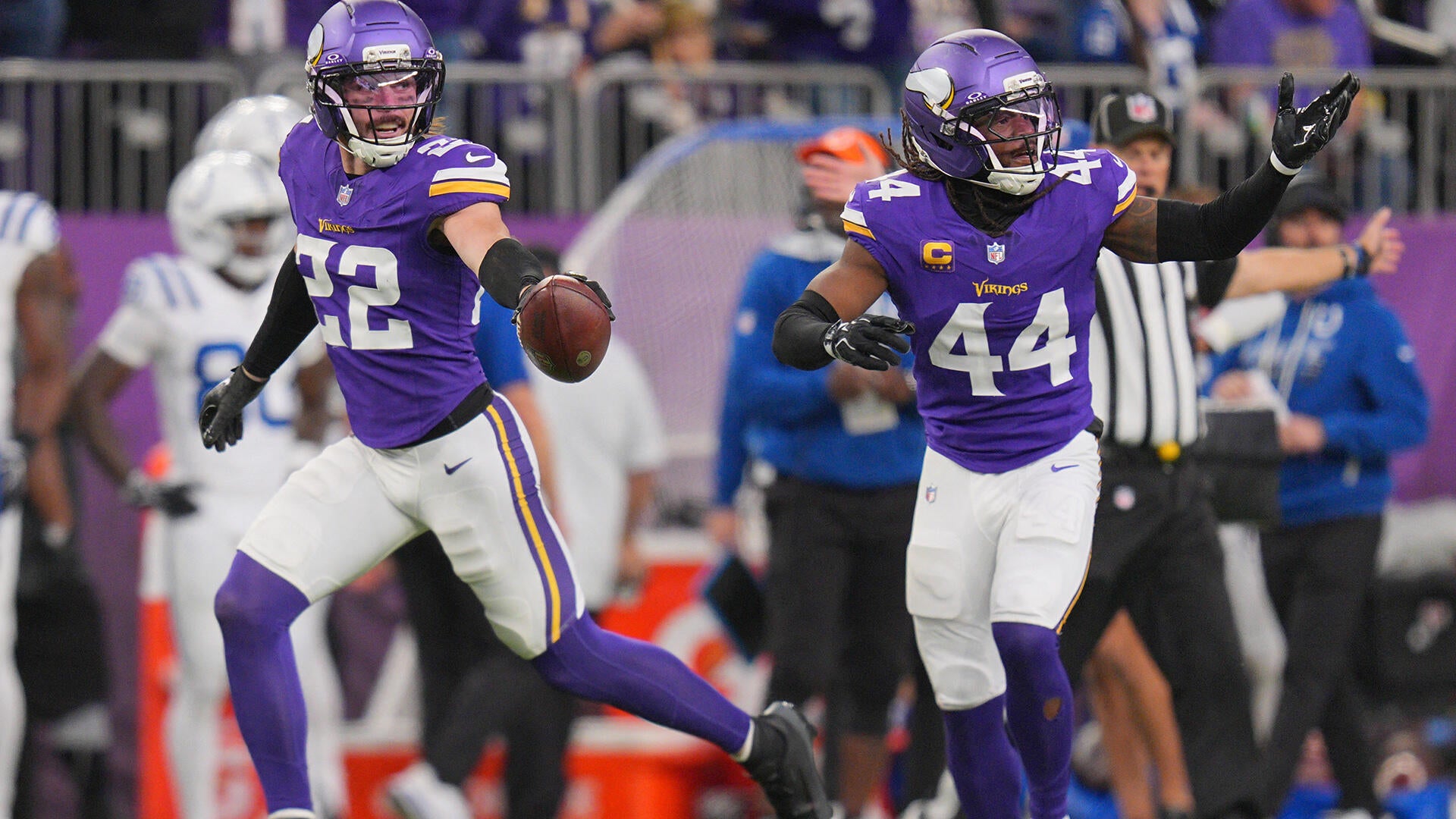
Minnesota has one of the NFL's worst offenses and a defense playing at a historically dominant level -- the 2015 Broncos provide a blueprint, but there are reasons to be skeptical

• 6 min read
The Minnesota Vikings are 6-0, which is remarkable for one very obvious reason: their offense, by any objective measure, is anemic. They've scored all of 10 touchdowns this season. Their kicker, Will Reichard, has 63 points. Everybody else on the roster? Sixty-two.
Sunday against the Colts offered more of the same. Kyler Murray threw for 150 yards, the offense scored a lone touchdown, and Minnesota won anyway, 16-10. Indianapolis quarterback Daniel Jones managed 108 passing yards, threw an interception and was sacked four times. The Vikings have now won 11 straight games dating to last season, despite scoring just 21 touchdowns during that stretch, the fewest in an 11-game winning streak in NFL history.
At this point, there's no debating whether Brian Flores is an elite defensive coordinator. But here's a question worth considering: Is he so good that his defense can drag this offense all the way to a Super Bowl? I know, this sounds ridiculous – even for the terminally online, where hyperbole, hype and mock outrage are the fuel that keeps the internet running.
But this is not that. Just ask the 2015 Denver Broncos.
The '15 Broncos proved a defense can win a championship almost by itself
Eleven years ago, Denver started 6-0 with a 39-year-old Peyton Manning who looked nothing like the quarterback who'd won five MVP awards. His arm strength had diminished, injuries had taken their toll, and a makeshift offensive line wasn't helping. Manning threw nine touchdowns and 17 interceptions in 10 games before a foot injury opened the door for Brock Osweiler.
Denver's defense, led by Von Miller, DeMarcus Ware and a loaded secondary, made up for the offense's shortcomings. The Broncos finished 25th in offensive EPA per play but beat the Steelers, Patriots and Panthers on their way to winning Super Bowl 50.
But here's the fine print: Minnesota's offense ranks 31st in EPA per play, and its minus-0.148 mark is considerably worse than Denver's minus-0.063 in 2015. The Vikings aren't just struggling offensively. They're playing at a historically bad level.
Still, the Broncos established that winning a championship without consistently good quarterback play isn't impossible. And Minnesota's defense is performing at a level worthy of the comparison.
Just how good is Brian Flores' defense?
Since 2011, only two defenses have completed a season with better EPA/play than Minnesota's current plus-0.195: the 2019 Patriots and 2020 Rams. That's 480 completed team-seasons, and the Vikings' six-game performance? It would rank No. 3. Overall.
Historically dominant defenses, 2011–2026
Team | Defensive EPA/play |
2019 Patriots | +0.227 |
2020 Rams | +0.198 |
2026 Vikings* | +0.195 |
2017 Jaguars | +0.180 |
2020 Steelers | +0.177 |
2023 Browns | +0.174 |
Flores has taken an already aggressive approach to another level. Minnesota blitzes on 71.8% of dropbacks, nearly 28 percentage points more frequently than the next-closest team this season. Its 47.1% pressure rate ranks among the NFL's best, and opponents are averaging just 12.3 points per game.
Against the Colts, Flores blitzed on 85.2% of dropbacks, the highest single-game rate since 2013. Indianapolis managed 48 yards in the second half.
And the Vikings don't need to blitz to dominate. They lead the NFL in defensive EPA per play when rushing four or fewer defenders. But there's a difference between making life miserable for opposing quarterbacks and being asked to singlehandedly win games every week. That's effectively what Minnesota's defense has done through six games.
The Vikings offense isn't holding up its end of the bargain (duh)
The 2026 Vikings rank 31st in offensive EPA/play, 29th in passing yards per game and 31st in touchdown rate per drive. And that minus-0.148 EPA/play? It would rank 22nd-worst among those same 480 team seasons going back to 2011.
And this isn't just a Kyler Murray problem. The 2025 Vikings finished at minus-0.111 EPA/play, and the offense has become even less efficient in 2026. Murray didn't inherit the Kirk Cousins offenses that ranked fifth and sixth in EPA/play in 2019 and 2020. He inherited a mess. And so far, it's somehow worse.
The run game has been respectable, ranking 12th in yards per game. The passing game? Not so much. Murray is averaging just 162.3 passing yards per game, and Minnesota scores touchdowns on only 13.8% of its possessions, 31st in the NFL.
So how long can a defense keep winning games when its offense contributes so little? Three teams from the last decade faced similar challenges, and their seasons ended in three very different ways.
How far can an elite defense carry a bad offense?
Team | Record | Off. EPA/play | Def. EPA/play | Finish |
2026 Vikings | 6-0 | -0.148 | +0.195 | TBD |
2015 Broncos | 12-4 | -0.063 | +0.121 | Won Super Bowl |
2019 Steelers | 8-8 | -0.143 | +0.123 | Missed playoffs |
2023 Browns | 11-6 | -0.145 | +0.174 | Lost wild card |
The 2019 Steelers are the cautionary tale. Ben Roethlisberger suffered a season-ending elbow injury in Week 2, leaving Pittsburgh with Mason Rudolph and undrafted rookie Duck Hodges (!) at quarterback. Injuries elsewhere on offense compounded the problems. The Steelers' defense, featuring TJ Watt and Minkah Fitzpatrick, kept them competitive, but Pittsburgh finished 8-8 and missed the playoffs. Their offense ranked 31st in EPA per play, the same as Minnesota's this season. I know we now joke about Mike Tomlin never having a losing season, but I was serious when I said he should've won Coach of the Year after willing this team to eight wins.
The 2023 Browns provide a more encouraging comparison. Cleveland lost Nick Chubb, Deshaun Watson and key offensive linemen to injuries, eventually cycling through five starting quarterbacks. Joe Flacco provided an unlikely off-the-couch, late-season spark, while Jim Schwartz's defense helped the Browns finish 11-6. Cleveland's minus-0.145 offensive EPA/play is the closest historical comparison to Minnesota's, and its defense was lights out. But the Browns' wild ride didn't last long once they reached the postseason; the Texans beat them 45-14 in the wild-card round.
Three teams. Three outcomes. And proof that even an elite defense can't guarantee much if the offense consistently struggles.
Six wins in the bank, but how far can Minnesota go?
There's another reason not to dismiss the Vikings' Super Bowl chances: They're already 6-0.
Of the 14 teams that opened a season with six consecutive wins going back to 2013, all 14 reached the playoffs. Seven made the Super Bowl, though only the 2015 Broncos won it all.
Not surprisingly, Minnesota has outperformed expectations, but not by a wildly outrageous margin, at least according to something called Pythagorean expected wins. The formula uses points scored and allowed to estimate how many games a team should have won. Based on their 125 points scored and 74 allowed, the Vikings have an expected 4.7 wins, compared with their actual 6-0 record. That's a better mark than the 2015 Broncos, who also started 6-0 but had just 4.1 expected wins through six games. And, as we've established, Denver went on to win the whole thing.
How far did these 6-0 teams go?
Team | Final record | Playoff result |
2015 Broncos | 12-4 | Won Super Bowl |
2019 Patriots | 12-4 | Lost wild card |
2020 Steelers | 12-4 | Lost wild card |
2021 Cardinals | 11-6 | Lost wild card |
2022 Eagles | 14-3 | Lost Super Bowl |
2026 Vikings | 6-0 | TBD |
At 6-0, the Vikings have already given themselves plenty of breathing room. Even a 5-6 finish would leave them at 11-6, and there's little reason to believe the wheels are about to fall off Flores' defense.
But getting to the playoffs and winning three or four games against the NFC's best teams are two different conversations. And that brings us back to the original question: Forget about making the playoffs – that feels almost inevitable at this point. Let's get nuts: Can these Vikings actually win the Super Bowl?
The Broncos proved it's possible. The Steelers and Browns showed how quickly things can go sideways. Minnesota's defense is playing well enough to make a championship run – no doubt about it – but its offense is asking even more of Flores than Denver asked of its defense a decade ago.
The good news for Minnesota? At 6-0, there's time to figure it out. And with Flores making life miserable for opposing quarterbacks, O'Connell and Murray don't need to turn this into a top-five offense. They just need to make it replacement-level.
Because right now, the Vikings look like a Super Bowl contender on one side of the ball and a team headed for a top-five draft pick on the other. Something's got to give.
KioskNews shows a cleaned-up reading view extracted from the publisher’s page — the original always lives on their site, not ours.