Ex-AG admits he didn’t approve all police action in criminal probe of Netanyahu or review full indictment
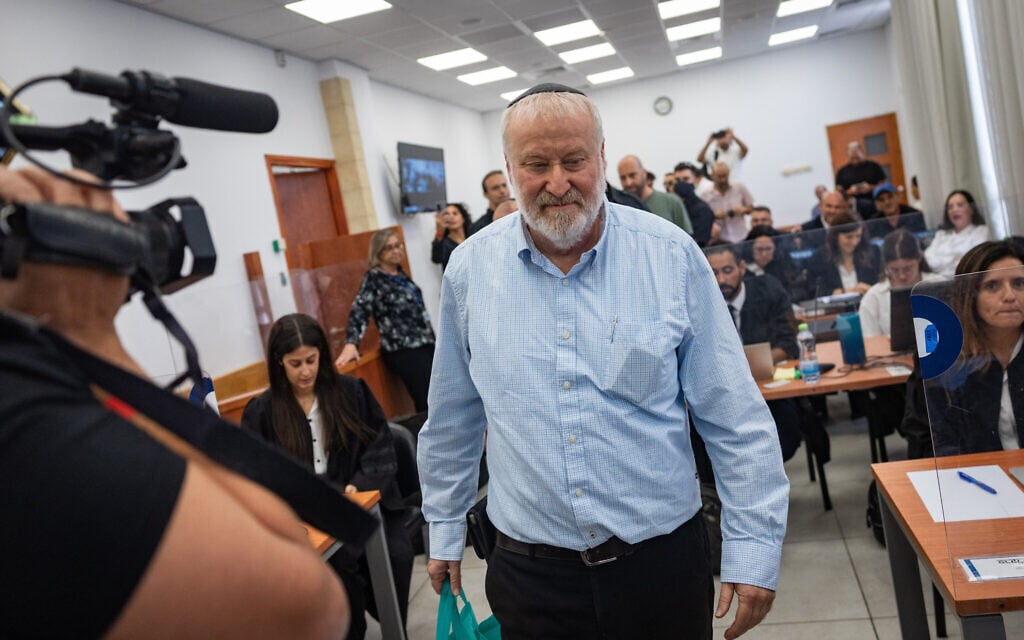
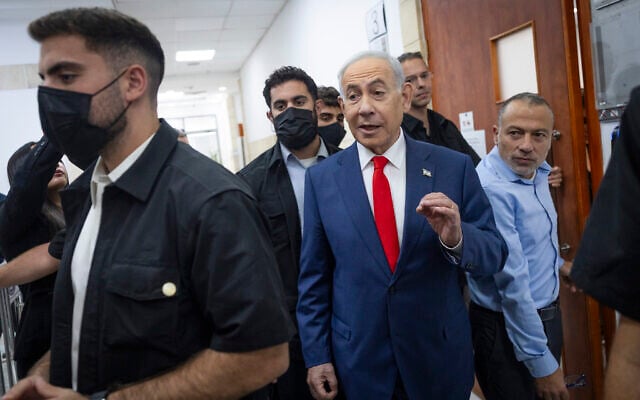
In an extraordinary spectacle, former attorney general Avichai Mandelblit gave testimony in Prime Minister Benjamin Netanyahu’s criminal trial on Sunday in the Jerusalem District Court, with Netanyahu arriving later in the morning to listen to the hearing.
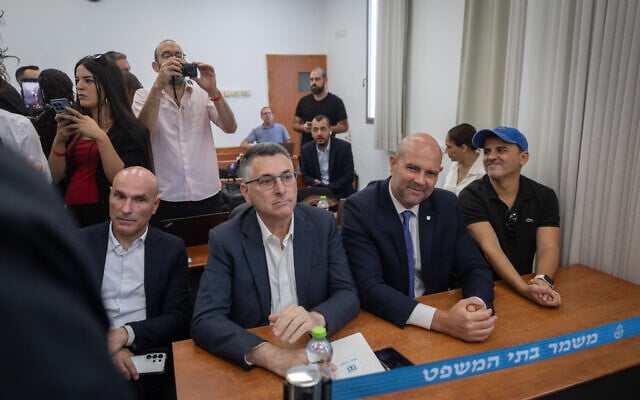
Knesset Speaker Amir Ohana and Foreign Minister Gideon Sa’ar were also in attendance to support the prime minister, as were several of his vocal allies. They denounced Mandelblit, who indicted Netanyahu in January 2020, as he entered the courtroom.
During the course of the testimony, Netanyahu’s defense attorney, Amit Hadad, sought to expose various problematic aspects of the way the criminal investigation into Netanyahu was conducted, and how Mandelblit had managed it.
0:00 / 0:00
Promoted: JPPI

Hadad succeeded in getting Mandelblit to acknowledge in court that he had not approved every single investigative procedure carried out by police during the investigation, and that on one occasion he ordered that a wiretap he had not approved be canceled.
Questioned by Hadad, Mandelblit said he was critical of the way police had applied pressure on a key witness to get him to testify against Netanyahu but that he had not ordered any kind of investigation into the incident because he did not want to taint the investigative process.
Get The Times of Israel's Daily Edition by email and never miss our top stories
By signing up, you agree to the terms
Mandelblit also conceded that in Case 4000 — in which Netanyahu is accused of taking a bribe in the form of positive media coverage in return for favorable regulatory decisions for Bezeq majority shareholder Shaul Elovitz — he had not reviewed the 315 examples of alleged media bribery cited in the indictment. Many of those examples were discredited during Netanyahu’s testimony.
Mandelblit insisted, however, that he had approved the decision to open an investigation into Netanyahu as required by law despite Hadad’s allegations to the contrary.
Netanyahu has been on trial in three corruption cases since he was indicted in January 2020. He faces charges of fraud and breach of trust in Case 1000 and Case 2000, and charges of receiving a bribe, as well as fraud and breach of trust, in Case 4000.
The court has twice recommended to the prosecution that it drop the bribery charge, stating that it will be difficult to prove, but the prosecution has refused.
Following Mandelblit’s testimony on Sunday, senior Likud officials. including Justice Minister Yariv Levin and Ohana, called for the trial to be canceled, with Levin calling for an investigative commission to be established to determine how the investigation against Netanyahu was conducted.
The Likud party itself issued a statement, saying Mandelblit’s testimony proved that “the trial against the prime minister was a witch hunt designed to topple a strong right-wing prime minister,” and called for the trial to be canceled and for criminal investigations into the prosecutors.
During one key exchange, Mandelblit insisted he had approved an investigation into the gifts Netanyahu received from various businessmen, including Arnon Milchan.
But Hadad showed a minutes document in court from a meeting Mandelblit had with prosecutors, in which he said, “With all due respect to champagne, cigars and a suit… this is not the industry [of gifts] that we suspect perhaps exists. In this case [with the champagne, cigars], we will need to look for aggravated circumstances, which I still don’t see here and is explicitly not what I authorized at the time.”
Mandelblit repeated in court, however, that he had authorized the investigation, with the prosecution pointing out that the former attorney general had approved such an investigation before the meeting in question.
Hadad previously underlined problems with the indictment in Case 4000, specifically the 315 alleged examples in which Netanyahu was supposed to have received favorable treatment from Walla, owned by Bezeq majority shareholder Elovitz.
Hadad said that the original indictment included just 15 examples of favorable treatment by Walla but that an amended indictment boosted that number to 315.
Mandelblit was evasive when answering questions as to whether he had gone over the hundreds of examples, but admitted he had not been told by prosecutors that Netanyahu himself had not been questioned about the overwhelming majority of them.
Judge Rivka Feldman-Friedman, the head of the three-member panel hearing the case, asked Mandelblit if he had not checked and he admitted that he had not.
In his efforts to try and expose illegitimate police actions during the investigation, Hadad highlighted the wiretapping of Netanyahu’s then chief of staff, Natan Eshel.
The former attorney general acknowledged that he had not authorized every single police action in the investigation, but that this was permissible and that he had approved all the principal investigative actions.
Quizzed about Eshel, Mandelblit said he had been angered by the wiretapping and ordered that it be stopped immediately.
Mandelblit also criticized the police for having arrested and questioned a woman close to key witness Nir Hefetz in order to exert pressure on Hefetz to testify against Netanyahu.
“I think it was illegitimate and wrong,” said Mandelblit, but added that he did not order disciplinary measures because he did not want to taint the investigative process.
Mandelblit also acknowledged that he had not known that prosecutor Yehudit Tirosh was present in the meeting in which the police approved the idea of using the woman to influence Hefetz.
“We demand that the trial be halted immediately upon the conclusion of Mandelblit’s testimony, and that the trial be closed because the cases were unlawfully fabricated,” the Likud party stated after the hearing concluded.
“At the same time, a criminal investigation must be opened immediately against all those who acted in violation of the law: Mandelblit, Shai Nitzan, Yehudit Tirosh, Liat Ben-Ari, Roni Alsheikh, and the investigators involved in fabricating the cases.”
Levin labeled Mandelblit’s testimony “disgraceful” and said it proved the cases against Netanyahu had been fabricated.
“The testimony proves not only that the case was stitched up from the outset, but that Mandelblit did not even bother to look into the details when he dragged the prime minister and the entire country into a tailspin that continues to this day,” said Levin.
Help us report truthfully on social media

As a multimedia journalist, my job is to take the quality, fact-based journalism produced by The Times of Israel newsroom and make it accessible across every platform — from Instagram posts to podcasts to short-form videos.
This is how many, especially young people, consume news these days. But misinformation is rampant on social media. Our team at ToI produces accurate, responsible short-form reporting on Israel and the Jewish world.
If you believe in the importance of factual social media journalism, please consider joining our reader support group, The Times of Israel Community. Your financial support is essential to sustain responsible multimedia reporting.
— Gabriella Jacobs, multimedia journalist
Support our work Support our work Already a member? Sign in to stop seeing this
KioskNews shows a cleaned-up reading view extracted from the publisher’s page — the original always lives on their site, not ours.