Modi and Xi can’t bridge the India-China divide by themselves
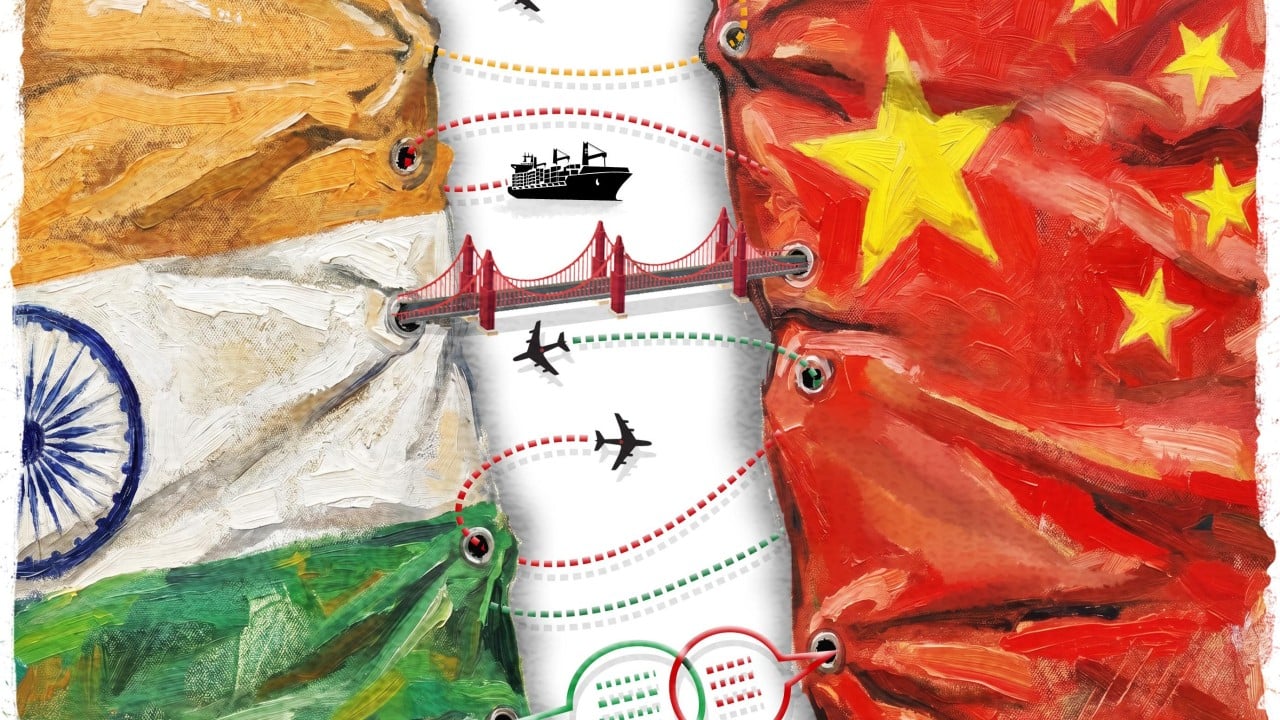
Last month, President Xi Jinping travelled to New Delhi to attend the Brics summit – his first visit in seven years. On the summit’s sidelines, Xi and Indian Prime Minister Narendra Modi had an in-depth conversation that explored topics of shared interest between them, such as leveraging open-weight artificial intelligence (AI) for mutual benefit.
Even so, such sanguine signals were soon drowned out by a spate of downbeat headlines. One recent story warned of the “asymmetric” relationship between the two, with China’s manufacturing dwarfing India’s. Another reported Delhi’s renaming of 28 sites in Ladakh, situated near the heavily contested Line of Actual Control.
For keen observers of Sino-Indian relations, such dynamics are by no means a new phenomenon. Positive reassurances from the top leadership are welcome, yet they take time to percolate through to the policy level. Impediments to warming ties, on the other hand, are aplenty – especially concerning territorial claims.
Conversations with informed stakeholders suggest a stark disparity in strategic frameworks. While the Chinese leadership views the border issue as one among several other dimensions to the bilateral relationship that can be set to one side, Indian leaders view the border issue as the foremost priority in negotiations with China.
Given such core differences, while summits of the Shanghai Cooperation Organisation and the Brics bloc of emerging economies in recent years have paved the way for the ongoing detente, there remains significant mistrust between the two countries’ bureaucratic apparatuses.
Such mistrust is mirrored by the wider public, especially since the 2020 Galwan Valley clashes. A 2024 survey found that 89 per cent of surveyed urban youth viewed border conflict with China as the greatest challenge to India’s foreign policy. A Tsinghua poll a year prior revealed that more than 50 per cent of Chinese respondents held an unfavourable view towards India.
02:29
Chinese nationalism surges across social media as viral video mocks downed Indian jets
It did not help that people-to-people exchanges were effectively frozen during the Covid-19 pandemic, which saw the suspension of direct flights between the two countries for five years. Visa restrictions have made studying one another up close extremely difficult for scholars and students. Ultra-nationalist propaganda poured fuel on the fire and amplified unhelpful stereotypes.
This need not be the way. I had the pleasure of visiting Delhi twice this year, in March for Raisina Dialogue and October for the Kautilya Economic Conclave. On both occasions I visited Jawaharlal Nehru University, where I exchanged views with astute, aspiring China scholars on topics ranging from involution to how China does AI. They came to Hong Kong in April.
It dawned on me during our conversations that proactive trust-building requires more than time – it demands starting with small, provable steps. I have three suggestions.
First, people-to-people exchanges must be bolstered through reciprocal lowering of visa restrictions and travel barriers. Delhi could resume tourist and conference e-visas and issue longer-period, multi-entry visas to Hong Kong passport holders, which would mirror Hong Kong’s 14-day visa-free entry for Indian passport holders. Given that mainland and Hong Kong passports are distinct, there need be no worry that this overwhelms the Indian security vetting system.
At the same time, Beijing should ease the stringent restrictions on Indian journalists. Both sides should recognise that even as tensions flare up, accurate reporting with quality assurances is preferable to an information vacuum which spurs vitriolic speculation.
If the above arrangements work out successfully, then Indian tourist and conference e-visas should be resumed for Chinese applicants. Meanwhile, Beijing should expedite and streamline business visa applications for executives, engineers and technical specialists.
04:20
Will India and China’s new border deal lead to long-term peace in the disputed Himalayas?
Second, China must recognise that the widening trade deficit in its favour does its image in India no favours. Prolonged weaponisation of chokepoints could spark an unwarranted push for decoupling.
To bridge policy differences and chip away at the underlying mistrust, the two bureaucracies could take a leaf out of the Boards of Trade and Investment mulled by China and the United States and establish comparable working groups and bilateral dialogue mechanisms. The Indian Ministries of Commerce and Electronics and Information Technology could jointly explore this idea through focused engagement with their Chinese counterparts.
In exchange for better market access into India for Chinese corporations, Beijing should enforce tighter regulations against the overseas excesses of its private enterprises, as well as encourage them to undertake technology exchange in relatively non-sensitive domains, such as automobiles, solar panels and lithium batteries.
The crystallisation of such efforts calls for reviving the two joint industrial estates in Gujarat and Maharashtra. If these parks can meaningfully create new jobs and generate state government revenue, this would show Chinese investment in India can benefit the wider community, as opposed to Chinese firms alone.
Third, China and India should build working-level trust through fighting for the Global South. There are clear domains where Indian and Chinese entrepreneurs can collaborate on global public goods needed by many emerging economies, such as pharmaceuticals, renewable energy and food. Both sides must resist the temptation to impose chokepoints for strategic leverage.
Sub-national entities, such as individual states in India and provinces in China, can also play a crucial role in amplifying national-level efforts. The southern state of Tamil Nadu has a long history of trading with China. With its sizeable Indian diaspora and potent financial linkages with India, Hong Kong is the prime location for the convening of conferences and workshops on South-South financial collaboration.
Trust is easily broken and hard to build. The road to more robust Sino-Indian relations remains long and arduous, yet it is imperative that we start somewhere and do so now.
KioskNews shows a cleaned-up reading view extracted from the publisher’s page — the original always lives on their site, not ours.