Plenum could formalize Xi’s extended rule: experts
The latest Chinese Communist Party plenum could help institutionalize Chinese President Xi Jinping’s (習近平) prolonged rule while preparing a new generation of officials without identifying a successor, experts said at a forum in Taipei yesterday.
The four-day plenum — the fifth of the party’s 20th Central Committee — concluded in Beijing on Thursday and adopted a measure on sustaining efforts to bolster party discipline and governance, an official communique published by Xinhua showed.
It also confirmed earlier decisions to expel 33 officials from the party, including former senior military leaders Zhang Youxia (張又俠) and Liu Zhenli (劉振立).
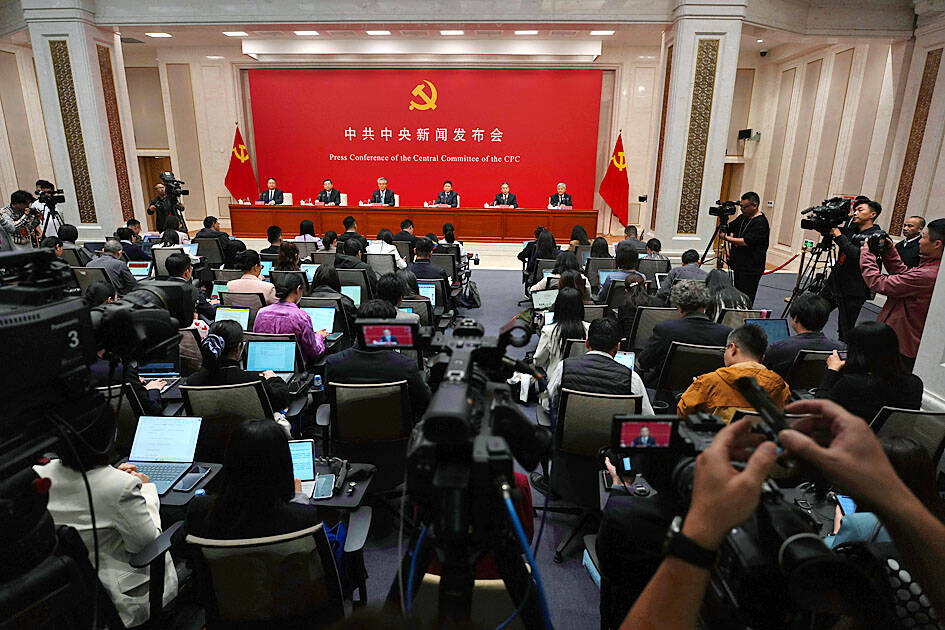
Chinese officials yesterday hold a news conference a day after the Chinese Communist Party Central Committee’s fifth plenum closed in Beijing.
Photo: AP
That left what the Guardian described as “an unprecedented number of empty seats” at the plenum, “indicating the scale of purges under Xi.”
Of the 376 Central Committee full and alternate members named in 2022, only 279 attended this week’s gathering, the Guardian said.
The plenum also elevated Central Military Commission Vice Chairman Zhang Shengmin (張升民) to the politburo and promoted 10 alternate Central Committee members to full membership.
National Chengchi University Institute of International Relations associate research fellow Tzeng Wei-feng (曾偉?) said the plenum elevated Xi’s thinking on party building, and established standards for training, selecting and supervising officials loyal to his vision.
“It is using the language of institutions to carry personal authority,” Tzeng said at the institute’s forum examining the meeting.
The process was a “succession without a successor,” he said, referring to generational turnover within the leadership rather than a transfer of power from Xi to a designated heir.
Tzeng suggested Xi’s thinking on party building could be incorporated into the party constitution at next year’s 21st party congress, potentially followed by changes to supervisory institutions and cadre assessment.
Party supervision could place greater emphasis on officials’ performance and conduct, extending beyond corruption and criminal wrongdoing, Tzeng said, adding that those standards could guide a substantial leadership reshuffle, bringing forward younger officials whom Xi considered capable and trustworthy.
Tzeng said his interpretation remained preliminary pending an examination of all of the measures adopted at the plenum.
Chihlee University of Technology Department of International Trade professor Chang Hung-yuan (張弘遠) said disciplinary purges should increasingly be seen as a lasting feature of the party’s governance rather than a temporary campaign.
“In the past, we treated the anti-corruption drive as a campaign. Now it appears to be part of the system,” Chang said.
The promotion of officials with disciplinary inspection and regulatory backgrounds reflected greater emphasis on supervision and ideological control ahead of the next congress, he said.
However, tighter discipline also risked discouraging officials from taking action, Chang said, adding that Xi needed cadres to implement policies and address economic problems while remaining obedient, creating tension between strict control and administrative flexibility.
CY Cergy Paris University Chinese Studies professor Zhang Lun (張倫) offered a distinction between formal institutions and the exercise of power.
Party plenums often confirmed agendas and personnel arrangements already largely settled, providing procedural legitimacy, he said, adding that some earlier meetings had allowed substantive discussion.
Under Xi, actual authority was concentrated in him, despite the party’s formal organizational hierarchy, Zhang Lun said.
The latest plenum was transitional, with purges and personnel selection still underway, he said.
Vacancies did not necessarily require immediate replacement, and some arrangements might become clearer at the next plenum as Xi consolidates control over the leadership lineup, he added.
This week’s plenum decided to hold the next party congress in the second half of next year.
Zhang Lun said he expected a “sixth plenum” of the Central Committee to take place before then.
KioskNews shows a cleaned-up reading view extracted from the publisher’s page — the original always lives on their site, not ours.