Opinion: Why Guadalajara’s water crisis is a warning to the rest of us
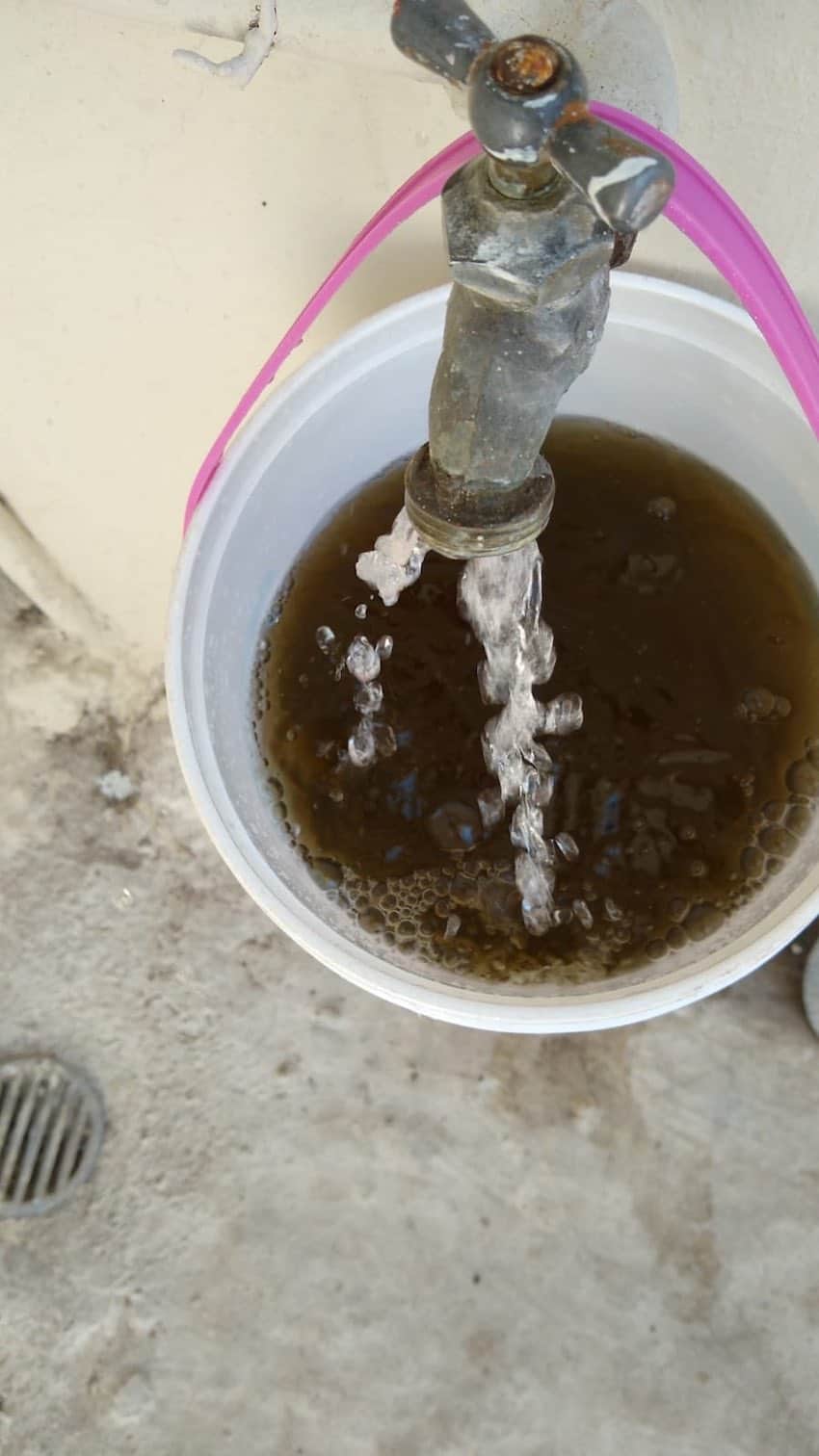
As if on cue, the moment I sat down to type this essay, the water from my faucet finally came out brown. For weeks, my friends around Guadalajara had traded stories about the city’s water crisis. In group chats, folks shared photos of brown water filling their sinks, alongside anecdotes about the new ways they’re learning to shower with store-bought water.
Paulina Cano, a lifelong resident of Guadalajara, told me the unusual smell coming from the water at her house started months ago.
“I decided to test the water at a nearby clinic, and I found out it had a bacteria that is one of the hardest to cure,” Cano told me. “Then, my mother started to get red, itchy rashes on her skin, and she needed several different creams to get rid of it.”
‘Lo que pasa en Guadalajara, pasará en tu casa’
Following weeks of protests advocating for a solution to Guadalajara’s water crisis, I knew it was only a matter of time before the situation would reach my apartment. But the moment it did, it felt like a microcosm of what Guadalajara means for the rest of the world: Simply put, it’s only a matter of time before the water crisis reaches your apartment too.
I thought of the poster I had seen repeatedly at city protests: “Lo que pasa en Guadalajara, pasará en tu casa.” — “What happens in Guadalajara will happen in your house next.”
Through my work with various environmental organizations, I have learned the phrase “sacrifice zones,” areas of the Earth we surrender to irreversible pollution, in order to create industrial projects.
Essentially, sacrifice zones are the places we collectively agree to poison, for the sake of maintaining the capitalist comforts of our society.

50 years of increasing pollution
For decades, the towns and rivers surrounding Guadalajara have become sacrifice zones for Mexican development.
Enrique Encizo, a cofounder of the local advocacy group Un Salto de Vida, recalled fond memories of growing up in El Salto near the Santiago River.
“Anytime you went to the river, there were always kids swimming and playing, women with their tubs washing baskets of clothes,” Encizo told me. “The ravine by the river was also filled with fruit trees. We would fish in the river, then harvest fruit nearby — guayabas, mangos, avocado, papaya, bananas.”
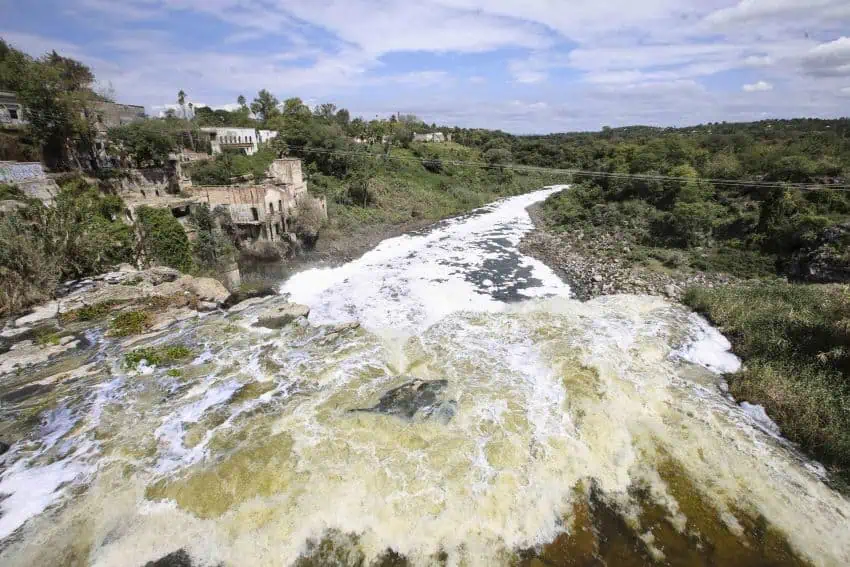
Up until the 1970s, nearby Juanacatlán Falls was known as “the Niagara of Mexico.” But in just 50 years — in Juanacatlán, El Salto and other nearby towns — corporations like Hershey’s, Nestle and IBM severely contaminated the rivers.
They became so toxic that in 2008, an 8-year-old boy died from acute arsenic poisoning after accidentally falling into the water.
Encizo noted that although El Salto contributes almost 15% to Jalisco’s GDP, it remains one of the poorest and unhealthiest towns in the state. The residents of these towns now suffer from much higher rates of hepatitis, cancer, respiratory infections and skin damage.
For example, the town of Poncitlán has some of the highest rates of kidney disease in the world. Meanwhile, other studies have shown that contamination is impacting the DNA of these populations so intensely that the next generation will inherit symptoms genetically.
This Jalisco community has highest rate of kidney disease in the world
Surrounded by sacrifice zones
When the water crisis hit Guadalajara these last few months, the sacrifice zone simply expanded. Those of us living in the city could no longer ignore what was happening right around the corner, in smaller towns surrounding us, because finally — and inevitably — it landed in our own homes.
In the United States, sacrifice zones similarly widen each time the government allows development on previously protected land, such as the case of Bears Ears National Monument.
At the same time, data centers — also often built near low-income communities — again expand the sacrifice zone farther and farther, contaminating nearby water sources in similar ways to what has happened in Guadalajara.
When U.S. Rep. Alexandria Ocasio-Cortez recently showed Congress a jar of local water from houses near a Meta data center in Georgia, it looked just like the water coming out of my friends’ faucets here.
The most important point about a sacrifice zone is that it is intentional. Corporations and governments effectively deem certain landscapes, communities and people less important than others. In Jalisco, they chose El Salto, Juanacatlán and the Santiago River.
The question then becomes: How long will it take before they choose your landscape and your community?
In Guadalajara, we now have that answer. I worry many other cities will soon get theirs too.

Failing to prevent pollution at its source
To address Guadalajara’s water crisis, President Claudia Sheinbaum promised financial resources for improving our water infrastructure.
But as journalist Jonathan Lomeli Lopez recently wrote for El Informador, “The root of many of our water-related problems lies in this obsession with prioritizing pipes and large-scale infrastructure, while failing to prevent pollution at its source.”
So long as companies can continue polluting water sources with impunity, no amount of new and improved infrastructure will make the problem go away.
Criminalizing the struggle for clean water
Unfortunately, after attending Guadalajara’s first large protest for clean water, it’s clear the government is opting to hurt and punish those protesting water conditions, rather than hold any corporation accountable. At the protest, I saw a young girl with a giant bandage wrapped around her head, as well as a young man helping carry his bloody-nosed friend by the shoulder.
For hours, police sprayed a water hose at the crowd, forming a small creek on the right side of the street — the irony of so much wasted water in a city where so many haven’t had clean water for months.
In response, the crowd chanted “Esa agua limpia, mándala a mi casa.” — “Send that clean water to my house.”
While some of the protesters in Guadalajara still face criminal charges, companies routinely contaminate water sources without facing severe consequences. And as police violence escalated during protests around the world last month, it is clear that many governments are prepared to respond in similar ways.
‘Lo que hacen en Gaza lo harán en tu casa’
It’s also important to name: Corporations have not only actively destroyed Guadalajara’s water sources, but also continue to hoard the clean water the region has left.
In her essay, “Los Acaparadores del Agua,” María Gonzalez Valencia chronicles how corporations and real estate developers essentially get first access to clean water, while the rest of the population gets stuck with whatever is left — sometimes as little as 15% of the total water available.
We have already seen this same scenario play out across Mexico — in places like Puebla and the Cholula Valley — and we’ve also seen it play out across the world.
Israel continually consumes seven times the amount of water as people in Palestine, and more recently, Doctors Without Borders spoke out against Israel’s water company systematically depriving people in Gaza of water. What’s more, this is the same water company now meddling in projects in Chihuahua, Argentina and other parts of Latin America.
At the water protest, I saw several people waving Palestinian flags. It’s clear that people recognize the connection between the water crisis in Palestine and Guadalajara, and the necessary solidarity between both places.
“Lo que hacen en Gaza lo harán en tu casa,” other protest signs read. “What they do in Gaza, they’ll do in your house next.”
Water apartheid has existed for decades, but it has become even more apparent as the Earth’s water supplies become increasingly scarce.
I worry that we underestimate the extent to which corporations and government leaders will continue doing this. And I worry about our tolerance for it — the continued respect and deference for these leaders, while those protesting their actions become criminalized.
During a recent lecture in Guadalajara, Encizo said: “The people of these towns did not kill the river. It was people whose names and surnames we know. Our streets are even named after them.”
Guadalajara unrest over water crisis intensifies as presumed infiltrators provoke violence
When not seeing is not believing
The day after starting this essay, my water turned clear again. I don’t know if that means my water actually became clean, or if it just looks better, while still containing less visible contaminants that are just as dangerous.
Either way, I am starting to understand the psychological impact of all of this: how not “seeing” a social issue can turn us complacent, keep us delusional even, as we convince ourselves these issues will never reach us.
Encizo’s river memories disappeared within just a few decades. When I speak to other Guadalajara residents my age, whose families have lived here for decades, they also speak about the stark difference between their parents’ memories of Guadalajara’s rivers and their own.
“When my mother was a kid, she’d hike down to the Santiago River from the popular city trail at Huentitan, and spend the whole day there swimming,” Xochitl Esmeralda Garcia Velazco told me. “But by the time I was born, the first time I went to that same spot, it was already too contaminated. I never got the chance to do the same.”
What happens next?
I am in awe of the loss that is possible in just one generation. And I am terrified of the loss I am slowly witnessing even in the course of just a few months.
Just six months ago, I kissed a lover under the waterfalls at Huaxtla, a town 45 minutes from Guadalajara. I swam in her pools, sunbathed on rocks overlooking her turquoise water. This month, I saw photos of the same waterfall, with its pools turned brown.
Lately, I am understanding time differently. If Juanitatlán Falls became toxic in less than 50 years, how long before Huaxtla Falls goes next?
In just a few years, will I only tell my niece and nephew of the rivers I used to swim in, the water that used to be clean, the places that used to feel like they were still ours? How long before we sacrifice them too?
Amanda E. Machado (she/they) is a queer nonbinary Latine writer whose work seeks to expand the stories we tell about the outdoors. Their essays about nature and climate justice have been published in The Atlantic, The Guardian, Vox, Outside, Sierra Magazine, and many other outlets. In addition to their writing, Amanda is also a public speaker and facilitator who has worked with organizations like Patagonia, Breakthrough Institute, the Appalachian Trail Conservancy, Hip Camp, and many more.
KioskNews shows a cleaned-up reading view extracted from the publisher’s page — the original always lives on their site, not ours.