Proposal to import 500MW of renewable electricity from Laos to S’pore mooted
SINGAPORE - Singapore’s plan to beef up its energy security via electricity imports could be strengthened if a proposal to bring in up to 500 megawatts (MW) of renewable energy from Laos comes to fruition.
This amount, which makes up slightly over 4 per cent of Singapore’s current generation capacity of 12 gigawatts (GW), will mainly come from hydropower dams in Laos, according to plans by Tuas Power, a Laotian conglomerate and its national grid operator.
But as hydropower is a resource that may not be available during the dry season, the electricity imported into Singapore could be supplemented by other renewable energy sources in Laos, including solar and wind, said chief operating officer of Tuas Power Michael Wong.
The three parties -Tuas Power, Electricite Du Laos and Phongsupthavy Group - on Oct 30 signed an agreement to explore a long-term energy cooperation arrangement of between five and 15 years.
It was inked on the sidelines of the Singapore International Energy Week at the Marina Bay Sands.
Wong said the three firms are securing approvals for the proposal.
In Singapore, before a company is granted an electricity import license from the Energy Market Authority (EMA), the Republic’s energy regulator, it has to undergo three stages.
The first stage entails the firm getting EMA’s “conditional approval”, which indicates that a project’s proposal is technically and commercially viable. The firm will then begin further surveys and feasibility studies.
If it can demonstrate its ability to meet the requirements of both the host country and Singapore, EMA will then award it a conditional license.
The third and last step is when EMA issues the importer licence.
Tuas Power said in a statement that Laotian hydropower plants are expected to ramp up from 100 MW of electricity in the first contract year, to 300MW in the second and 500MW thereafter.
Wong said the companies will be working to source for buyers of the imported electricity, approvals from authorities and the necessary certificates by 2027.
He said the company also plans to build up existing energy infrastructure, such as laying new cables, over the years as demand rises.
The power generation firm hopes to appeal to businesses looking to green their electricity supply, and potential customers could include data centres and semiconductor companies, several of which are part of Tuas Power’s existing customers.
Wong said: “Through this potential collaboration with Phongsupthavy Group and Electricite Du Laos, Tuas Power can offer customers with immediate bundled renewable energy solutions – hydropower paired with certified environmental attributes.”
While the partnership had been in the works since 2023, some time was needed to ensure a stable volume of electricity, he added.
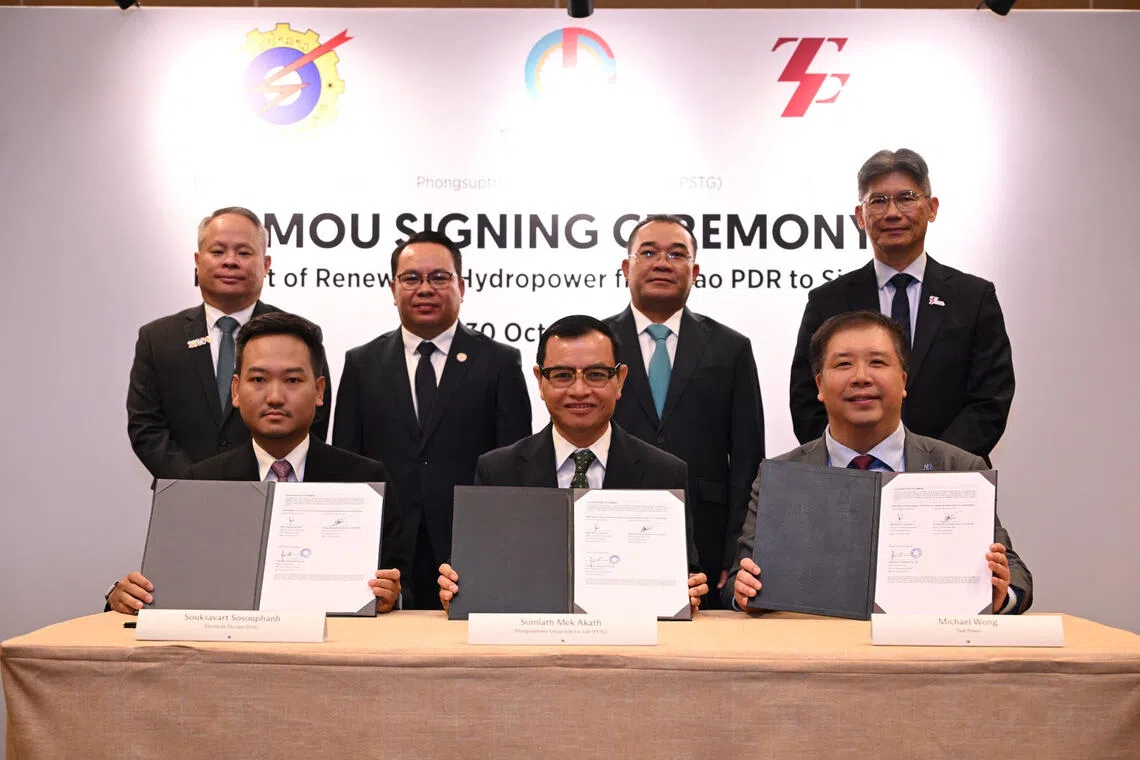
Signing of the memorandum of understanding between Tuas Power, Electricite Du Laos and Phongsupthavy Group to explore up to 500 MW of hydropower supply from Lao PDR at SIEW 2026.
PHOTO: TUAS POWER
Souksavart Sosouphanh, managing director of Electricite Du Laos, welcomed the opportunity to explore the collaboration between Tuas Power and Phongsupthavy Group, which is “a strategic developer of renewable and energy-mix power generation appointed by the Government of the Laos with the support of the Ministry of Industry and Commerce”.
He added: “Regional power trade in ASEAN has made good progress in recent years, and we believe deeper cooperation among likeminded partners can support a more integrated ASEAN Power Grid.
“We look forward to working together to examine how Laos’ hydropower resource scan contribute to the region’s energy needs.”
Somlath Mek Akath, managing director of Phongsupthavy Group, said the electricity will flow from the conglomerate’s projects in northern and southern Laos, noting that the key obstacle for the partnership will be securing the bilateral contracts that authorise the cross border flow of electricity.
The group’s chairman Phongsavath Senaphuan, added: “We recognise that hydropower is a seasonal resource, and we will work towards a supply profile that is transparent and deliverable, should the arrangement proceed.”
When fully scaled up to 500MW, the electricity imported under this proposal is more than double of the 200MW of permitted capacity under an existing power integration project involving Laos, Thailand, Malaysia and Singapore.
Launched in 2022, the Laos-Thailand-Malaysia-Singapore Power Integration Project involves exporting hydropower from Laos to Singapore.
That effort has been touted as a precursor to the ASEAN Power Grid, a regional power grid that aims to bring socio-economic growth and greener electricity to member states that need it, such as Singapore.
The first phase of the project led to up to 100 MW arriving in the Republic via existing interconnectors. Keppel was the firm that had been granted the licence to import electricity under the project.
Its renewal in 2024, however, was momentarily snagged by disagreements over how the energy was to be transmitted through Thailand and Malaysia, before they were resolved in January 2026.
Electricity imports are one pillar in Singapore’s straetgy to boost its energy security through a portfolio of energy sources. Conditional approvals have been granted to 13 projects to import 9.25GW of low-carbon electricity from Australia, Cambodia, Indonesia, Malaysia, and Vietnam.
Other energy sources Singapore is considering include geothermal and nuclear.
KioskNews shows a cleaned-up reading view extracted from the publisher’s page — the original always lives on their site, not ours.