My child just turned one: What nutrients do they need?
From the slides and swings at the neighbourhood playground to the shared toys and books at childcare, there is plenty for young children to discover as they enter their toddler years.
With every new experience comes more exposure to the world around them – including the germs they encounter along the way.
Between the ages of one and three, children’s immune systems are still developing, shaped in part by their interactions with microorganisms in the environment.
While parents cannot shield their little ones from every germ, everyday habits can help support their overall health. Alongside adequate sleep, active play and good hygiene, a balanced diet provides nutrients needed for normal immune function.
The toddler years also bring changes at mealtimes. As children move beyond their first birthday, they begin exploring a wider variety of foods – from fruits and vegetables to grains and protein-rich options.
What does gut health have to do with a toddler’s developing immunity?
When choosing what to feed a growing toddler, parents may naturally look for familiar nutrients such as protein, vitamins and minerals.
But supporting a child’s growth is not simply about packing as many nutrients as possible into their diet. It is also about understanding what their developing body needs at this stage.
One area researchers are studying is the gut, and its potential role in supporting the developing immune system. This has put the spotlight on ingredients such as milk oligosaccharides (MOs) that are derived from lactose.
MOs can serve as food for certain beneficial bacteria in the gut. Researchers are also studying how MOs may interact with the gut barrier and influence immune responses during early childhood.
This forms part of wider research into the relationship between the gut microbiome – the community of microorganisms living in the digestive tract – and immune development.
Probiotics are another commonly discussed part of the gut-health picture. These are live microorganisms that, when consumed in adequate amounts, may provide health benefits.
Certain strains have been studied for their potential effects on the balance of gut bacteria and digestive health, although the benefits can vary depending on the specific strain and formulation.
With high-protein diets and protein-enriched foods gaining popularity among health-conscious adults, it may be easy to assume that more protein is always better. But for growing toddlers, getting the right amount matters just as much as quality.
Protein remains essential for normal growth and development. However, research has linked excessive protein intake during early childhood with greater weight gain, highlighting the importance of providing high-quality protein in age-appropriate amounts.
For parents, the takeaway is a relatively simple one: rather than focusing on any single “star” ingredient, consider how a child’s overall diet provides an appropriate balance of nutrients to support their growth and development.
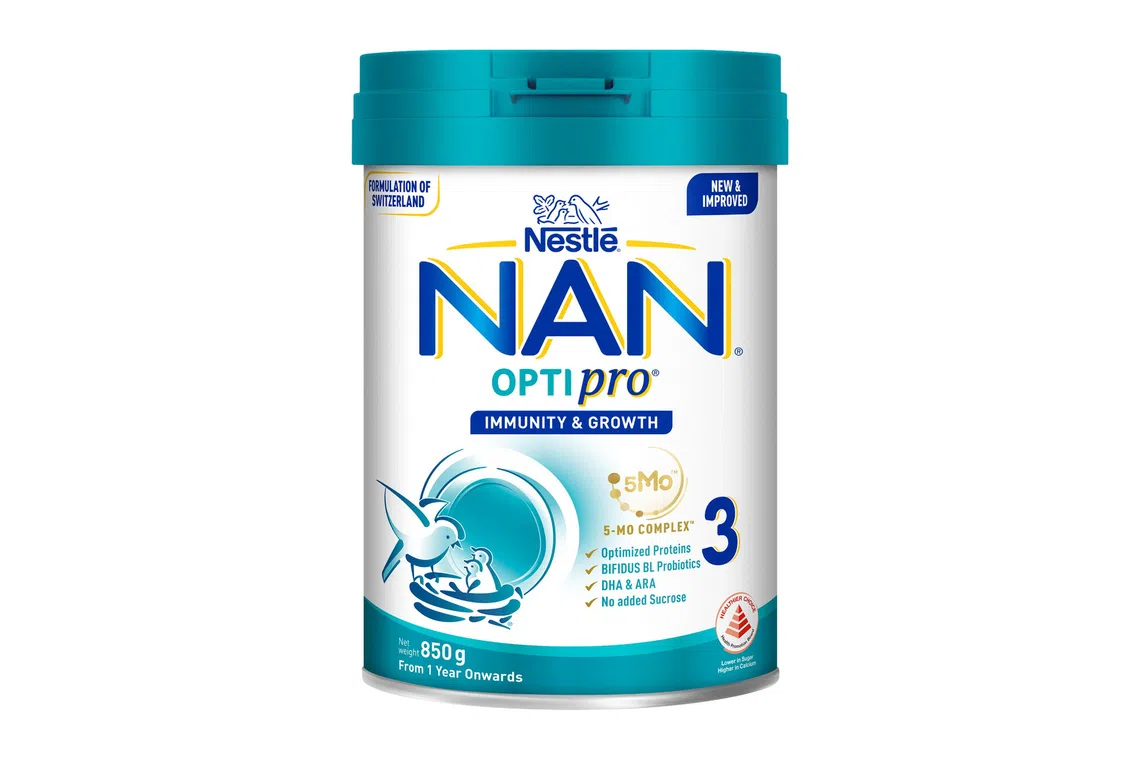
Nestle Nan Optipro 3 is a growing-up milk formulated for children from 12 months, with nutrients that complement a varied diet.
PHOTO: NESTLE
What to look for when choosing growing-up formula milk
For parents considering growing-up formula milk, reading nutrition labels can help them understand how a formulation fits into their child’s overall nutritional needs.
For example, Nan Optipro 3, formulated for children from 12 months, contains the proprietary 5-MO Complex, a blend of five milk oligosaccharides (MOs): 2’-FL, DFL, LNT, 3’-SL and 6’-SL.
It also contains Immunity Guardians, comprising iron, zinc, folic acid and vitamins A, B12, C and D, which together with the MOs, play various roles in supporting normal immune function.
Besides this, Nan Optipro 3 also contains optimised proteins and Bifidus BL probiotics to support growth and good gut health. Nan Optipro 3 contains no added sucrose.
Made in Singapore, Nan Optipro 3 undergoes more than 1,200 quality checks throughout the production process, according to the company, with quality and safety testing conducted at its Nestle Quality Assurance Centre.
As toddlers grow more independent, their nutritional needs continue to evolve.
No single ingredient can determine their immune health. What matters is the bigger picture: a varied diet, adequate sleep, physical activity and good hygiene that support healthy growth and development through the toddler years.
Find out how Nestle Nan Optipro 3 can help support your child’s immunity as part of a balanced diet.
KioskNews shows a cleaned-up reading view extracted from the publisher’s page — the original always lives on their site, not ours.