10 car brands in S’pore register fewer than 1 car a month; 4 dominate Jan-Sept sales
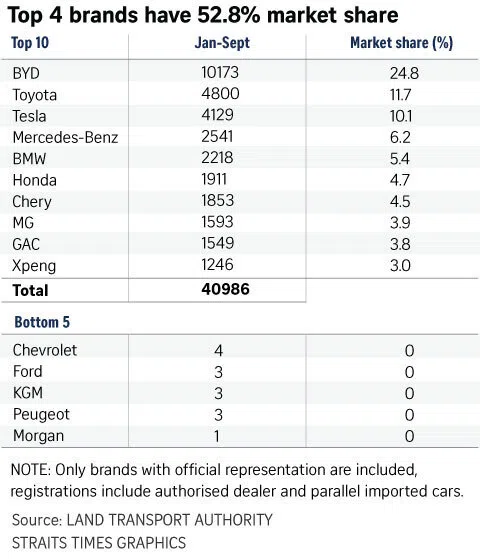
SINGAPORE – In an increasingly crowded car market, 10 of Singapore’s 57 car brands registered fewer than one car a month on average in the first nine months of 2026. At the other end of the spectrum, just four brands accounted for more than half of all new cars on the road.
Based on car registration data from the Land Transport Authority (LTA) on Oct 26, BYD, Toyota, Tesla and Mercedes-Benz were the strongest performers between January and September. The four brands accounted for 52.8%, or 21,643, out of the 40,986 new car registrations.
The remaining 47.2% is split among 53 other brands with official agents in Singapore.
While the bottom 10 brands include ultra-luxury and niche sports cars, such as Aston Martin and Lamborghini that are not expected to sell in large numbers, four are mass-market brands.
These are French brand Peugeot, American carmaker Ford and Korean brand KGM – which each registered three cars over the first nine months of 2026 – and Chinese electric car brand Skyworth that registered six units.
Some brands recorded no new car registrations in recent years. Renault and Mitsubishi did not register any new cars in 2024, 2025 or 2026. Chinese brand Seres, which entered Singapore in 2024, registered eight cars in 2025 but none so far in 2026.
This comes amid the influx of new car brands, many of them by Chinese carmakers. In 2024, there were 49 car brands with official representation that registered cars. This rose to 57 brands in 2025.
For the whole of 2025, 10 car brands registered fewer than 12 cars, five of which are mass-market brands. This was an improvement from 2024, when seven brands posted fewer than 12 registrations, of which three were mass-market brands.
A spokesperson for Wearnes Automotive, which represents Renault, said that the company is waiting for the carmaker to provide models for the Singapore market. For now, the multi-franchise dealership is selling Renault’s commercial vehicles, while continuing to support Renault car owners in repair and maintenance.
Industry watchers noted that the brands with low sales volumes are represented by larger companies with diverse interests or multi-franchise dealerships.
Seres, for example, is distributed by Hong Seh Group, an 80-year-old local business active in the commercial vehicle sector. It represents brands like Riddara and Farizon – both sibling brands under Chinese automotive group Geely – and DFSK, another Chinese commercial vehicle brand.
KGM, previously known as Ssangyong, is distributed by Motorway Group that has businesses spanning vehicle distribution, financing, retail and leasing. One of its subsidiaries, Motor-East, is an authorised dealer of BYD. It also owns Lion City Rental, a large car rental and private-hire vehicle leasing company.
Skyworth is distributed by Think One Group, an automotive group known for its commercial vehicle business, including the distribution of Yutong buses.
As for Peugeot, its distribution was taken over by multi-franchise motor dealer Cycle & Carriage in 2025, bringing it into the same showroom as Citroen from France and Leapmotor from China.
All three brands are from the Stellantis automotive group. Peugeot’s range of electric vans is among the stronger performers in the commercial vehicle segment.
Having other business interests help dealers spread the costs of representing brands with low sales volumes, said automotive consultant Say Kwee Neng, who headed various car distributorships in Singapore and Taiwan before setting up his own consultancy here.
He said that for most brand dealerships, a healthy aftersales operation – including vehicle servicing, repair and parts – can generate enough revenue to make a dealership’s business viable. Established brands have an edge, he added, because there is a larger pool of their cars on the road, translating into business for the aftersales business.
LTA’s records show that brands like Renault and Peugeot each had over 3,000 cars on Singapore’s roads at the end of 2025, while Mitsubishi had more than 16,000 cars.
Despite the low registration numbers of some existing brands, as many as six new ones are expected to enter Singapore in the coming months, industry sources said. This comes as car prices are elevated on the back of high certificate of entitlement (COE) premiums.
During the most recent tender on Oct 21, Category A COE, which is needed to register smaller and less powerful cars and electric vehicles, was priced at $132,004.
A mass-market car like the Toyota Corolla Altis costs $230,000 with COE before applicable discounts, higher than the $193,888 in October 2025.
KioskNews shows a cleaned-up reading view extracted from the publisher’s page — the original always lives on their site, not ours.