Economists see AI boom sustaining Taiwan growth, urge diversification
Staff writer, with CNA, BANGKOK


Economists attending the International Monetary Fund (IMF) and World Bank annual meetings in Bangkok said strong demand for artificial intelligence (AI) chips is boosting Taiwan’s economic outlook, but urged the country to use the boom to diversify its economy and mitigate market risks.
The IMF yesterday raised its forecast for Taiwan’s economic growth this year to 10.7 percent from 5.2 percent it estimated in April, making Taiwan the only economy projected to post double-digit growth this year.
Iyabo Masha, director of the Intergovernmental Group of Twenty-Four (G24), told CNA that Taiwan’s growth is being driven mainly by its semiconductor industry, which is benefiting from strong demand in the AI sector.
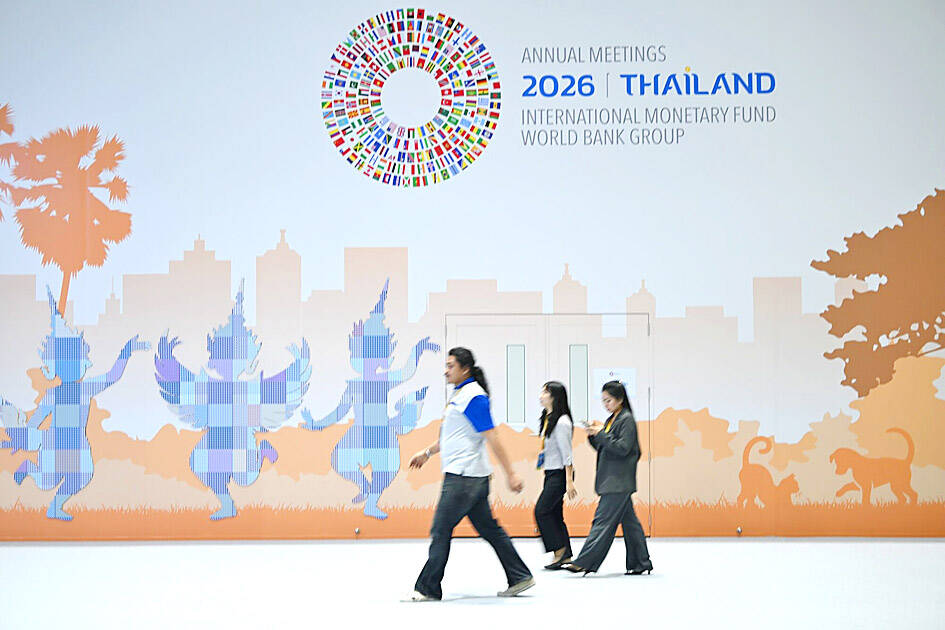
People walk past a signage displayed at the International Monetary Fund and World Bank annual meetings in Bangkok, Thailand, yesterday.
Photo: Sirachai Arunrugstichai, Bloomberg
She said the industry could continue expanding over the next two to three years, although growth might slow as the sector stabilizes.
Masha urged Taiwan to take advantage of the current economic expansion by using additional government revenue and other resources to develop industries beyond technology.
Eric LeCompte, executive director of Jubilee USA Network, a nonprofit organization that advocates debt relief for developing countries, said AI could help Taiwan and other economies achieve strong growth even as many countries around the world struggle economically.
However, he warned that overly optimistic expectations for AI could inflate asset prices and trigger a market crash if the technology fails to deliver the anticipated returns.
"I think the most important thing for the Taiwan government if they’re really going to hedge their risk or not be as concerned about the risks is they need to diversify how their economy is growing and they need to diversify their job sector," he told CNA.
While Taiwan is in a favorable position in the short term, LeCompte said, its long-term resilience will depend on how effectively it uses the current boom to strengthen other parts of the economy.
Emma Rafaelof, an economist at the US-based Semiconductor Industry Association, recently told CNA that she was optimistic about AI’s continued growth, adding that cross-border cooperation would be needed to capitalize on the trend.
She urged the US, Taiwan and other economies to work together to support AI’s expansion.
KioskNews shows a cleaned-up reading view extracted from the publisher’s page — the original always lives on their site, not ours.