Markets To Crash Before Diwali? Key Nifty, Sensex Levels, Trends Investors Must Watch

Share Market News: The stock market's festive mood may depend on whether the Nifty and Sensex can hold their crucial support levels. After a sharp correction from their highs, both benchmarks are trading near levels that have acted as a base during previous declines. This could open the door to a technical rebound ahead of Diwali. But if these levels break, investors may need to brace for further weakness.
According to Deep Himanshu Shah, Research Analyst at Shoonya, the Nifty is trading around 22,694, with support at 22,180. The Sensex is hovering near 72,939, with 71,600 serving as its key support level. These levels are important for investors looking to navigate the market during the festive season. While the current setup offers scope for a recovery, Shah believes investors should remain cautious and keep their exposure under control.
A sustained recovery will depend on whether the indices can defend these support zones and move past their immediate resistance levels.
Also Read | Layoffs Are Rising In Tech, But These Skills Are Helping People Unlock Better Pay
Nifty, Sensex: Key Levels To Watch Before Diwali
For the Nifty, 22,180 is the crucial support level, while 22,780 is the immediate hurdle. A sustained move above the latter could strengthen the recovery outlook. However, a decisive fall below 22,180 would weaken the technical setup.
For the Sensex, 71,600 is the key support. The index also has an upside resistance marker at 81,450 on Shah's weekly chart.
Investors should note that these are technical levels, not guaranteed turning points. A breach of support could trigger further selling, while a move above resistance would need confirmation.
Crude oil prices, global market cues, institutional investor flows and the upcoming earnings season could also influence sentiment around Diwali.
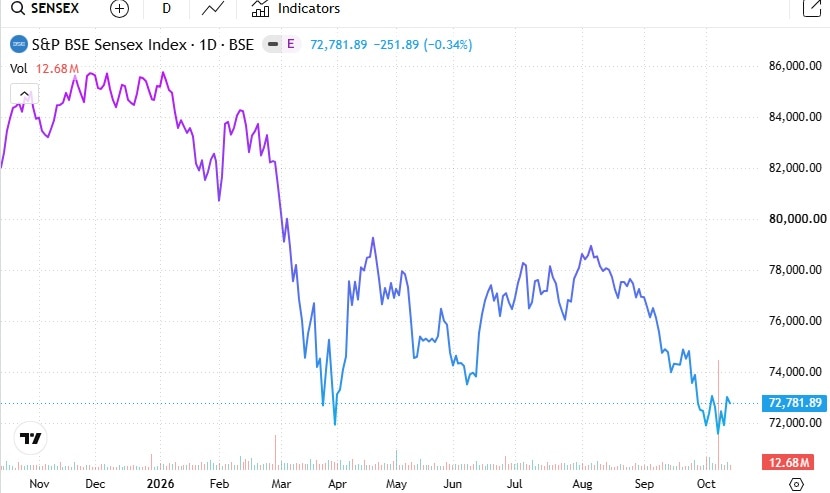
Sensex performance over last 1 year (Trading Economics)
Defence, Smallcaps Among Sectors To Watch
Beyond the headline indices, defence, smallcap and capital market stocks are among the segments Shah believes investors should track. The Nifty Mid Small Cap 400 is holding near its support level of 20,086, indicating resilience in the broader market. However, strength in select segments does not necessarily mean that the entire market has recovered.
Investors should also watch how rising crude oil prices and input costs affect corporate earnings. Cement, chemicals and automobile companies could face pressure on their margins if costs remain elevated and companies struggle to pass them on to consumers.
The focus, Shah said, should be on identifying businesses that are delivering sustainable earnings growth rather than stocks whose prices are rising mainly because of valuation-driven momentum.
Stocks that have run up sharply without a corresponding improvement in earnings may be more vulnerable when market sentiment turns.
Should Retail Investors Buy Stocks Before Diwali?
For retail investors, a market correction can create opportunities, but buying simply because prices have fallen can be risky. Shah recommends keeping position sizes small and deploying money in stages instead of investing the entire amount at once. This approach can help investors manage volatility and reduce the risk of entering the market at an unfavourable time.
Conservative investors can consider index exchange-traded funds (ETFs), which provide diversified exposure to a basket of stocks rather than concentrating investments in individual companies. However, diversification does not eliminate market risk. Index ETFs can also decline when the broader market falls.
Investors should align fresh investments with their financial goals, risk tolerance and liquidity requirements. Money needed for near-term expenses should not be exposed to short-term market fluctuations.
Diwali Trading Strategy: Keep Short-Term Bets Separate
One mistake investors can make during a volatile market is allowing short-term price movements to influence long-term investment decisions. Shah told NDTV that traders need to maintain clear risk limits and keep tactical positions separate from their long-term portfolios.
For long-term investors, the focus should remain on financial goals, business quality and sustainable wealth creation rather than daily movements in the Nifty or Sensex. Staggered investments can help investors spread their entry points over time. Quality stocks and diversified ETFs may also form part of a long-term strategy, depending on an investor's risk profile and investment horizon.
For traders, however, support levels and stop-loss rules are important. A decisive break below a key support should prompt a reassessment of long positions rather than an emotional attempt to recover losses.
{Note: Market levels cited in this report are based on weekly charts dated October 14, 2026, as provided by the analyst. The Sensex level of 81,450 is an upside resistance marker on the chart, not an immediate target.}
KioskNews shows a cleaned-up reading view extracted from the publisher’s page — the original always lives on their site, not ours.