As bad polling dims his parliamentary wins, Albanese faces a long summer of political heat | Tom McIlroy

Taking a victory lap after passing a slew of bills in parliament’s final sitting days for the year, Anthony Albanese said on Friday he was not contemplating major changes to Labor’s frontbench before the next election.
On the nose over the state of the economy and at a time when two-thirds of voters believe the country is heading in the wrong direction, Albanese is surely wondering how he can turn things around after the summer break.
But, barring any unexpected ministerial retirements in the next year or so, he ruled out a reshuffle as part of efforts to jumpstart Labor’s political fortunes.
“I am not envisaging that,” Albanese said. The kind of statement that is true right until the minute it’s not.
Days after revealing Labor’s campaign committee had already assembled to build a re-election plan for 2028, any indication of moving key personnel would be an instant distraction. Certainly, suggestions that senior ministers such as the treasurer, Jim Chalmers, or the energy minister, Chris Bowen, could be moved on seem impossible, especially for the methodical and considered Albanese.
But something has to give. On the latest polling numbers, Labor is deadlocked with One Nation, while Albanese’s personal approval ratings have taken a battering since the budget. Even usually down-in-the-mouth Coalition MPs think their side is cutting through effectively for the first time under Angus Taylor.
As Guardian Australia’s polling guru, Peter Lewis, observed this week, the chance for a summer break and a reset “can’t come fast enough” for the prime minister.
Labor risks making its own job harder in next month’s budget update. Expectations are building around a series of “substantial” cuts being promised by Chalmers, amid broad acceptance that the government’s big spending agenda is fuelling inflation. But the update is highly unlikely to be seen as the start of Labor’s fight back.
The effect of even substantial changes in spending will take a long time to flow through, and implied in dramatic cuts is a concession that Labor has spent too much in its first four and a half years in office. Government departments and popular renewables programs vastly exceeding their initial budgets look set to be pared back, and despite the ongoing energy shock, there is no room for additional cost-of-living assistance in the current climate.
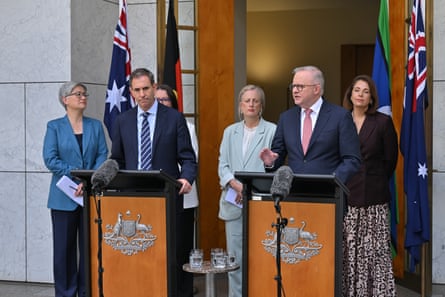
Chalmers conceded this week it was a very serious moment in the national economy, after inflation surged to 4.9% in the year to October, up from 4.3%, and as fears grow about a recession arriving sometime next year.
At least for Labor, the dire numbers saw economists rule out further interest rate increases from the Reserve Bank. NAB’s Taylor Nugent was among those expecting two rate cuts from the bank, with the possibility of a third if unemployment rises even further.
There was a small slice of good news for Chalmers on Friday: the government’s latest monthly figures showed the budget deficit is running $8.2bn smaller, four months into the financial year. The underlying cash deficit was $26.4bn so far for the year, better than the expected $34.6bn, due to lower spending and a higher tax take.
The May budget predicted the deficit for the year would be $31.5bn, but that was before Chalmers flagged serious savings in the package due about 10 days before Christmas.
New digital duty of care laws, changes to taxation arrangements for trusts, and big agreements with Singapore and Solomon Islands are all important deliverables for the government, but none are likely to move the needle politically. The new gas reservation plan may help with supply and prices, particularly through new obligations for over supply of the market, but the scheme isn’t due to commence for another year.
Albanese said the full ministry would meet before the end of the year and again over the summer, plotting next steps on important reforms and responding to choppy geopolitical waters. Interestingly, his commitment to deliver universal childcare should Labor win a third term appeared to soften slightly on Friday, perhaps in recognition of just how expensive and difficult the plan would be to deliver in the current climate.
If Taylor and the Coalition finished the parliamentary year strongly, it may be more to do with Labor’s performance than their own. Obsessed with incremental wins and trivia in parliament, the opposition demanded Bowen be sacked over the failure of the Cop31 climate talks in Turkey before being reduced to calling out a Labor “dibber dobber” in question time.
Any momentum Taylor was gaining was undercut by the defection of South Australian senator Leah Blyth to One Nation on Thursday. Despite warning colleagues that Pauline Hanson’s insurgent party was a danger to democracy, and then fumbling badly on key policy points, Blyth insists she is taking a principled position by leaving the Liberals. A frontbencher – albeit a low-profile replacement senator – jumping ship is no vote of confidence.
Blyth must be in part motivated by an unfavourable position on the Coalition Senate ticket for the next election, even if her main contribution to the polity of the country so far is giving big tobacco executives prominence in a key parliamentary inquiry, blowing up years of precedent in federal politics and health policy.
Hanson’s ragtag team looked a bit like a used car yard after Blyth’s arrival. Saturday’s Victorian state election will be key to maintaining One Nation’s drive towards the next federal poll, because defectors from the Coalition don’t exactly represent a breath of fresh air to voters who are angry with the major parties.
The parliamentary year ends in the flux that has existed for much of 2026, especially since the start of the war in Iran. For Albanese, the prospect of a much-needed reset may only eventuate after a long summer of political heat.
KioskNews shows a cleaned-up reading view extracted from the publisher’s page — the original always lives on their site, not ours.