AI could reverse political polarization with probability-based centrism
It could be a return to the monopole media of the 1950s, without the hard work or accountability
By Stephen Mihm / Bloomberg Opinion


Political polarization has become so extreme that when Democrats and Republicans find common ground on a single issue — like their shared hatred of AI data centers — it becomes major news.
Those data centers could also be mending the nation’s political divisions. The large language models people increasingly use are far from benign, but they are quietly — if unintentionally — promoting consensus in how and what the public learns about the world. For better or worse.
It seems impossible to think that such a thing could happen. Research and commentary dedicated to analyzing today’s fragmented media ecosystem have made it seem like people have reached the point of no return. Looking back at the roots of extreme political polarization underscores why the time might be ripe for a reversal of that trend.
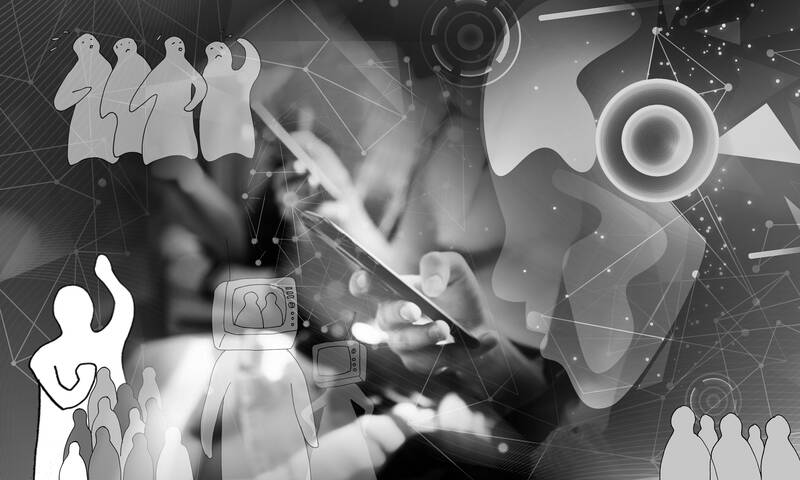
Illustration: Tania Chou
An ever-shrinking overlap between the two major parties began in the 1970s, but it intensified in the 1990s and beyond. Why that happened is the subject of longstanding debate, but one particularly compelling explanation traces the shift back to evolutions in the media landscape during that same period.
The rise of radio and television broadcasting resulted in a handful of stations and networks catering to a mass audience in the 1950s and 1960s. That meant the average person got much of the same information, even if there might be slight variations between outlets.
That era had legendary anchors like Walter Cronkite, who presided over CBS Evening News, building a brand based on overt neutrality. Such was the faith in this kind of media figure that Cronkite typically closed his broadcasts with a catchphrase: “And that’s the way it is” — as if there was no other version of the truth. This was problematic in that it tended to oversimplify reality, banishing dissident voices to the margins. As an antidote to polarization, it proved quite effective.
That manufactured reality fell apart in the 1970s, with the rise of cable television. Congress effectively removed barriers to entry in 1984 with the Cable Act, which allowed the number of cable networks to explode. Instead of three or four broadcast networks, Americans could seek out channels that suited their particular political and cultural sensibilities. By 1998, the US had 174 different national cable networks — it was 82 just six years earlier — along with thousands of local stations.
The rise of the internet only accelerated these trends, giving everyone with access to a computer the ability to go down various rabbit holes. The resulting amplification of conspiracy theories and other fringe ideas was bad enough before social media effectively obliterated any vestiges of a national common ground. Different platforms gave rise to a collection of adversarial digital tribes living in their separate realities.
Consensus and moderation prevailed when citizens relied on a highly centralized and homogenous group of media outlets. When that system was replaced by a multiplicity of outlets and sources, polarization intensified to dangerous levels.
Enter AI. Critics have said that the technology’s chatbots and models could sow disinformation, fueling polarization. Yet there is some evidence to suggest a different outcome.
People rely on the Internet for information. In the past, someone might Google a particular topic and then spend a long time clicking through links, searching for results that interested them or perhaps resonated with their own biases. Or they might turn to their social media connections, amplifying their own prejudices.
AI has upended that system. Increasingly, people are looking at what has been described as a “zero-click” future, where someone posing a query instead accepts an AI summary rather than exploring the cacophony of the internet. Or AI is relied on more directly, as when people pose questions to chatbots, which many often trust as much as, if not more than, other humans.
These developments represent a return to the spirit, if not the reality, of broadcast networks and moderating voices. This is inevitable, given the way that AI works.
Models are trained on vast collections of information in order to generate words and phrases. As such, they are probability machines, producing the likeliest answer based on training data. This means that chatbots and AI-generated search results tend to move to the middle, distilling an otherwise invisible consensus about any given issue. Answers come across as a reassuring, neutral and believable summary that comes across as the objective truth. Something like a digital Walter Cronkite. Little wonder that, even as Americans tell pollsters that they do not trust the “media,” they increasingly turn to AI for information.
A hint of where we could be going was captured in a report on election disinformation from the Brennan Center for Justice. It found that AI chatbots, far from amplifying fringe theories of election fraud, did the opposite, gently pushing back on these claims and banishing them. A study published in the Journal of Computer-Mediated Communication found that individuals who interact with chatbots about political issues tended to moderate their views.
That is all well and good, but we should not forget that AI models have a built-in bias toward conventional wisdom, not minority or fringe points of view. The public has been so conditioned to associate “fringe” with bad that we might forget those views can lead to a more equitable society. Many civil rights that we now regard as essential began as ideas far outside the mainstream.
As our reliance on AI grows, a decades-long drift toward polarization might reverse. The resulting consensus could come at a cost: a new kind of groupthink that is no less dangerous for democracy than the polarization it replaces.
Stephen Mihm, associate dean and professor of history at the University of Georgia, is coauthor of Crisis Economics: A Crash Course in the Future of Finance.This column reflects the personal views of the author and does not necessarily reflect the opinion of the editorial board or Bloomberg LP and its owners.
KioskNews shows a cleaned-up reading view extracted from the publisher’s page — the original always lives on their site, not ours.