James Talarico’s ‘love thy neighbour’ message won over Texas. Is Australia ready to embrace a new Christian left? | Brigid Delaney

There was a time, within living memory, when Australian Christianity had a definable and active left wing: Palm Sunday peace marches, guitar masses, priests coming home from far-flung missions with stories of liberation theology and, in the early 2000s, powerful and sustained activism against government policies of mandatory detention.
For the left wing of the church, Jesus was an anti-capitalist who smashed the tables of the money lenders and told a wealthy young man to sell his possessions, give to the poor, and follow him – for it was easier for a camel to go through the eye of a needle than a rich man to enter heaven.
However, by the mid-2000s, this flavour of Christianity went quiet, and for more than 20 years the loudest Christian voices in our politics belonged to the right.
In Australia, these decades saw the rise of individualism under Howard as his battlers filled megachurches, an ex-seminarian prime minister, Tony Abbott, who denied his party a conscience vote on same-sex marriage, and Scott Morrison with his hands raised at the Horizon church, practising the evangelical tradition of the “laying-on of hands” when visiting unsuspecting victims of trauma in evacuation centres.
While the two most recent popes – Francis and Leo – have been progressive, the Christian right has dominated the political space so thoroughly that it has become difficult to imagine what a Christian left may look and sound like, let alone how they might govern.
Then this month in the US, James Talarico, a progressive Presbyterian seminarian, won Texas for the Democrats and gave us a sense of how a new Christian left may animate politics.
Sign up for Guardian Australia’s Politics, really newsletter here
Talarico spoke of loving thy neighbour as thyself and welcoming the stranger in response to the Republicans’ anti-immigration stance.
He repeatedly cited Matthew 25 as scriptural authority for caring for the vulnerable, feeding the hungry, clothing the poor and caring for the sick. And he argued that policies like healthcare access and raising the minimum wage reflect the core teachings of Jesus.
In yoking the church’s teachings with policies that change the material conditions of the disadvantaged, he has created new excitement for the left and provided hope that the traditional distrust between progressives and religion might be thawing.
Maybe the two groups could find a common language, a path to power and a different way to govern after all?
But more than that, Talarico tapped into a collective hunger for a different kind of politics – one that has an older, more sturdy moral authority.
It is as poet Philip Larkin observed in Church Going “… someone will forever be surprising / A hunger in himself to be more serious.”
The yearning for a politics of moral clarity can’t be separated from our times, which are complex, cynical and frightening: global heating, AI, wars and growing wealth inequality.
In a time of disorder and leaders of dubious character, the re-establishment of a moral order offers something politics has struggled to provide for a long time.
The New York Times podcaster Ezra Klein, who had Talarico on his show in January, said what Talarico offers is something people seem to yearn for, “a language of morality, and even of faith, at a time of incredible cruelty”.
So would all this wash in Australia, after such a long stretch of prosperity Christianity in the halls of power in Canberra?
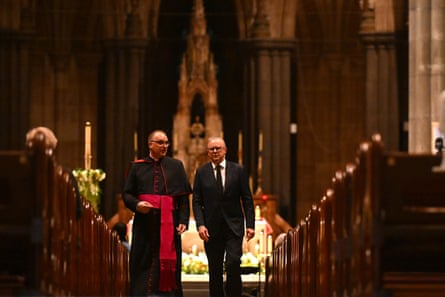
Currently on the Labor side, many of the party’s most powerful figures grew up in Catholic households and were educated in the Catholic system.
after newsletter promotion
The PM has previously cited (during his time as opposition leader) the parable of the Good Samaritan and said that “our care for others should be neither conditional nor transactional”.
But there are few overt displays of religiosity in Labor’s top ranks. Maybe there doesn’t need to be. Many of the Catholic church’s social teachings are baked into traditional Labor values such as care for the sick (Medicare), rights for workers (unions), and a social safety net.
There is an argument to be made that a traditional Labor agenda is by default an old-school leftist Catholic agenda due to the deep roots the church once had with the party.
(If you want to know more, Jeff Kildea has written about those once strong links between Catholicism and Labor and how they have been severed in recent decades.)
But such a debt to biblical ideals is whispered rather than shouted in Australia.
The end of sectarianism, the decline of relevance of the church and an increase in multiculturalism has seen the landscape shift in Australia.
Research by the United States Studies Centre noted that unlike the US, Australia is a largely secular nation where overt displays of religiosity in politics often make mainstream voters uncomfortable.
In Morrison’s case, overt displays of his Pentecostalism were greeted with discomfort (with questions raised as to whether people consented to be blessed by him) while Rudd’s forays into more explicit religious language with his long 2006 Monthly essay on Dietrich Bonhoeffer, Faith in Politics, was met in some circles with cynicism.
And then there is the reality. How many politicians can claim to live up to Jesus’s teachings in a real world where there are so many outside factors and competing interests? So many ways to be compromised?
KioskNews shows a cleaned-up reading view extracted from the publisher’s page — the original always lives on their site, not ours.