Centre expects 371 MPs to back delimitation bills, says Opposition concerns addressed
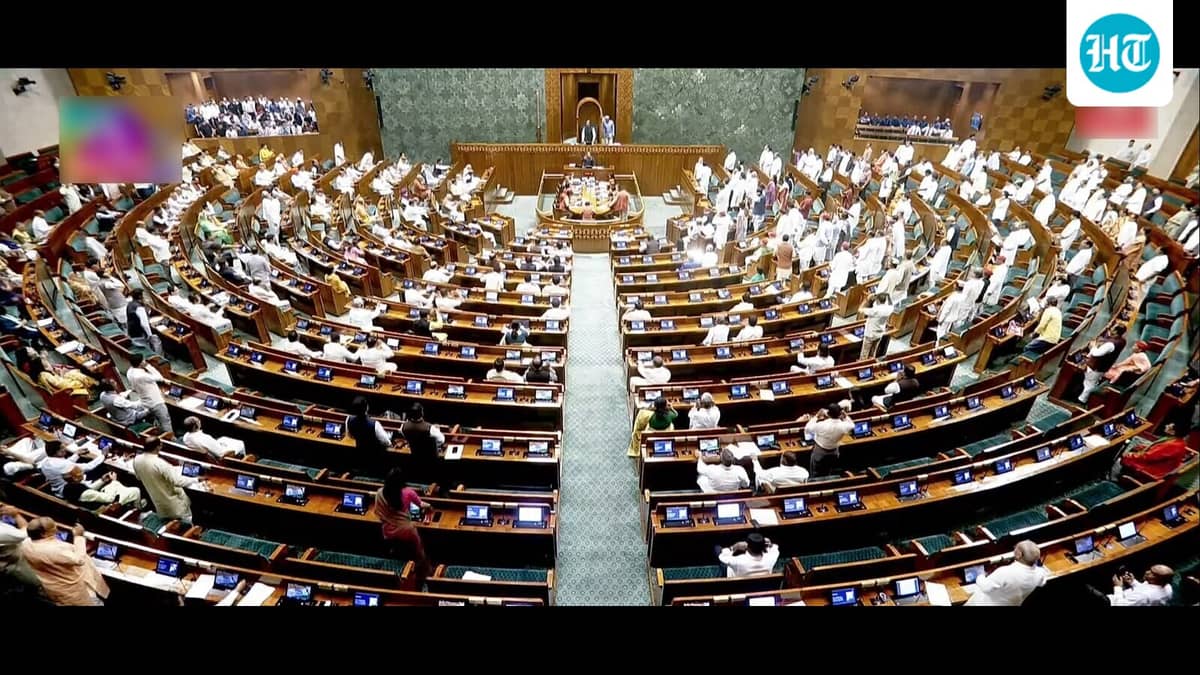
The Union government seems confident of securing the requisite number of votes to pass the Constitution Amendment Bill and the Delimitation Bill, even as the Congress-led Opposition renewed its efforts on Sunday to convince the Dravida Munnetra Kazhagam (DMK) to reconsider its support for the bills.
According to people aware of the details, the government expects at least 371 Lok Sabha MPs to support the revised bills which will pave the way for rolling out 33% reservation for women in legislatures by 2029.
According to a person familiar with the matter, there are three vacancies in the 543-member Lok Sabha, bringing the number of eligible voters down to 540. The government would therefore need 360 votes to pass the bill, which requires a two-thirds majority. The person said the government had the requisite numbers, with some to spare, indicating that the final tally could reach 371.
While parties such as the DMK (with 22 lawmakers) and the Nationalist Congress Party (Sharadchandra Pawar) (with eight) are on board, the government did not share details about the other parties that have signalled their willingness to support the bills.
The Jharkhand Mukti Morcha which has three MPs has also kept the parties guessing.
The government dismissed the Congress’s outreach toward the DMK—a last-ditch effort to prevent the party from supporting the ruling NDA—and said the principal opposition party has been misleading people about the bills’ provisions.
A government functionary speaking on condition of anonymity said an effort was also made to get the Congress on board, but the party remained defiant. “Significant efforts were made to engage with the Congress...” the functionary said.
He attacked the Leader of the Opposition in the Lok Sabha, Rahul Gandhi, for alleging that Chief Election Commissioner Gyanesh Kumar would head the Delimitation commission that will be set up for carving out new constituencies.
“The composition of the Commission has not changed since 2002. The chairman will be a serving or retired Supreme Court judge appointed by the Union government. The members will be the chief election commissioner or election commissioner nominated by the CEC... it is a 12-member commission which has laid down procedures to follow. The commission’s report will be tabled in Parliament and its working is transparent,” the functionary said.
In case of the Delimitation commission for states, the state election commissioner of that state will also be a member. Five Lok Sabha MPs and five MLAs of the respective states will also be associate members of the commission.
“The MPs will be nominated by the Lok Sabha speaker based on the strength of each political party in that state. The members in turn will be chosen by the party. Similarly, the state assembly speaker will nominate five MLAs based on party positions in that state. They hold extensive public hearings and then compile a report,” the functionary said.
In the case of states with fewer than five MPs, all lawmakers will be part of the commission; similarly in states with fewer than five legislators all legislators would be part of the commission.
Gandhi had alleged that the Union government was attempting to “capture” the proposed Delimitation commission through Kumar. He also said that the government wanted to give him a “blank cheque” to redraw the electoral map to benefit the ruling Bharatiya Janata Party.
The functionary said the commission’s report cannot be challenged in court but Parliament can reject it or seek an amendment to it.
The functionary went on to say that Articles 81 and 82 of the Constitution mandate the government to carry out delimitation from time to time. The process was delayed in Assam and carried out after 47 years owing to issues such as the influx of immigrants and insurgency.
“The Congress at that time had wanted the NRC and went to the Supreme Court..” the functionary said.
The delimitation commission is expected to submit its report within two years in time for the 2029 general elections.
On how the government managed to address the concerns of political parties about the proposal to increase the number of seats in the Lok Sabha by 50%, the functionary said the assurance that proportional representation would remain the same broke the ice.
“In April when the government tabled the bill the opposition was confused why the proposal of a 50% increase in seats was not incorporated. The government had assured all the political parties that it wants justice for all the southern states,” the functionary said.
The opposition parties were also assured that the southern states would get more seats (maintaining the existing proportion) and that the number of seats reserved for SC and ST candidates would also increase by 50%.
The government has also refuted All India Trinamool Congress’s allegation that the rebel MP’s could not be permitted to vote since the case pertaining to their disqualification is still pending. According to people aware of the details, these MPs can vote and as for those who are imprisoned, permission rests with the Lok Sabha speaker and the court.
“In the case of the 20 TMC MPs who have joined the NCPI [Nationalist Citizens Party of India], the speaker is following parliamentary procedure and precedent. There is no question of violating the whip as they have already quit the Party and the threat of disqualification does not apply to them,” said the functionary.
Regarding the timing of the exercise, the functionary said that if it had not been done now a new delimitation process would have kicked in after 2026, carried out based on the latest census and the southern states would have then lost seats. Delimitation is typically carried out on the basis of population and the geographical expanse.
KioskNews shows a cleaned-up reading view extracted from the publisher’s page — the original always lives on their site, not ours.