Calls for progress on Taichung airport
By Wu Liang-yi, Chang Hsuan-che and William Hetherington / Staff reporters, with staff writer


Taichung International Airport has struggled to keep pace with growing demand for tourism and business travel, while its joint military-civilian use has constrained efforts to expand the airport, legislators said.
The airport is a key gateway for more than 7 million people in central Taiwan. However, of the projects outlined in a development plan five years ago, only improvements to the existing terminal and construction of connecting and apron taxiways have been completed. Plans for a third terminal, remote aprons and an aerospace industry zone remain unrealized.
Taichung airport has more than 30 international routes. Passenger traffic surpassed 2 million in the first seven months of this year, with full-year traffic expected to surpass last year’s 2.75 million passengers.
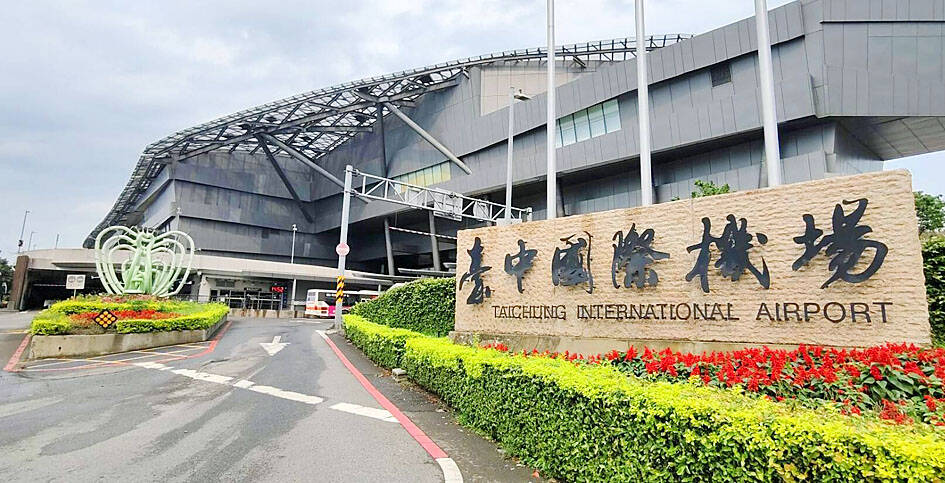
The Taichung International Airport is pictured in an undated photograph.
Photo: Taipei Times
Despite the increase in traffic, the airport has only two baggage carousels, with most international flights arriving in the afternoon. When two flights arrive at the same time, passengers might have to wait about 30 minutes to collect their luggage. Parking is also a major problem, with spaces difficult to find during long weekends and holidays.
Taichung airport is inside the Air Force’s Ching Chuan Kang Air Base, which is divided by the runway into eastern and western areas. The eastern area is used by the military, while civilian aircraft operate in the western area, although most of the land there is also owned by the air force. Restrictions on military land and difficulties developing the western area have become major obstacles to the airport’s expansion, legislators said.
Democratic Progressive Party (DPP) Legislator Ho Hsin-chun (何欣純), who is also a candidate for Taichung mayor, said that the airport should add more aircraft stands and baggage carousels in the short term.
In the long term, the central government should coordinate with the Ministry of National Defense over the allocation of military land and restrictions on military flight operations at night, she said.
The Ministry of Transportation and Communications and the Civil Aeronautics Administration should submit a development plan for Taichung Airport through 2045 by the end of the year, Ho said.
Deputy Legislative Speaker Johnny Chiang (江啟臣) of the Chinese Nationalist Party (KMT), who is also a candidate for Taichung mayor, said that the third terminal had already been included in the airport’s next phase of construction in 2019.
“The central government must clearly explain what is holding it up,” Chiang said, adding that it should coordinate the competing needs of national defense and aviation safety and present an implementable and trackable construction schedule.
DPP Legislator Tsai Chi-chang (蔡其昌) also said the government should assess options for adding parking spaces, building temporary parking lots or introducing transfer services, while accelerating the Taichung Airport Gateway Project.
Deputy Minister of Transportation and Communications Lin Kuo-hsien (林國顯) said that the civilian airport occupies only 30 hectares of the base’s land, or about 2 percent. The airport would need to expand into the western area to obtain sufficient space, he said, adding that the Civil Aeronautics Administration is working on the airport’s overall development plan through 2045.
Huang Tai-lin (黃泰林), a professor in the Department of Shipping and Transportation Management at Chang Jung Christian University, said that the Civil Aeronautics Administration might be considering a more balanced distribution of airport capacity between northern and southern Taiwan. Taichung and Taoyuan airports have relatively close airspace, while airports in northern and southern Taiwan are farther apart, potentially affecting the order in which projects are developed, he said.
Chaoyang University of Technology Department of Aviation director Lu Yen-liang (盧衍良) said that the development of Taichung airport is also constrained by its role as a regional gateway for central Taiwan, an aircraft maintenance industry cluster and a resilient backup facility, as well as the unique challenges of joint military-civilian use.
He recommended accelerating approval and construction of the Taichung Metro’s orange line, evaluating an elevated access road connecting the airport directly to a national freeway, and building multi-story parking facilities on public land around the airport.
The government should also begin planning and environmental impact assessments for a third terminal and improve operational efficiency, Lu said.
It could also capitalize on central Taiwan’s aerospace and precision machinery clusters to accelerate construction of an aircraft maintenance industrial zone, he said.
KioskNews shows a cleaned-up reading view extracted from the publisher’s page — the original always lives on their site, not ours.