Will the US midterm ‘blue tsunami’ erode China’s faith in Trump and Xi’s relationship?
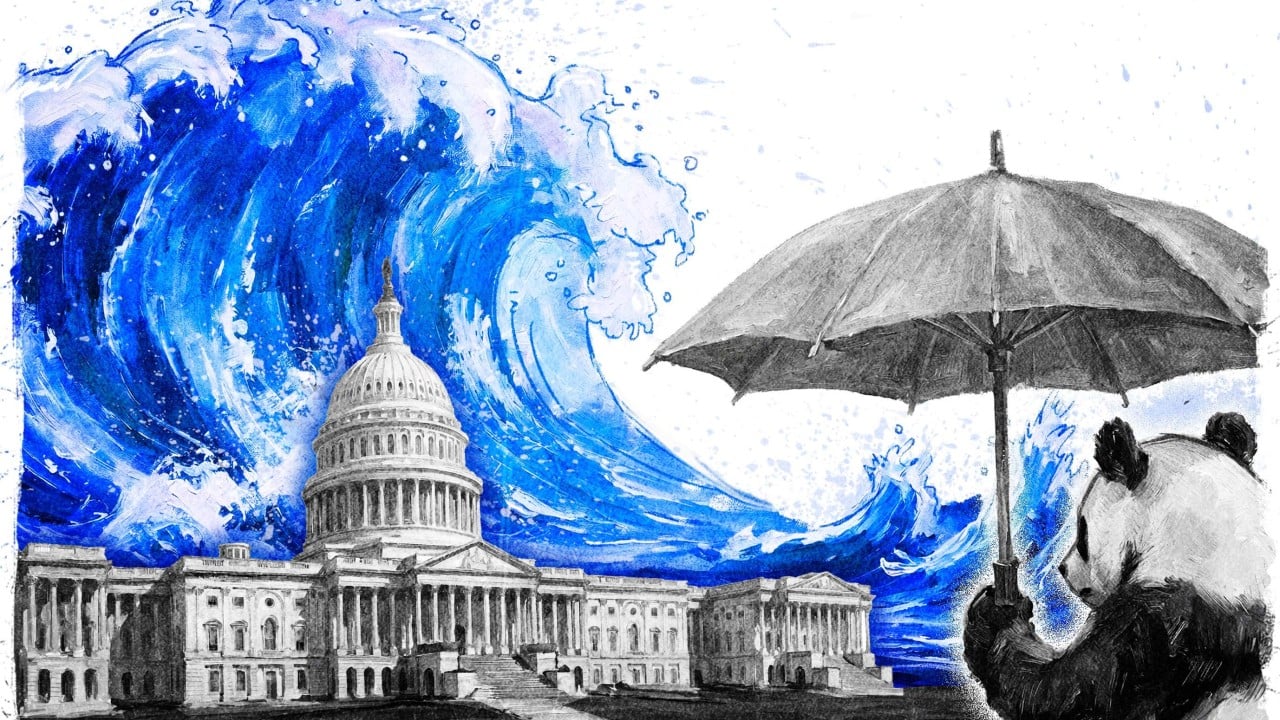
The Democrats’ majorities give them the power to block legislation, control federal spending and launch investigations into the Trump administration for the final two years of his term.
But the shift could test the efforts to stabilise ties that have seen Trump and Xi meet twice this year, with further meetings expected at the Asia-Pacific Economic Cooperation summit in Shenzhen next week and the Group of 20 meeting in Miami in December.
They could create various obstacles, poison the atmosphere of US-China relations, and sour the mood for these encounters
Xin Qiang, a professor and deputy director of the Centre for American Studies at Fudan University, said the Democrats could “make things difficult” ahead of these meetings.
“They could create various obstacles, poison the atmosphere of US-China relations, and sour the mood for these encounters,” he said.
Xin also said they could put pressure on Trump over Taiwan, which Beijing considers a red line in ties with Washington.
He said he expected Congress to press Trump to resume arms sales to Taiwan, which have been put on hold, and to push bills strengthening US military support for the self-ruled island.
“With the Democratic Party in control, Congress will almost certainly initiate more pro-Taiwan actions in these areas,” he said. “Given the constraints imposed by Congress, it is likely to become even more difficult for Trump to elevate US-China relations.”
Beijing views Taiwan as part of China and has never renounced the use of force to reunite it with the mainland.
The US, in common with most countries, does not recognise Taiwan as an independent state, but Washington opposes any attempt to take the island by force and is committed by law to supplying it with weapons.
SCMP Plus is a new premium news platform that gives you an
all-inclusive edge to stay ahead on China news.
To access our exclusive content you’ll need to subscribe.
Already a subscriber?
LOG IN
Zhao Minghao, another professor at Fudan University, said several newly elected Democratic lawmakers were staunch supporters of Taiwan who had called for stronger deterrence against Beijing over the island.
“Their entry into Congress is expected to elevate the focus on the Taiwan issue, likely leading to demands for the Trump administration to accelerate new arms sales to Taiwan and bolster US-Taiwan military and security ties,” he said.
Zhao said a Democrat-controlled Congress was also “set to accelerate measures – including new legislation – aimed at tightening export controls on advanced AI chips and semiconductor manufacturing equipment destined for China, as well as restricting investments in China’s chip sector”.
The Republican losses could also shape how Trump approaches his meetings with Xi. Trump has partly blamed the losses on the war in Iran, telling reporters that rising fuel prices driven by the conflict were the main reason, although he remained defiant about his decision to order the strikes.
Vice-President J.D. Vance has also attributed the Republican Party’s crushing defeats to the decision to attack Iran.
“The reason we lost is the war,” he wrote in a lengthy post on social media on Wednesday. “The president himself said so last night.”
Sun Chenghao, a fellow at Tsinghua University’s Centre for International Security and Strategy, said voter frustration over the high cost of living could push Trump to seek trade gains with Beijing when he met Xi, or give him grounds to lower tariffs and stabilise supply chains.
“With the cost of living having become a major point of pressure within the United States, Trump is likely to place greater emphasis on outcomes that can be easily showcased to voters, such as those involving agricultural products, market access and tariff arrangements,” he said.
Even with heavy Republican losses, Trump had not lost all his leverage with Beijing, Sun said, citing US advantages in markets, finance and technology.
“The erosion of Trump’s political capital primarily weakens his ability to convince the other side to trust his long-term commitments. He may place a stronger emphasis on reciprocal returns, raise his asking price or even employ tough rhetoric to deflect domestic criticism,” he said.
But once Democrats take control of Congress in January, they could scrutinise deals the White House has made with China and limit Trump’s ability to ease export curbs in exchange for commercial agreements.
“Therefore, China-US relations may see continued economic and trade engagement alongside deepening technology and security friction,” Sun said.
“The challenge ahead is turning the leaders’ consensus into policies that can be implemented on a sustained basis.”
[Trump is] not in a particularly favourable position to manage relations with Beijing
According to Fudan University’s Zhao, Trump is “not in a particularly favourable position to manage relations with Beijing” following the midterms.
“For its part, Beijing places great importance on maintaining strategic stability; however, defining the new parameters of the China-US relationship with Trump presents certain challenges.
“Factors such as the decline in Trump’s personal political authority and the checks and balances imposed by the US Congress will only add further complexity to the bilateral relationship,” Zhao said.
When asked about the elections, foreign ministry spokeswoman Mao Ning repeated Beijing’s line that it was a domestic matter.
She added: “China stands ready to continue working with the US to uphold and deliver on the important common understandings reached by the two heads of state, enhance communication, properly manage differences, expand cooperation, and build a constructive relationship of strategic stability on the basis of respect, fairness and reciprocity.”
Zhao also said: “I believe Beijing will also place greater emphasis on strengthening communication with the Democratic Party.”
02:53
US midterm elections: What the results mean for mainland China, Taiwan and foreign policy
Sun agreed that Beijing needed “to continue strengthening communication with both parties in Congress, as well as with local authorities and the business community”, adding that such contacts had helped distinguish lasting, substantive disagreements from rhetoric driven by elections or partisan politics.
But Sun said Beijing was likely to pay closer attention to Trump’s ability to deliver on his commitments.
“In the remainder of his term, Trump can still influence diplomacy, sanctions, export licences and military deployments. A decline in his political appeal will not eliminate these practical powers,” he said.
He added that the two sides should look to “refine the implementation” of the agreements they have already reached and clarify which items the US executive branch could deliver on its own and which required congressional funding or changes to the law.
“Furthermore … the relevant authorities, implementation steps and specific timelines should be clearly defined – thereby reducing the reliance on the personal relationship between leaders for the agreement’s execution,” he said.
Zhou Bo, a senior fellow at the Centre for International Security and Strategy at Tsinghua University, was more optimistic in his outlook, suggesting that while the midterm election results had “sent shock waves across the US”, the impact they would have on US-China relations was far less severe.
Major-power relationships such as China-US relations were not as fragile as people thought and possessed “inherent resilience”, the retired senior colonel in the People’s Liberation Army said.
“Most importantly, China today is not what it used to be; its national strength is on an entirely different level,” he added, arguing that Beijing could now deal with Washington from a position of strength.
Beijing, he said, could substantially step up the scope and severity of its countermeasures if Washington took actions Beijing considered unfair.
“At its core it simply means being evenly matched – a relationship where the two sides stand on roughly equal footing and possess comparable power,” Zhou added.
He suggested that the impact a Democrat-controlled Congress would have on Taiwan and future US arms sales to the island was also limited.
As China’s strength grows, Beijing possesses far more leverage and countermeasures to constrain Washington
“It is not that the US doesn’t want to sell, but that doing so will become increasingly difficult. The reason is straightforward: as China’s strength grows, Beijing possesses far more leverage and countermeasures to constrain Washington,” he said.
He also said that even if the Democrats tried to push Trump on arms sales, “I think it’ll be difficult for him this year because his schedule of high-level meetings is so packed”.
Zhou added that Trump needed stable US-China relations as part of his legacy, and while his negotiating position with Beijing might be slightly weakened by the midterm election losses, they would not fundamentally alter ties between the two countries.
Beijing, too, would adopt a wait-and-see approach, he said, adding that he expected no fundamental recalibration of its US policy.
KioskNews shows a cleaned-up reading view extracted from the publisher’s page — the original always lives on their site, not ours.