Slowdown calls deflate AI stocks
INTELLIGENT THREATS?: Several industry leaders called for a more measured and careful development of AI models over widespread concerns of misuse and harm
Stocks related to artificial intelligence (AI) fell sharply yesterday after the CEOs of the US companies developing the most advanced AI models warned the pace of development must slow to prevent threats to humanity.
Anthropic PBC CEO Dario Amodei, in a lengthy essay shared on social media on Saturday, called on AI companies to slow the rate at which they advance model capabilities amid mounting fears of AI misuse. OpenAI CEO Sam Altman and Elon Musk, who runs xAI, said that they agree with Amodei.
In Japan, shares in ChatGPT maker OpenAI’s investor Softbank Group Corp tumbled as much as 13.2 percent, and memory maker Kioxia Holdings Corp plunged 9.8 percent initially, while chip supply chain company Tokyo Electron Ltd fell 3.7 percent.
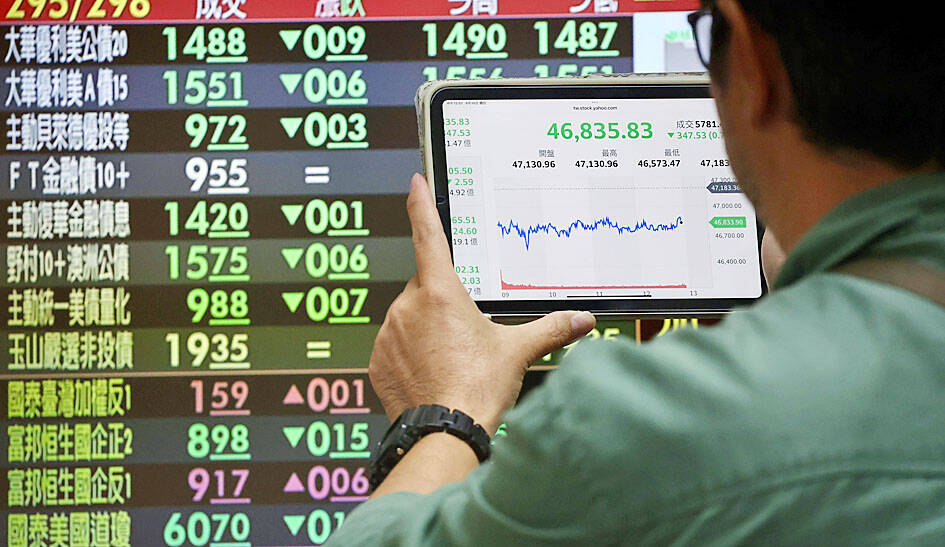
A man looks at a mobile device showing the movement of the TAIEX at a brokerage in Taipei on Thursday last week.
Photo: CNA
In Taipei, Taiwan Semiconductor Manufacturing Co (台積電) slipped 1.2 percent, while in South Korea SK Hynix Inc slid 5.3 percent and Samsung Electronics Co fell 3.7 percent.
“Selling pressure is likely to hit AI and semiconductor-related stocks in Tokyo following a series of weekend comments calling for a slowdown in the pace of AI development,” Sony Financial Group Inc senior economist Takayuki Miyajima said in a note. “Additionally, uncertainty surrounding the situation in the Middle East continues to weigh on sentiment.”
In Shanghai, memory maker ChangXin Memory Technologies Inc (長鑫存儲) dropped as much as 3.6 percent, while Semiconductor Manufacturing International Corp (中芯) fell 2.6 percent.
In Hong Kong, Zhongji Innolight Co (中際旭創) shed as much as 6.7 percent at one point, while MiniMax Group Inc (稀宇科技) dropped as much as 7.8 percent. Shares of Z.AI Co (智譜), the developer of the GLM AI series, tumbled as much as 10.5 percent after making a discounted share placement.
San Francisco-based Anthropic released a threat intelligence report on Thursday detailing how several actors had used its Claude AI models for activities ranging from weapons development and cyber operations to surveillance and fraud.
Alarm about the harm from AI grew when Anthropic researcher Jacob Coxon resigned, saying that the “people building AI earnestly believe that it could kill us all by the end of the decade.”
While several US lawmakers have raised concern about AI’s rapid progress and called for new rules, US President Donald Trump on Sunday likened AI critics to “very negative forces” bringing up scenarios that would not happen, and said he wanted to make sure that the US remains the industry leader.
China’s state-backed Global Times called the Anthropic essay a “Cold War playbook” in an editorial, one intended to curb the country’s technological development.
Some investors dismissed the warnings from Anthropic and OpenAI.
Michael Burry, whose prescient bets against the US housing market before the 2008 financial crisis were chronicled in the movie The Big Short, said in a message on social media the warnings were “hype and puffery” and “cover for real uncontrollable slowing growth.”
Others said the warnings would be an overhang.
“In the short term, these warnings could still weigh on AI and chip stocks,” Saxo Bank A/S chief investment strategist Charu Chanana said. “Their valuations assume both strong demand and a relentless pace of technological progress,” she said. “When expectations are this high, even a possible delay can trigger profit-taking.”
The bigger question for markets around AI was who would ultimately earn the return on all the capital being spent on building new capacity, T Rowe Price Group Inc portfolio manager Sebastien Mallet said.
“There is little doubt that AI will change the world,” he said. “But that does not necessarily mean every investment being made today will generate an attractive return.”
KioskNews shows a cleaned-up reading view extracted from the publisher’s page — the original always lives on their site, not ours.