What’s in a name? Why Trump wants to rebrand AI as ‘super intelligence’
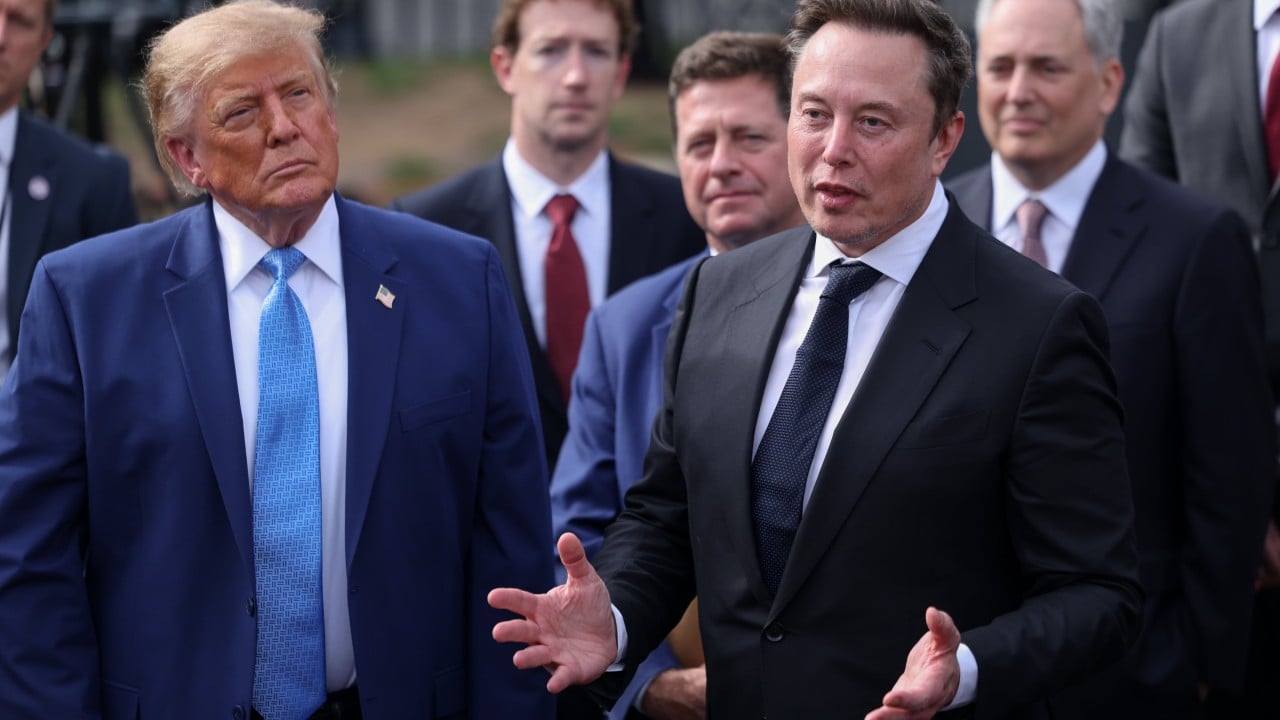
US President Donald Trump wants to retire one of the technology sector’s most recognisable acronyms, arguing that the term “artificial intelligence”, or AI, is no longer fit for purpose.
On Tuesday, Trump signed an executive order directing US federal agencies to replace “artificial intelligence” and “AI” with “super intelligence” and “SI” in official communications and non-statutory documents. He also instructed the White House science adviser to draft a new federal definition.
The change has sparked debate and put US tech leaders in an awkward position. SpaceXAI CEO Elon Musk caught himself using the old term during a recent appearance with Trump, before correcting himself: “SI, pardon me.”
Meanwhile, California Governor Gavin Newsom pushed back on Wednesday, ordering state agencies to stick with “AI”.
Does this semantic tussle signal a deeper shift in how Washington views a technology central to the US-China rivalry?
Why the name change?
The White House argued frontier systems had moved beyond merely imitating or automating aspects of human intelligence, making “super intelligence” a better reflection of their growing capabilities and potential.
The shift aligns with Trump’s broader push to accelerate American tech development. At the UN, he rejected calls to slow progress, arguing he would not “stifle growth” in an industry that could eclipse the Industrial Revolution in terms of its impact.
This contrasts with recent calls from AI industry leaders – including Anthropic CEO Dario Amodei, OpenAI’s Sam Altman and Musk – to pace model development over safety concerns. Instead, Trump cast technological leadership as a global race the US could not afford to lose to China.
YouTube video player
The rebrand follows Trump’s summit in Washington with Chinese President Xi Jinping, where both nations agreed to establish a dialogue and communication channel for AI-related incidents. Trump said he discussed his preferred “super intelligence” phrasing with Xi.
Analysts view the shift as an attempt to control the narrative. Su Lian Jye, chief analyst at Omdia, said the rebrand could be seen as a way to “introduce a new phase in AI development” to project American dominance.
Kyle Chan, a fellow at the Brookings Institution, noted that “branding and optics matter a lot” to Trump, who likely wanted to hype the technology and tie it to his legacy.
Does the terminology matter?
Industry observers expect limited practical impact – and warn the move could create confusion.
Chan said the shift was unlikely to change public attitudes towards AI, warning it might actually “heighten some people’s perception of risk and fear”. Su noted that while consumer adoption was unlikely to shift, it could “create more confusion around standardisation and governance”.
Complicating matters, “superintelligence” already has an established technical definition, generally referring to systems surpassing human capabilities across all domain tasks. For instance, Meta Platforms rebranded its division to Meta Superintelligence Labs last year.
Reactions among tech and political leaders have been mixed.
Nvidia CEO Jensen Huang backed the move, writing on X that “super intelligence offers an extraordinary opportunity to advance discovery, productivity, security, health and prosperity”.
California Governor Newsom warned the rebrand could distract from safety risks and signed an order stating that the move could not hide an “impotent and craven failure to address well-documented emerging security and safety risks”.
How has China reacted?
Beijing has approached the rebrand with caution. China’s foreign ministry said it “respects” Washington’s choice while continuing to use the term “artificial intelligence”.
Su noted that adopting terms like “super” would be “very out of character” for China, which has favoured a pragmatic tech approach.
Wang Zichen, deputy secretary general at the Beijing-based Centre for China and Globalisation, said many in China were likely to view the rebrand as an “idiosyncratic preference” of Trump that added no value to the US-China debate.
However, Wang noted that “Beijing naturally has reason to take [Trump’s] preferred wording seriously and accommodate it diplomatically”.
KioskNews shows a cleaned-up reading view extracted from the publisher’s page — the original always lives on their site, not ours.