This Gen Z Actor From Azerbaijan Is Awards Season’s Biggest Surprise
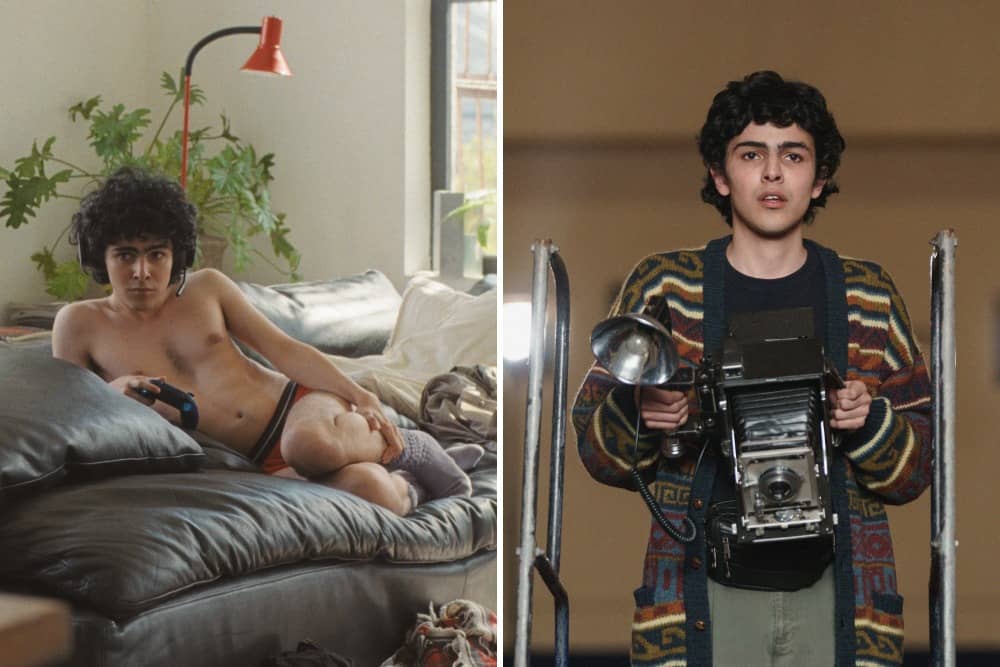
Eldar Isgandarov is this awards season’s unlikeliest success story.
The Azerbaijani actor’s first two professional acting roles ever just happened to be in a pair of A24 films that are garnering critical raves (and awards buzz): “Club Kid,” Jordan Firstman’s feature directorial debut about a gay, drugged-out New York City party promoter (Firstman) thrust into the position of caring for the young son (Reggie Absolom) he never knew he had; and Jesse Eisenberg’s “The Debut,” a surreal screwball comedy about a neglected housewife in the Jersey suburbs (Julianne Moore) who decides to audition for a local community theater musical and clashes with its domineering director (Paul Giamatti). In the former, Isgandarov steals every scene he’s in as Nicky, a layabout twink/aspiring queer philosopher who crashes on Firstman’s character’s couch until he’s foisted onto his eccentric neighbor (Colleen Camp), eventually posing as a straight guy in order to marry her. “The Debut,” in theaters Dec. 11, sees him embody Piotr, the musical’s assistant director and friendly foil to Giamatti’s tyrant.
None of this feels entirely real to the 25-year-old Isgandarov. Born in Azerbaijan to a news anchor mother and diplomat father, he was raised in The Hague and Brussels, and graduated from the Savannah College of Art and Design (SCAD) just two years ago. Acting does run in the family — Isgandarov’s grandfather, Shahmar Alabarov, is a renowned actor and director in Azerbaijan. “He died of cancer when my mom was 20, so I never actually met him. But I grew up hearing a lot about him and seeing his movies,” he shares.
Isgandarov is soft-spoken, bashful and utterly charming; it’s no surprise Hollywood’s top casting agents and filmmakers are drawn to him. As if this one-two punch out of the gate weren’t enough, he’ll next star in another A24 film, Molly Gordon’s “Peaked,” alongside the likes of Gordon, Emma Mackey, Connor Storrie and Dua Lipa; and “Reenactment,” opposite Cameron Diaz, Benicio Del Toro and Ana de Armas.
Over coffee, the in-demand actor opens up to Variety about his rapid ascent.
What an amazing first two professional jobs.
A double feature! Both A24 and “Peaked” by Molly Gordon, which is also A24. There was a time when that seemed so untouchable, and now I’m doing all the A24s. Back in college, we were all fans of A24, and it was seen as the cream of the crop. That’s just not something you usually get to and was so out of reach — and now I’ve done two, and a third one is coming.
What A24 movies gave it that mystique for you?
There are so many. “The Witch.” Obviously “Moonlight.” Of course, “Everything Everywhere All at Once.” That was like, whoa. For me, coming from Azerbaijan, it made A24 more global.
You were born in Azerbaijan but grew up elsewhere, right?
I was born there, but I moved to the Netherlands when I was six years old, and then I moved to Brussels until I graduated from high school. My dad was a diplomat from Azerbaijan.
Was going from Azerbaijan to Europe an adjustment for you?
Not so much in the Netherlands but moving to Brussels was. I remember my first year in Brussels, there was a kid in class who was very annoyed that I had “girly” eyelashes, since apparently my eyelashes were too long for him. It was an international school, but there weren’t that many people of color there. There was a good Asian demographic, but they were very much cast out because people thought they couldn’t have fun — that classic stereotype. It wasn’t straight-up bullying, but there were a lot of microaggressions. I wasn’t affected as much by it because I was sitting at home playing video games all day and removed myself from it.

Did people make fun of your name? I got a little of that growing up.
People would say, “You’re the Eldar tree.” It was weird being from Azerbaijan because they had no idea what it was!
When did you know you wanted to be an actor?
I did school plays in the Netherlands like “Arabian Nights,” but I didn’t really lock in until I was in middle school in Brussels and I did “The Jungle Book.” I played the younger Mowgli. I didn’t know what I was doing onstage, but I was in a little [loincloth] and there was a rope that I had to swing across the stage. It was so much fun and then I joined performing arts classes.
Growing up, I didn’t see a lot of people that looked like me onscreen. Did that make the dream of becoming an actor seem far away for you?
Yeah. Besides just how I look, I think I hadn’t seen emasculated men onscreen. I feel like everyone I saw was very macho. It just didn’t click for me until I saw “Mysterious Skin” and “Call Me by Your Name,” and I thought, oh, you can be this lanky little weird guy who cries onscreen. Something resonated there. In terms of how I look, it was hard to resonate with any male characters, so I resonated with a lot of female characters. Maybe I saw more diversity among women. When I saw “Orange Is the New Black,” I was like, oh my god, you can really create an ensemble with all these different people and have it feel natural and intentional. After that, I started to have hope.
What was it like going to college at SCAD and having that be your introduction to the U.S.?
It was very interesting because I had no idea what the “South” experience would be like. When I first landed in Atlanta, I was in this airport hotel room with a popcorn ceiling and walls, and I was on the phone with my mom having a panic attack, like, “What am I doing? What have I done?! I could have just stayed!” But as soon as I got to Savannah, it was nice.
Did you go to SCAD to act?
I had an eye on that. I did a lot of theater in high school, but it took me two years to persuade my parents to want to do acting, and we struck a deal where I would focus on the production side of film and TV, and SCAD was the perfect selling point because it’s very industry-focused as opposed to just the conservatory. My first two years, I was just connecting with animation, fashion, advertising and photography people and didn’t have a lot of actor-friends. And then my last two years, I started preparing for Acting Showcase, where you audition and the performing arts department picks twenty students for basically a troupe. I got my managers from Acting Showcase.
How did you go from there to landing a role in “The Debut?”
It was about half a year of auditioning, and my managers were sending me five auditions a week, and I met a lot of casting directors. I ended up graduating in November 2024 but had gotten my managers in May since that’s when we did the Showcase, so the whole period between May and November I was auditioning a lot. And then December is when I heard about “The Debut” and I auditioned for it. There was no callback, they just liked the tape and I was like, “Damn!” Because when we shot the audition tape, my sister was the reader and she was like, “Um… I don’t think you’re getting this one,” and I agreed with her! It was a horrible audition where I started laughing halfway in, but I had experience as a director’s assistant and was recreating my mom’s accent.
Where did your experience as a director’s assistant come from?
In high school they had this Brussels-Broadway mashup of songs. I didn’t get in but my theater director felt so bad for me that he made me a director’s assistant who would go and get him coffee, and so “The Debut” is very true to life for me. I lived it!
What were some big auditions you went out for in those months of ‘round-the-clock auditions before you landed “The Debut?”
Oh… I really wanted to do “Phony,” which is now streaming. I read the script and thought it was such a cool concept and fantastic writing. That was a big one for me that I was sad about. And I auditioned for Heather Basten in the U.K., who did “The End of the F***ing World,” and she did this audition for this movie called “Animol,” about a group of boys at a juvenile detention center. That one I really wanted to get.
It is pretty wild that you made your screen acting debut in a movie called “The Debut,” playing a character whose job you used to have.
And Mona, Julianne Moore’s character, is me, in a way.
What was your reaction like when you got “The Debut?”
When I first got the call that “they might offer it to you,” I was going into “Nosferatu.” And I liked “Nosferatu,” but all I could think about was this offer that I might get. I told my parents, “It might be on the table, but we’re not sure yet!” And then I got a call a few days later. I was in Switzerland, where my parents were living, and the apartment complex had a rooftop area. I would run up there whenever I got calls because my parents were too curious. So, I run up there and it’s dark, and there are my bugs flying all around me, and they told me they were going to offer it to me. I came down, told my parents, and they went crazy. But I still hadn’t signed anything until I came to New York two or three weeks before filming “The Debut,” which was in April, and that’s when I felt like I got the role. I kept thinking, “What if they recast? I haven’t signed anything! What if they go in another direction?!” That had happened so many times to me. It just didn’t feel real… And it still doesn’t feel real!
What was it like for you to have your first role be in a film by an Oscar-nominated filmmaker alongside two of the finest actors around in Julianne Moore and Paul Giamatti?
They threw me right in there! The first day was like Disneyland. I was like, “Where am I right now?!” And my first day was the mocha scene where Paul Giamatti gets mad at me because I got the order late. So, I’m waiting outside this door which leads to this rehearsal room in the film, all the theater cast is there, and [Julianne’s character] gets shouted at, and then the room is in complete silence as I come out, waiting for my line, which is three words. It was terrifying! I almost shit my pants, basically. And Havana Rose Liu was so kind, just hyping me up as we hung out between takes. She really helped me get through those initial scenes. But having that be the first scene made everything else easier, since it’s such an intense moment. It was all very meta. And I was playing the assistant director who helps out the cast and is kind of the outsider in the whole thing, and I was the outsider, so it fit really well.
Your character is a very kind, welcoming presence for Julianne Moore’s Mona.
And Julianne was very much that way to me on set. We bonded and talked about so many things. It made it easier. It felt like I could talk to her with a level of respect, because the characters have respect for each other, but there’s also a degree of authority since my character is the assistant director — and how do you do that when you’re acting off Julianne Moore? You have to balance yourself and not think, “Oh my god, I’m the new one! I’m not as good as everyone else!” You can’t let those thoughts get in there.
How did “Club Kid” come to be?
A few months after “The Debut,” I auditioned for it through my manager, and it was also Topic Studios, who did “The Debut.” Jordan saw my original tape and said, “But I want him to do it with an accent!” So, I did it with an accent the second time. He said something in an interview recently that I thought was funny and I kind of confronted him about it. He said that when he heard me audition for the first time for “Club Kid” he wanted me to do it in my “normal accent,” or the Eastern European accent my character uses in the film. And I was like, “What are you talking about? My accent isn’t like that!” I know it slips up sometimes, but I don’t just have an accent.
But it was nice because while I think both of those characters are so different — Piotr is kind, generous and giving, and Nicky is kind of the opposite, a little bit of a parasite — they can totally exist in the same [dimension]. If you believe in the “Everything Everywhere All at Once” theory of how your pathway can go any way, it’s like something happened, and it’s the same person in different universes. It’s fun playing queer characters, but I want to do more characters that have a story arc, which is why I really like “Club Kid” because it’s such a trope, but it’s the best trope where he goes straight and thinks he’s straight.
Were you able to make any festival premieres for “Club Kid” and “The Debut?”
New York Film Festival was my first for both of them. It was so funny. I came to the “Club Kid” premiere and it was my first time, and then “The Debut” felt like déjà vu. The whole time I was thinking, “Wow! I’m at Alice Tully Hall the same year that Cameron Winter is debuting his Carnegie Hall performance” — so that’s where my brain was going — “as well as ‘You Can See Everything.’” It was a cool year to be at New York Film Festival.
How did your experience working on “The Debut” with a director making his third film and a cast of seasoned actors compare to working with a first-time filmmaker on “Club Kid?”
With “The Debut,” the way Jesse writes doesn’t leave a lot of space for improv, at least not for my character, because the tone is so clear. “The Debut” feels so elevated, in a way, and there’s an absurdity to it. We rarely did a second take; and with Jordan, it was the opposite where it felt a little bit like improv school — we would do two takes in the script, and then we would just play and throw stuff on the wall to see if it stuck.
Were there any big improv moments for you in “Club Kid?”
Oh, so many moments. The scene where I’m arguing with Jordan and say I’m an Azerbaijani queer philosopher wasn’t supposed to be as big. I was supposed to just say it, he gets annoyed, and then I get annoyed, but we improvised the whole part where I try to grab him and attack him. And a lot of the stuff with Colleen Camp was improvised. You could give Colleen and I one day to film something, and that will be enough. It would work out somehow.
I’m ready for a spinoff with you two.
And we’re ready too! I would love that. The issue is that I could not stop laughing all day. It’s impossible not to laugh with her. She just does stuff that is so funny. But both projects were very fun to work on because they’re both stuff that I like to do. “The Debut” is so absurd and there’s a theatricality to it similar to what I’ve done in theater, and at the same time I love very stream-of-consciousness, naturalistic type of stuff, and Jordan’s film really reflects that. I got the best of both worlds.

After you landed “The Debut,” were your parents like, “We know we sent you to SCAD to be behind the scenes, but we are now onboard with the acting thing.”
Yes. They started getting onboard slowly — when I got into Showcase, then when I got my managers — but it was really “The Debut” that cemented it all. They let me do what I wanted to do, but they were very real about the situation and didn’t sugarcoat it. I didn’t grow up in an environment where they were hyping me up and a lot of the time, I didn’t want them to see the plays I was in in middle school or high school because I was too embarrassed. I wasn’t spoon-fed this thing of, “Oh, you’re great!” A lot of it was very discreet. They actually just saw “The Debut” and I think it’s probably the first time they’ve seen me act since “The Jungle Book” because I didn’t send them my Showcase performance. I just always thought they’d see through me because they know me so well, but they loved it.
When did you land an agent?
I only got agents this summer, two years after I got my managers, so it was after “The Debut” and “Club Kid,” and actually after the Molly Gordon film “Peaked.”
Can you tell me about “Peaked?”
I’m not sure how much I can say, but in “Peaked,” Molly Gordon and Emma Mackey play these girls who are just reaching 30 and it’s their 10-year high school reunion, but they’re not invited to it because they were the mean girls. They represent the millennials and me and Levon Hawke represent Gen Z. We clash and I play [Molly’s] brother’s best friend. I love that script.
And you have the film “Reenactment” coming up as well. You are booked and busy.
Yeah! That one is filming in January in LA. It’s been delayed so much, but now it’s locked and loaded and we’re going to get it done. It’s with Benicio Del Toro and Cameron Diaz, and it’s gone through various ups and downs, but I’m very excited because it’s more of a thriller. I totally get him, but it will show a completely different side of me.
How does this ride that you’re on feel? Your first two movie roles are in these big awards-season movies.
I knew they were going to do well, but wow, they’re doing well. It’s weird because I have my moments where I step out, put my headphones on, and pretend like I’m in my own world in New York — I’ve been living in Bushwick for two years now — and can step back and reflect on the journey, but also a lot of the time I like locking in with friends in my personal life and giving them my time.
Trying to strike a good balance.
It’s weird. I’m trying to balance this thing and what’s going on in my own life. It’s all great — there’s no drama — but I’m in this Bushwick apartment with a roommate who I’ve known since Savannah, and I’m on the first floor, so when you go to bed at night you can hear the rats in the wall. Bushwick just doesn’t have enough trees for me.
Speaking of “Club Kid,” have you gone clubbing in New York?
I have, but not enough. I’ve been to House of Yes, Nowadays, Elsewhere, Basement, Purgatory — a lot of good ones. We just had an official screening for “Club Kid” and I kept getting asked, “What are your top four clubs?” And I was like, “I’m not the best representative for this! I spent my nights sitting at home playing video games or listening to musicals.”
What video games?
I’m not a big fan of first-person shooters but I love a good story, so a first-person shooter game I enjoyed because I liked the story was “Far Cry.” I’m a big Rock Star fan and am so excited for “GTA 6.” But I love a lot of indie games, too. As a kid, I loved “Life is Strange.” I love episodic games, choose-your-own-adventure type of stuff.
They’ve got to get you to voice some video game characters.
Oh, please! And my favorite-ever game that got me into the storytelling aspect of games was “Beyond: Two Souls” with Elliot Page. It changed my perspective of what games could be, and even thinking about it now blows my mind.
Beyond voicing a video game character, are there certain types of projects you’re keen to do as a young star on the rise?
I would love to work with Joachim Trier, who did “Sentimental Value.” I love “Sentimental Value.” I’d love to do theater again. I haven’t done it in a while, and this is the place for it.
How are you liking living in New York City?
I was recently in Kensington, and there’s something about the Soviet aspect of it all — Eastern European supermarkets — that felt very comforting. I ordered a Soviet bologna in Russian, and it was so natural, like, “Oh, I can talk to these people.” I’m getting to like New York more and more by the day. But I do still love a good town. There’s something in my DNA, maybe with moving to the Hague when I was young. I like it, but I also need some little-town time.
KioskNews shows a cleaned-up reading view extracted from the publisher’s page — the original always lives on their site, not ours.