Leading US brain scientist Doris Tsao joins Chinese university that has not been built

After spending most of her life in the United States, leading neuroscientist Cao Ying – better known as Doris Y. Tsao – has decided to leave California’s prestigious UC Berkeley at the peak of her scientific career for a new Chinese research university that has not yet been built.
Unlike most Chinese scientists who moved to the United States as adults, often not until their PhD, Cao Ying – better known as Doris Y. Tsao – received an American-style education from an early age after emigrating to the US as a four-year-old.
She grew up in Maryland, went to college in California and received her academic training and much of her early fame at Harvard. Outside the laboratory, she played the violin, enjoyed cooking and listened to classical music.
In an eyebrow-raising notice released on November 19, the Tsientang Institute for Advanced Study (TIAS) – the organisation responsible for establishing the new Tsientang University – announced that Cao Ying had begun recruiting for her yet-to-be-built laboratory in Hangzhou.
According to an on-site investigation by local media in January, construction of Tsientang University – which is backed by a 40 billion yuan (US$6 billion) pledge from Zhong Shanshan, one of China’s richest people – is ongoing and the first phase is expected to be completed by 2028.
In her new role at TIAS, Tsao is responsible for hiring for her new neurobiology laboratory, which is recruiting every position, from research scientists and postdoctoral fellows to primate surgery and behavioural training specialists.
The South China Morning Post has contacted Tsao, TIAS and UC Berkeley for comment. Tsao is still listed on UC Berkeley’s laboratory webpage, while the webpages of the labs she previously worked at, such as Caltech, are no longer available.
The 51-year-old was born in Changzhou, a city in Jiangsu province in eastern China.
When she was four, she moved with her family to the United States. She grew up in College Park, Maryland, and attended Springbrook High School.
On her lab website, Tsao described the thought that led her into science – with the first idea occurring at the age of 11, when she was in the sixth grade.
08:30
Why are more Chinese scientists leaving the US to return to China?
“Is space infinite? If so, that sounds downright frightening; if not, then what lies beyond space?” Tsao recounted. “But more than the question itself, what strikes me as incredible is how I imagined the concept of space in my own mind.”
Her father was a researcher in machine vision who encouraged her curiosity from an early age. Tsao enjoyed reading and was most moved by biographies of scientists, which led her to decide that she wanted to become one herself.
Only one question remained – which university to start her academic career.
“I went to a presentation about Caltech by a visiting admissions officer, who showed slides of students taking tests under olive trees, swimming in the Pacific, huddled in a dorm room working on a problem set … I decided: this is where I want to go to college!” Tsao recalled on her laboratory’s website.
After receiving the offer, she worried that she would not be able to keep up with her university studies.
“So I went to the library and started reading the Feynman Lectures. This was another world … where one could see beneath the surface of things … I was enthralled,” Tsao said.
“At the same time, I tried to read Kant’s Critique of Pure Reason, and even though I didn’t understand everything, I found the idea that our spatial perception is due to our mental representation absolutely wonderful.”
Tsao did not fall behind in her studies; if anything, her studies could not keep up with her.
In 1996, she earned a bachelor’s degree in biology and mathematics from Caltech in only three years. Tsao then began graduate work at Harvard Medical School, where she studied binocular depth perception.
She received her PhD in 2002 and stayed on as a postdoctoral fellow at Harvard to carry out further experiments on face perception.
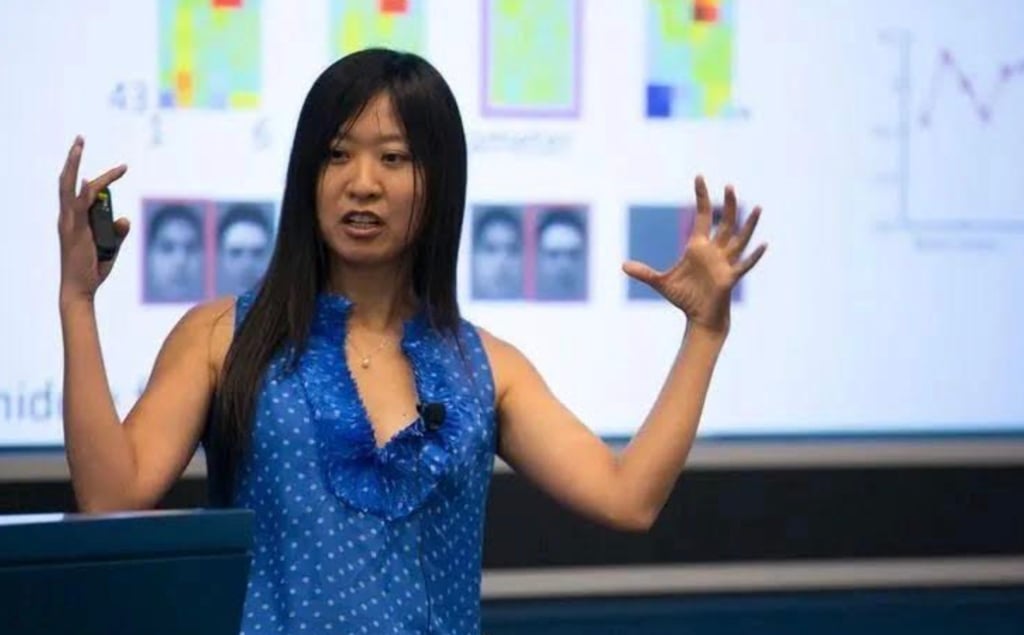
At Harvard, she became interested in using functional magnetic resonance imaging (fMRI) in monkeys – a method for mapping unexplored regions of the brain.
Scientists have long used fMRI to identify a brain region that responds strongly to faces: the fusiform face area (FFA). Cells in this region become excited when viewing faces but remain indifferent to other objects.
In 2003, Tsao identified for the first time a number of similar “face patches” in the brains of rhesus macaques: when the monkeys watched human or monkey faces flashing on a small television screen, several brain regions became active, just as they do in the human brain.
In 2006, her team planned a trajectory and inserted an electrode precisely into the face-processing area of a monkey’s brain, effectively listening to the voice of a single neuron.
She showed that 97 per cent of the cells in the face-processing area responded specifically to faces – responding nearly 20 times more strongly to faces than to other objects.
“We saw six regions light up, and it was always the same six regions,” Tsao later said in a Scientific American podcast in 2019.
Although their discharge waveforms, frequencies and intensities all differed, their response strength to faces was significantly higher than to all other types of objects. Most cells responded not only to standard human faces but also to monkey faces and even highly simplified cartoon faces.
This research was published in the top academic journal Science and Tsao was consequently awarded the 2007 “Innovators Under 35” (TR35) award by MIT Technology Review.
In 2009, more than a decade after graduating, she joined Caltech as an assistant professor and was promoted to full professor in 2014.
She continued to conduct research on visual processing in the brain and in 2017, a further study of hers, published in the top journal Cell, revealed the coding system for face recognition in the primate brain.
“The cells were coding faces in a very simple way,” Tsao told US broadcaster NPR in 2017. “Each neuron was coding a different aspect of the face.”
Tsao thought the brain must be using some sort of code to represent each face it encountered, so her team studied two monkeys as they looked at pictures of human faces, focusing on the electrical activity of just 205 brain cells in two of the six brain areas that process faces.
In 2018, Tsao received the MacArthur Fellowship – often called the “genius” award – established in 1981 and presented annually to 20-30 creative individuals in their fields.
In 2020, she was elected to the National Academy of Sciences. In 2021 she joined UC Berkeley and in 2026 she was elected a fellow of the American Academy of Arts and Sciences, before TIAS announced she would be setting up her own lab at Hangzhou.
TIAS was established by the Hangzhou Tsientang Education Foundation, backed by a pledge from Zhong Shanshan.
In January 2025, Zhong announced at his company’s annual meeting that he planned to donate 40 billion yuan over the following decade to help establish Tsientang University.
It will be the third new-type research university in Zhejiang backed by private donations exceeding 10 billion yuan, after Westlake University in Hangzhou and the Eastern Institute of Technology (EIT) in Ningbo.
The university’s site in Zhijiang, Hangzhou, is less than 200km (124 miles) in a straight line from Changzhou, Tsao’s birthplace.
KioskNews shows a cleaned-up reading view extracted from the publisher’s page — the original always lives on their site, not ours.