Escaping Russia’s web: Central Asia is caught between Chinese networks and US tech curbs

But observers said the ambitious effort to avoid Russian vulnerabilities might not deliver true digital autonomy for Central Asia – and it could turn the region into a frontier for geopolitical rivalry between China and the US.

Central Asia’s digital sovereignty has been constrained by geography. Kazakhstan, for example, has 17 fibre-optic lines with Russia but only two with China and five with its Central Asian neighbours, according to an April report by the Carnegie Russia Eurasia Centre.
More than 90 per cent of its internet traffic transits through Russia’s networks, while its internet service providers source around 80 per cent of their international bandwidth from Russian operators, the report said.
Russia’s top internet firm, Yandex, is a dominant presence in digital life across Central Asia – it is the company behind everything from ride-hailing and food delivery to search engines, cloud storage and fintech.
So when Ukrainian drones hit Yandex’s key data facilities in western Russia between October 8 and 11 it sent immediate shock waves across Kazakhstan, Kyrgyzstan and Uzbekistan.
Artem Khan, an analyst with Beijing-based think tank the Grandview Institution, said the recent Yandex disruptions were a “wake-up call that the region desperately needs to independently diversify its data transit and computing capacities”.
Since the start of the Ukraine war in 2022, Moscow has steadily tightened control over the internet in Russia, curbing independent services and ramping up digital censorship amid concerns over battlefield security.
Khan said that had made digital transit through Russia a “toxic asset”.
“Distancing the region from Russian platforms is no longer driven by geopolitics, but by elementary requirements for cybersecurity and business continuity,” said Khan, an expert on Central Asia’s ties with China.
But as governments across Central Asia look for other options, observers said they could end up with more dependencies.
“True diversification means redundancy: an outage in one direction can be compensated by another,” said Shairbek Juraev, the president of Crossroads Central Asia, an independent research institute in Bishkek.
“What is emerging instead is a division by layer. Russian influence in the region’s digital life sits mainly in platforms and consumer services. China’s role is growing in physical infrastructure and data,” he said.
“Each major power is becoming hard to replace in its own layer, so the region might be accumulating several dependencies rather than reducing any one of them.”
While the EU grapples with bureaucratic delays and limited funds and sanctions-hit Russia struggles with semiconductor shortages, China has a few advantages on the ground. They include ready-to-use equipment, accessible loans and the ability to rapidly build the sort of projects in remote regions that Western investors are reluctant to finance.
The Tajikistan-China internet route is one example. The cost of the project has not been announced but more than 90 per cent of Tajikistan is mountainous, meaning that laying fibre-optic infrastructure will be exceptionally difficult, costly and vulnerable to seismic activity.
China is also working with Central Asian nations on a remote-sensing and monitoring network in space.
Under the agreement, five satellites are to be launched by the end of the year in a constellation dubbed Tianwu. The project aims to provide Kazakhstan, Uzbekistan and Tajikistan with artificial intelligence-driven monitoring of climate patterns and natural hazards.
Juraev said there was a real need for disaster monitoring in the region, and the project could also give China the ability to consistently observe the mountains and borders to the west of its Xinjiang Uygur autonomous region and the area near Afghanistan.
According to the Chinese Academy of Sciences, satellite data collected over the region will be processed by a computing centre in Xinjiang, where AI models will be developed for geological disaster prediction, agricultural pest detection, and glacial melt monitoring.
That has raised concerns among some observers that Beijing could secure crucial information regarding regional glacier dynamics and transboundary river basins – some of the most sensitive issues in Central Asian water-sharing diplomacy.
Khan said concerns over data leverage were overstated.
“From a purely pragmatic standpoint, China already controls the headwaters of key transboundary rivers in the region, such as the Irtysh and Ili,” he said.
“For our region, water is a matter of survival. The main threat is not data leakage, but climate change and inefficient resource management.”
According to Juraev, the digital landscape in Central Asia is complicated by internal disparities.
While indebted countries like Tajikistan have limited bargaining power when presented with infrastructure proposals from China, resource-rich states like Kazakhstan and Uzbekistan appear to have more leverage.
Kazakhstan – which has positioned itself as a neutral Eurasian digital bridge – has sought to benefit from both sides of the global tech divide.
It has joined both the US-led Pax Silica initiative and China’s World Artificial Intelligence Cooperation Organisation. It has also looked to America for the chips needed to develop its AI industry – a move highlighted by last month’s visit to Astana by Nvidia chief executive Jensen Huang.
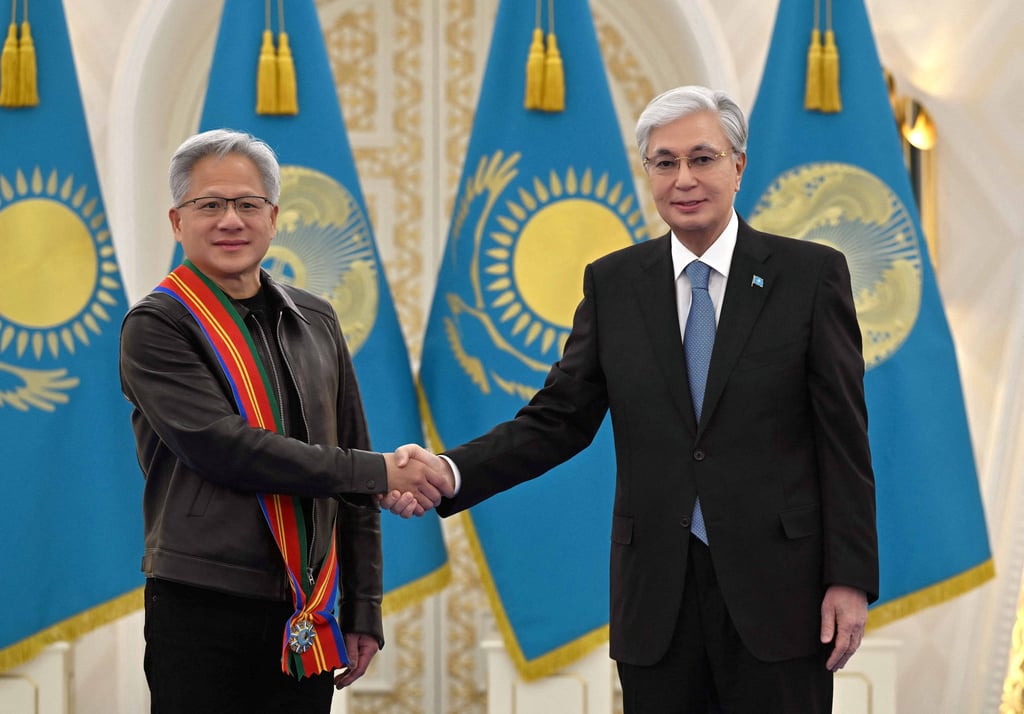
In June, Astana also announced a US$10 billion partnership with American AI cloud firm Firebird to build an advanced computing cluster powered by up to 100,000 GPUs.
But Kazakhstan could find itself caught between Chinese-built physical networks and Western-controlled computing architecture.
Under tightening US export controls, an export licence from the Department of Commerce is required for American AI chip exports, and projects involving Nvidia and Firebird in Kazakhstan would come with rigorous US auditing standards.
Khan said that to secure top-tier American processors, Kazakhstan must accept rigorous oversight.
“Astana is essentially forced to open its data centres to American auditors to prove that these computing powers are not being rented out to sanctioned Chinese or Russian companies,” he said.
Compliance could create friction with the Chinese hardware that underpins the region’s telecoms networks.
“Networks built heavily on Chinese equipment may face security concerns when they try to connect to Western-backed systems,” according to Juraev. “That could narrow the very diversification these governments are seeking.”
He said the stakes were particularly high for Kazakhstan.
“Kazakhstan faces a sharper version of this, as the top-end American chips come with US conditions on end use and access, while Chinese equipment and data services spread across the region,” he said.
“Keeping these layers separate enough to satisfy preferences of all partners will become a real policy task for Astana.”

Beyond geopolitics, there is another obstacle in the way of Central Asia’s digital ambitions: power shortages.
AI centres need a massive and uninterrupted supply of electricity to run – and that remains a headache for countries in the region.
In August there were large-scale blackouts in cities across Kazakhstan, Kyrgyzstan, Tajikistan and Uzbekistan. Kazakhstan’s energy ministry said at the time they had been caused by a “sudden change in the power flow” from the Central Asian grid.
Khan said the energy crunch could add a new dimension to the superpower rivalry in the region.
Powers including China, the US and Russia as well as the EU have been competing to supply energy infrastructure in Central Asia, from renewable megaprojects to nuclear power plants.
“Both the US and China understand that whoever ultimately builds new power plants for the country will gain actual control over these digital hubs,” Khan said.
KioskNews shows a cleaned-up reading view extracted from the publisher’s page — the original always lives on their site, not ours.