Speaking multiculturalism in Singapore – literally
While doing a course on linguistics recently, I was surprised to hear many younger classmates championing the use of Singlish. In fact, the use of the local, colloquial form of English was not only acceptable to them, but also something that they were proud of. “It represents our local culture” was a common refrain.
Some couldn’t even fathom how anyone could see Singlish as a poorer cousin of “standard” English, or why anyone would restrict its use, as long as speakers were able to code-switch between Singlish and more “proper” English in appropriate situations.
Their comments evoked in me a strange mix of validation and discomfort. Since I was young, I had been taught to regard Singlish as “bad English”, and was constantly reminded by parents, teachers and the media to speak “proper” English.
This meant obeying the textbook rules of British grammar and pronunciation strictly; broken grammar, poor pronunciation and particles like “lah” or “lor” were out. In secondary school, the casual request, “Teacher, go toilet”, earned us the coldest gaze and the sarcastic reply, “No, I’m not going to the toilet”.
This official stance was understandable when Singapore was in the earlier stages of its goal to go global. Speaking “good English” was seen as critical: If Singaporeans couldn’t speak a standard of English understood by foreigners, it was argued, how could they do business and interact with the world outside?
It was also believed that allowing people to speak colloquial English, or popularising it in media and entertainment, would hinder efforts to improve their English. Hence the Speak Good English campaigns, with even poor Phua Chu Kang being told to go back to school.
There was a part of me, however, that always wanted to question this tough approach.
A growing acceptance of Singapore English
It was thus comforting when I learnt just how much had changed since then.
Today, much of the linguistic fraternity regards Singlish – or, to go by its technical term, “Singapore Colloquial English” – as a legitimate variant of “Singapore English”, which is itself considered a variety of English, like, say, Indian or Hong Kong English. The other variant is “Singapore Standard English”, which is more formal and closer to British English.
While both variants are seen as a distinctive part of Singapore’s linguistic identity, it is the colloquial variant, with its grammar, vocabulary and syntax drawn from English, Malay, Mandarin, Hokkien and Cantonese, that is seen as truly embodying Singapore’s multiracial, multicultural character.
A typical Singlish sentence could mix words and grammar from any number of these local languages, demonstrating the extent – and beauty – of our “rojak” culture.
While it might not technically be an example of Singlish, my favourite representation of this unique Singaporean mix comes from the kopitiam code of ordering coffee or tea, which features an absolute host of vernacular languages, including Malay, Hokkien, Hainanese and Cantonese.
In one phrase alone, “kopi-C siew dai peng”, incorporates elements of Malay (kopi), Cantonese (siew dai, or “less base”), Hokkien (peng, or “ice”), and possibly Hainanese (the “C” or “si” apparently either referring to “fresh” in Hainanese, or the Carnation brand of evaporated milk) to describe an order of iced coffee with evaporated milk and less sugar.
What could be more local than that?
In line with the linguistic recognition of the value of Singapore English, there is the growing embracement of this local form of English as Singapore’s very own.
An Institute of Policy Studies study has found more Singaporeans using Singlish in everyday life, with 80 per cent of younger folk saying that they speak it well. That statement alone says plenty – I can’t imagine daring to say that I spoke Singlish “well” when I was young.
There is also a greater confidence in the Singaporean accent, with its distinctively un-British and un-American and unique pronunciation patterns that once used to be denounced as “wrong”.
And what could give more pride than seeing the Oxford English Dictionary take in more Singapore English words into the hallowed lexicon? Eleven more, including “jialat” and “wayang”, were added this year, taking the count to more than 30 (see infobox).
The growing acceptance of Singapore English indicates a coming of age, not just of our linguistic confidence, but also a pride in our multi-identity.
Our unique mix of races, languages and cultures is well reflected in the assortment of words and sentence structures that make up Singlish, such that speaking and hearing it reminds us that we are simultaneously Chinese, Malay, Indian and others.
The language of unity and home
One of the rationales behind the promotion of English, apart from its value as a global lingua franca, was that it was a neutral language for a fledgling nation whose populace mostly spoke only Malay, Tamil and Chinese. English was then clearly a colonial import, but now, this unique form of English feels truly local, giving us a common language that unites the races. What could make us feel more “together” than speaking a language that respects and celebrates the contributions of the different communities?
It’s often observed that nothing evokes “home” or a sense of unity more than hearing a Singaporean accent in a far-flung territory.
I’ll never forget how, on a tour some years back, our Singaporean tour guide had made sure to speak in “proper”, neutrally accented English for the benefit of several British fellow travellers – until the latter left for their home on an earlier flight. When he switched back to Singapore English (with great relief), the rest of the bus practically erupted in cheers. We were not home yet, but we felt that we were halfway there already.
It was thus a landmark event when the 2015 National Day Parade featured floats portraying the quintessential “lah” and “chope”, and then Prime Minister Lee Hsien Loong said in a Facebook post: “I’m glad that at 50, we are less ‘blur like sotong’, and more confident and comfortable with everything that makes us Singaporean.”
In many ways, it represented not just an official turnaround from the earlier hardline approach against Singlish, but also a recognition of our increasing comfort with our identity. In recent years, the Speak Good English Movement has moved from seeking to eradicate Singlish to acknowledging the differences between “standard” English, “broken” English and Singlish.
Of course, educators – and many parents, probably – would still like to stress the importance of being proficient in “standard” English when required. Which means code-switching – the practice of alternating between language or language variants as needed – could become as essential a skill as speaking “good” English.
What I think may be more worrying, however, is what kind of future Singapore English may have.
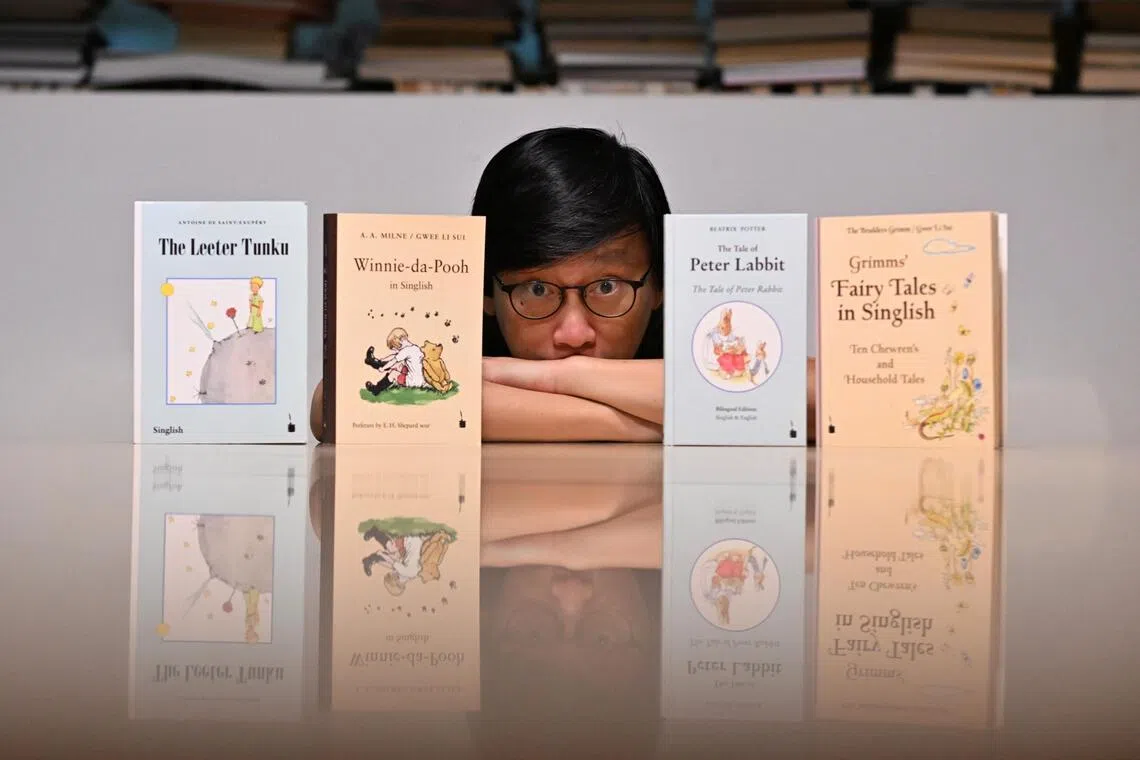
One of the many supporters of Singlish is author Gwee Li Sui, who has translated four children’s classics into Singlish. His book, Winnie-da-Pooh, is a translation of A.A. Milne’s Winnie-the-Pooh.
PHOTO: ST FILE
The future of Singapore English
It would seem that today, new and successive waves of millennial and Gen-Z slang are sweeping onto local shores. Where previous generations used to fret over their children not being able to speak English, younger parents today are likely to be more worried about not being able to speak their kids’ lingo.
In an age of globalisation and social media influences, could Singapore English be at risk of being overtaken by the latest slang?
While we still have Mr Brown championing local speak, could “skibidi Ohio”, “slay” and other trendy phrases edge out our “lahs” and “lors”? Might some parts of Singapore English become extinct one day, just like some Chinese dialects?
I hope not.
Languages are alive and constantly evolving, and their importance – and survival – ultimately depends on the people speaking it.
If a language expresses our identity and culture, then I can only hope that the reverse is true: that a continual pride and conviction in our multiracial, multicultural personality will compel us to keep Singapore English going strong. In a world of growing division and uncertainty, what may keep us united and sure is... Singlish.
Singapore English words in Oxford
The Oxford English Dictionary features dozens of Singapore English words. They include:
Assam laksa – sour, spicy noodle soup
Agak-agak – to estimate, guess
Boleh – to have the power or ability to do something successfully
BTO – to apply for a new HDB flat
Jialat – tiresome, strenuous
Kaypoh – nosy, interfering, prying
Play play – to trifle with, mess around, or take things lightly
Wayang – pretence, false display aimed at deceiving
Blur – ignorant, confused, unaware
Lepak – to relax, hang out, do something in an unrushed manner
Shiok – superb, enjoyable, excellent
Sabo – to play a trick, cause an inconvenience, or get someone into trouble
Sotong – a clumsy or ignorant person (see “blur”)

Elevated insights from seasoned perspectives. Crafted by journalists. Powered by Purpose: The Straits Times Signature Series is a new editorial project helmed by experienced journalists to shine a light on people, themes and ideas that rarely get the attention they deserve in everyday news cycles.
This article is part of a special collaboration between The Straits Times and Nexus – the lead agency that drives Singapore’s national education and Total Defence efforts – to spotlight national issues.
The writer was a journalist at The Straits Times’ political desk and news desk.
KioskNews shows a cleaned-up reading view extracted from the publisher’s page — the original always lives on their site, not ours.