Behind the BRICS agreement: No Ukraine, Iran-UAE balance, swipe at (US) tariffs, flagging Gaza
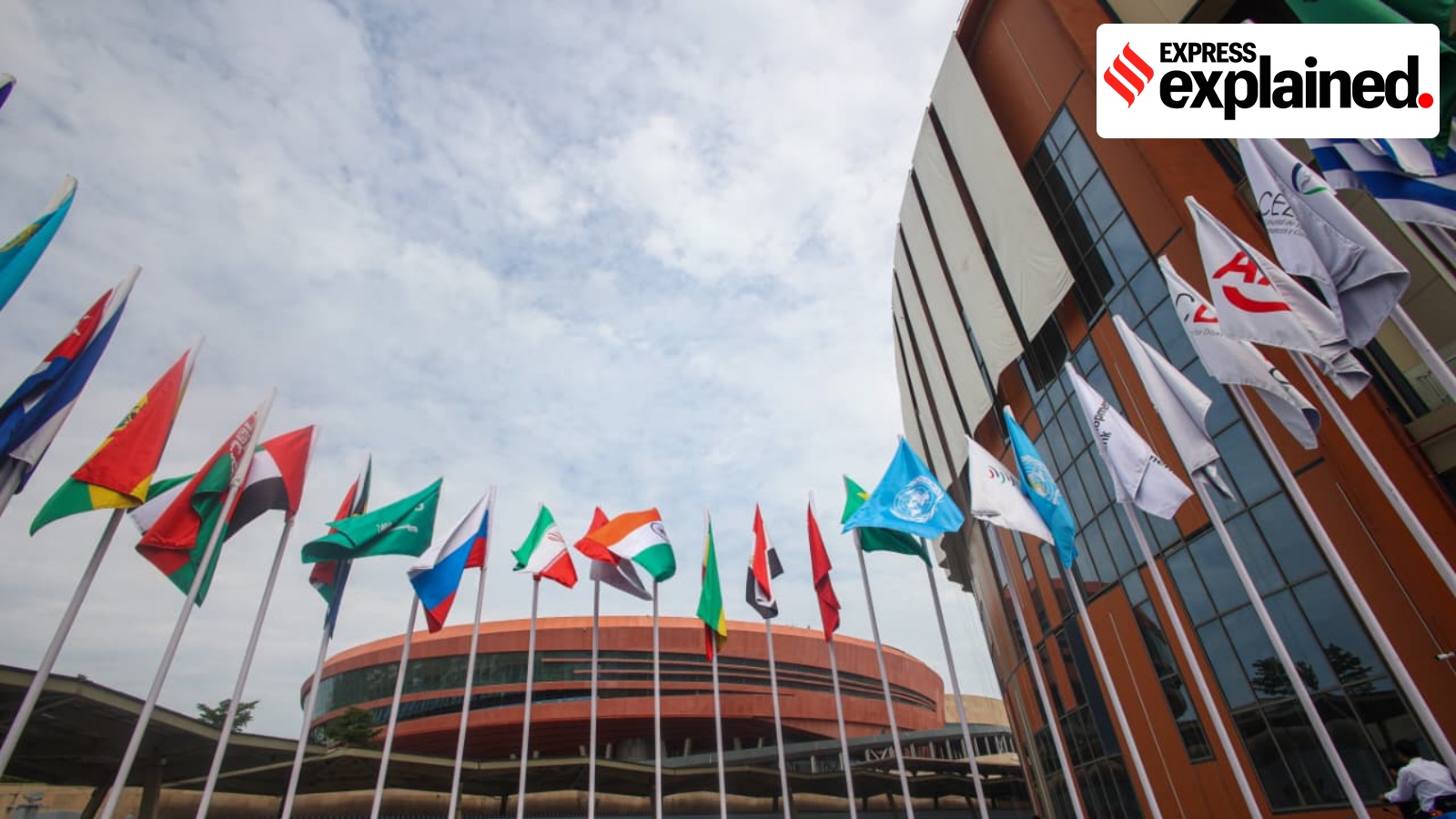
At the BRICS Summit venue in New Delhi, Saturday. (Photo: Praveen Khanna)
THE 45-page BRICS declaration achieved a consensus through careful diplomatic calibration nuancing the most divisive issues and creating space for each of the participants to walk away with their stated goals acknowledged — and their triggers avoided.
As many as 140 paragraphs of the document dwelt at length on trade, health, AI and tourism, making the document cooperative rather than confrontational.
In many cases, it echoed the 2025 Rio declaration — be it the war in Gaza, Pahalgam terror attack or UNSC reforms.
The declaration avoided any mention of the “T” that matters the most — Trump — but it used the other two Ts, trade and tariff. These found repeated mentions in the declaration. While all participants have been at the receiving end of US tariffs, two important members of the grouping – Russia and Iran – have repeatedly faced the pressure of US economic sanctions.
In this context, para 22 of the declaration says the members condemn “unilateral coercive measures,” “unilateral economic sanctions and secondary sanctions” — which is standard BRICS shorthand for Western sanctions regimes. Para 27 talks about Latin America and the Caribbean as a zone of peace, mentions “tightening of unilateral blockade measures” on Cuba, which is again an unnamed but pointed reference to the US embargo. There is also emphasis on “proliferation of trade-restrictive actions… indiscriminate rising of tariffs” — an oblique nod to Trump-era tariff policy. The declaration also opposed “carbon border adjustment mechanisms”, aiming at US/EU trade-climate measures.
In Rio BRICS declaration 2025, it had only said that the “multilateral trading system has long been at a crossroads…We voice serious concerns about the rise of unilateral tariff and non-tariff measures which distort trade and are inconsistent with WTO rules.”
On Ukraine, there was no mention at all in the Delhi 2026 declaration. In Rio 2025, there was an anodyne paragraph: “We recall our national positions concerning the conflict in Ukraine as expressed in the appropriate fora, including the UN Security Council and the UN General Assembly.”
Story continues below this ad
With Russia at the high table as India’s long-time partner, any mention of Ukraine has been avoided. No paragraph in the 45-page declaration mentions Ukraine, Russia’s invasion, or related sanctions by name.
Russia would have blocked any critical language, on a topic that could have been too divisive. At the G20 New Delhi Summit in 2023, India had forged a consensus on the Russia-Ukraine war by softening the language of the joint declaration to avoid naming or directly condemning Russia.
In the section on UN Security Council reform, the declaration states: “Recalling the 2022 Beijing and 2023 Johannesburg-II Leaders’ Declarations, China and Russia, as permanent members of the UN Security Council, reiterate their support to the aspirations of Brazil and India to play a greater role in the UN, including its Security Council..” This copy-paste of the Rio 2025 declaration is how the geopolitical weight of China, as a UN Security Council member, is made explicit, along with that of Russia, while supporting the aspirations of New Delhi and Rio towards a seat at the table.
On terrorism, the BRICS leaders got a consensus in 2026 Delhi but the language formulation was similar to the 2025 Rio declaration. “We express strong condemnation of any acts of terrorism as criminal and unjustifiable, regardless of their motivation, whenever, wherever and by whomsoever committed. We condemn in the strongest terms the terrorist attack in Jammu and Kashmir on 22 April 2025, during which 26 people were killed and many more injured.”
Story continues below this ad
In Rio 2025, it had said, “We express strong condemnation of any acts of terrorism as criminal and unjustifiable, regardless of their motivation, whenever, wherever and by whomsoever committed. We condemn in the strongest terms the terrorist attack in Jammu and Kashmir on 22 April 2025, during which 26 people were killed and many more injured.”
Para 20, which talks about trade diplomacy, acknowledges China for “expanding its zero-tariff treatment to cover 53 African countries with which it has diplomatic ties”, also casting China as a benefactor to the Global South at a moment when the region reels under the impact of unilateral tariffs and sanctions.
Other than the Iran-UAE consensus, the declaration, in Para 20, mentions strong support for “Iran’s bid for accession to the WTO, along with Ethiopia’s”. It also flags “deliberate attacks on civilian infrastructure and peaceful nuclear facilities under full safeguards of the IAEA… in violation of international law” — a reference to the June 2025 Israeli/US strikes on Iranian nuclear sites.
Just as in 2025 Rio declaration, the Israel-Gaza conflict, which started in October 2023 with the Hamas terror attack in Israel, is named directly.
Story continues below this ad
The Delhi 2026 declaration cites UNSC Resolution 2803, which opposes forced displacement of Palestinians. The declaration criticizes “arrangements that may… legitimize or prolong occupation,” in a reference to the International Court of Justice case brought by South Africa against Israel reaffirming Israel’s “legal obligation to ensure… humanitarian aid.”
In the case of Lebanon, it called on Israel “to respect the terms agreed… and to withdraw its occupying forces.” This was the copy-paste, same formulation in 2026 as well.
© The Indian Express Pvt Ltd

Divya A reports on travel, tourism, culture and social issues - not necessarily in that order - for The Indian Express. She's been a journalist for over a decade now, working with Khaleej Times and The Times of India, before settling down at Express. Besides writing/ editing news reports, she indulges her pen to write short stories. As Sanskriti Prabha Dutt Fellow for Excellence in Journalism, she is researching on the lives of the children of sex workers in India. ... Read More

Shubhajit Roy, Diplomatic Editor at The Indian Express, has been a journalist for more than 27 years now. Roy joined The Indian Express in October 2003 and has been reporting and writing explainers and analysis on foreign affairs for about 19 years now. Based in Delhi, he has also led the National government and political bureau at The Indian Express in Delhi — a team of reporters who cover the national government and politics for the newspaper. He has got the Ramnath Goenka Journalism award for Excellence in Journalism ‘2016. He got this award for his coverage of the Holey Bakery attack in Dhaka and its aftermath. He won the Ramnath Goenka Journalism award, 2023, for the second time for his reporting of the Oct 7 attacks on Israel and the war in Gaza. He also got the IIMCAA Award for the Journalist of the Year, 2022, (Jury’s special mention) for his coverage of the fall of Kabul in August 2021 — he was one of the few Indian journalists in Kabul and the only mainstream newspaper to have covered the Taliban’s capture of power in mid-August, 2021. ... Read More
KioskNews shows a cleaned-up reading view extracted from the publisher’s page — the original always lives on their site, not ours.