Taiwan raises issues vs. China, citing historical revisionism, disinformation
Make this your preferred source to get more updates from this publisher on Google.
Taiwan has accused China of using historical revisionism, disinformation, election interference, and economic coercion as part of its efforts to influence democratic societies, including the Philippines and Taiwan.
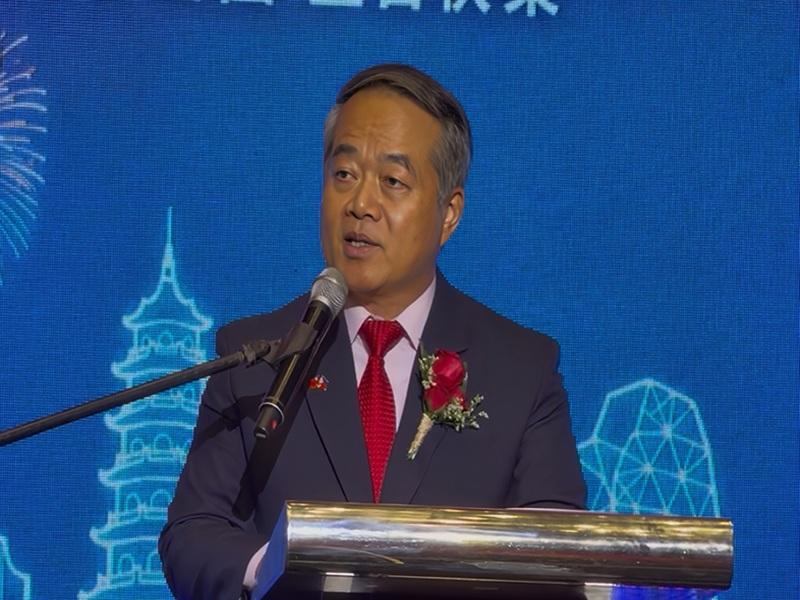
Speaking during the celebration of the 115th National Day of the Republic of China (Taiwan) in Manila, Ambassador Wallace Minn-Gan Chow, representative of the Taipei Economic and Cultural Office (TECO) in the Philippines, warned of growing geopolitical instability in the region, citing China’s increasingly aggressive activities in the Taiwan Strait, South China Sea, and West Philippine Sea.
“Our geographic proximity means we have to share geopolitical instability as well,” Chow said.
“Our big neighbor China’s aggressive maneuvers towards Taiwan Strait, South China Sea and the West Philippine Sea have increased exponentially over the years,” he added.
Chow also accused Beijing of employing so-called gray-zone tactics, which involve actions intended to exert pressure and influence without necessarily resorting to direct military confrontation.
“Moreover, the authoritarian regime of China is using grey-zone tactics,” Chow said, citing the spread of “online disinformation, distortion of historical facts, election interference or economic coercion” to infiltrate democratic societies, including Taiwan and the Philippines.
His remarks come amid fresh allegations of Chinese interference in Philippine politics.
Former Senator Antonio Trillanes IV recently alleged that China provided financial support to groups linked to Vice President Sara Duterte and her husband, Manases Carpio, amid reports of remittances from China and Hong Kong confirmed by the Anti-Money Laundering Council (AMLC), which said the transactions alone did not establish wrongdoing.
The Chinese Embassy in Manila strongly denied funding any Philippine political faction, dismissing the allegations as a “false narrative.” Duterte’s camp also rejected Trillanes’ accusations, calling them malicious and fabricated.
The controversy also follows reports in Chinese state-owned media in July citing scholars who suggested that the Philippine province of Batanes could be considered part of China because of its alleged historical and geographical links to Taiwan.
The scholars argued that Batanes is a natural geographical extension of Taiwan and, based on Beijing’s position that Taiwan is part of China, claimed that the Philippine province also falls under Chinese sovereignty.
Philippine authorities strongly rejected the assertions.
The Department of Foreign Affairs (DFA) maintained that Philippine sovereignty over Batanes is settled and not subject to debate, while the National Historical Commission of the Philippines (NHCP) dismissed the claims as lacking historical and legal basis.
The scholars’ assertions, however, do not constitute a formally announced territorial claim by the Chinese government.
Chow’s statements highlighted Taiwan’s concerns over what it considers Beijing’s attempts to manipulate historical narratives, spread misleading information, and exert political and economic pressure on democratic societies.
His remarks also underscored the shared security concerns of Taiwan and the Philippines amid continuing tensions in the region.
The Chinese Embassy in Manila has yet to comment on the statements made by TECO. — BAP, GMA News
KioskNews shows a cleaned-up reading view extracted from the publisher’s page — the original always lives on their site, not ours.