Michael Gambon: the authorised biography review – a brilliant actor, and a master deceiver

Michael Gambon began his acting career with a preposterous bluff. Applying for a job at Dublin’s Gate theatre, the young toolmaker from the south-east London suburbs embellished his CV with entirely fabricated theatrical experience. It was a gamble, but it worked. In 1962 he made his professional debut as the Second Gentleman in Othello. The following year he was hired by Laurence Olivier for the brand new National Theatre.
Gambon carried on telling tall tales long after there was any need. Some were self-aggrandising: he had been a dancer with the Royal Ballet, worked as a nuclear physicist and auditioned for James Bond. To be fair, this last one was half-true – producer Albert “Cubby” Broccoli had once called him in for a chat. Others were absurdities for the sake of it: he was thinking of buying a house in Hanoi, his mother had operated cranes in Dublin. Occasionally, the lies were intended to save his skin. Terrified of being sacked for turning up late yet again to rehearsal at the National, he claimed that his mother had died in the night. She went on to live for another 49 years. More often, he lied to make other people laugh, claiming that he had worked with the Russian director Dmitri Shagyerarsoff.
Gambon’s compulsion to invent and conceal presents obvious challenges for Jasper Rees, the veteran stage and showbiz journalist who interviewed the actor several times before his death in 2023 and reports always coming away feeling puzzled. Rees’s authorised biography draws on the archive held by Gambon’s wife, Anne, a woman whose existence was unknown to most of his colleagues. For years Gambon had a relationship with the National Theatre administrator Lyn Haill and was later photographed with set designer Philippa Hart, with whom he had two sons. Yet, apart from a brief period in the early 1970s, he remained in the marital home in Kent. That marriage lasted 61 years, and Anne and their son Fergus accompanied Gambon to Buckingham Palace when he was knighted in 1998.
Rees largely leaves his subject’s private life tactfully alone, focusing instead on the origins of Gambon’s talent for deflecting scrutiny. He belonged to no obvious cohort or peer group. Unlike Tom Courtenay and Albert Finney, he had not attended drama school. Unlike Ian McKellen and Derek Jacobi, he had not made his way to Cambridge on a scholarship. Instead he emerged from working-class London-Irish amateur dramatics, where his practical skills were useful for building sets. This delight in making and tinkering remained with him throughout his life: in his home workshop he once built an exact replica of an antique pistol that he’d been asked to restore by a West End dealer, “so really I’m a faker”.
Rees cross-references Gambon’s tall tales with other actors’ archives and draws on more than 100 new interviews, including conversations with Eileen Atkins, Penelope Wilton, Brian Cox and Simon Russell Beale. He also uses the archive of New York Times critic Mel Gussow, whose collection of interviews with Gambon appeared in 2004. The result is probably as near as anyone will get to a definitive account of Gambon’s life and career, although you would not want to bet on one or two of the actor’s misdirections slipping through undetected.
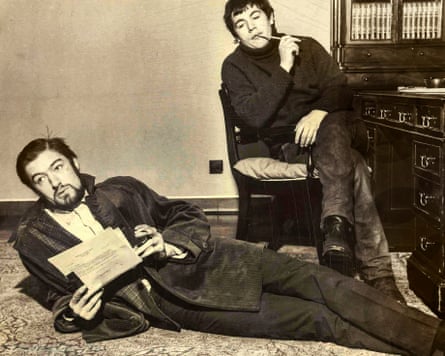
Despite being chosen by Olivier for the nascent National, Gambon initially failed to progress much beyond spear-carrying. His thuggish good looks – he was over 6ft tall, barrel-built, with a face of fleshy menace – made him useful as background colour. His unfamiliarity with the classical and modern repertory, not to mention the demands of iambic pentameter, left him ill-equipped for more demanding roles. Only after leaving in 1967 in search of better parts did his potential emerge. Most notably he played Tom in the London opening of Alan Ayckbourn’s The Norman Conquests.
Gambon’s return to the National in 1978 saw him triumph in Pinter’s new play Betrayal and a revival of Brecht’s The Life of Galileo, which established him as a leading stage actor. In 1986, his performance in the BBC’s The Singing Detective made him a household name. Although he was reportedly not the first choice, the part of Dennis Potter’s Philip Marlow could have been written for him. Confined to a hospital bed by psoriatic arthritis and heavily bandaged, Marlow escapes his anguish by imagining parallel lives. He becomes a private detective and nightclub crooner, inhabiting a world of femmes fatales and Nazi spies, while revisiting a childhood scarred by his parents’ sexual unhappiness. Gambon plays a man who assumes multiple identities but never escapes himself.
He liked to give the impression that he never planned anything, simply accepting the next job that came up. Perhaps that was true: there were certainly some poor choices along the way. For the moment, though, Gambon made the most of his newfound stardom. The following year, he played Eddie Carbone in Arthur Miller’s A View from the Bridge. Miller was enchanted: “This guy can really disappear into a role.” The Guardian wrote that it showed “Michael Gambon shaking hands with greatness”.
Rees devotes perhaps too much of this nearly 600-page book to Gambon’s mischief on stage and screen. His interviewees recall fart machines, water bombs and ad libs designed to throw fellow actors off their lines. The stories are often funny, but their cumulative effect is less comfortable. Was Gambon merely an antic fool, or was he a bit of a sadist? Rees leaves the verdict to his witnesses. Penelope Wilton recalls that the water pistols “got very tedious”.
During RSC rehearsals Eileen Atkins remembers him saying, “I don’t bother with matinees, I just say the words”, which made her furious. He also lost interest once a production had peaked. After the triumphant opening of A View from the Bridge, he began, says co-star Michael Simkins, to “gently destroy it”. His performances deteriorated and the anticipated New York transfer never materialised.
Gambon’s gradual decline makes for painful reading. In his late 50s he began to struggle with lines, flubbing them or improvising in ways that were no longer funny. Prompt boards were introduced, followed by “earwigs”, tiny earpieces through which a prompter fed him lines. This worked best on screen, where performances could be patched together from multiple takes, as happened in the Harry Potter films, where Gambon took over as Dumbledore after Richard Harris’s death. On stage, the difficulties became increasingly hard to conceal. Rees reveals that Gambon was diagnosed with dementia, something which he always denied, perhaps because he had watched his mother ravaged by the disease. It is at this late stage that we begin to glimpse the vulnerability and terror of exposure that lay beneath decades of blustery bravado.
Rees avoids a conventional cradle-to-grave structure by following each main chapter with an interlude devoted to an aspect of Gambon’s character or career that might otherwise get lost in the narrative. One explores his beautifully elegant hands, evident in his wand work in Harry Potter; another his love of fast cars, memorably displayed on Top Gear’s Star in a Reasonably Priced Car segment, when he almost overturned a family saloon.
Rees’s chief challenge is to convey what made Gambon such a great actor. He collates the testimony of colleagues and the verdicts of critics, but neither quite captures the alchemy of a performance. Nor can the actor’s wildly conflicting qualities be assembled into a single coherent character. This unresolved tension is not a failure of the biography so much as its most fitting conclusion: one suspects it is exactly the way that Gambon would have liked it.
KioskNews shows a cleaned-up reading view extracted from the publisher’s page — the original always lives on their site, not ours.