NTUH, Adata Tech unveil medical AI sanitation robot
By Lin Chih-yi and Jonathan Chin / Staff reporter, with staff writer


National Taiwan University Hospital (NTUH) and Adata Technology on Tuesday unveiled a jointly developed artificial intelligence (AI)-piloted medical-grade sanitization robot in a potential breakthrough for public health.
The sanitation robot, which comprises a mobile platform, algorithmic visual recognition system and an innovative robotic arm, has been used to sterilize operating and endoscopy rooms at the hospital, NTUH superintendent Yu Chung-jen (余忠仁) told a news conference.
Each feature is necessary for the robot to navigate through spaces cluttered with medical equipment, recognize objects that require sterilization and perform cleaning procedures with dexterity, he said.
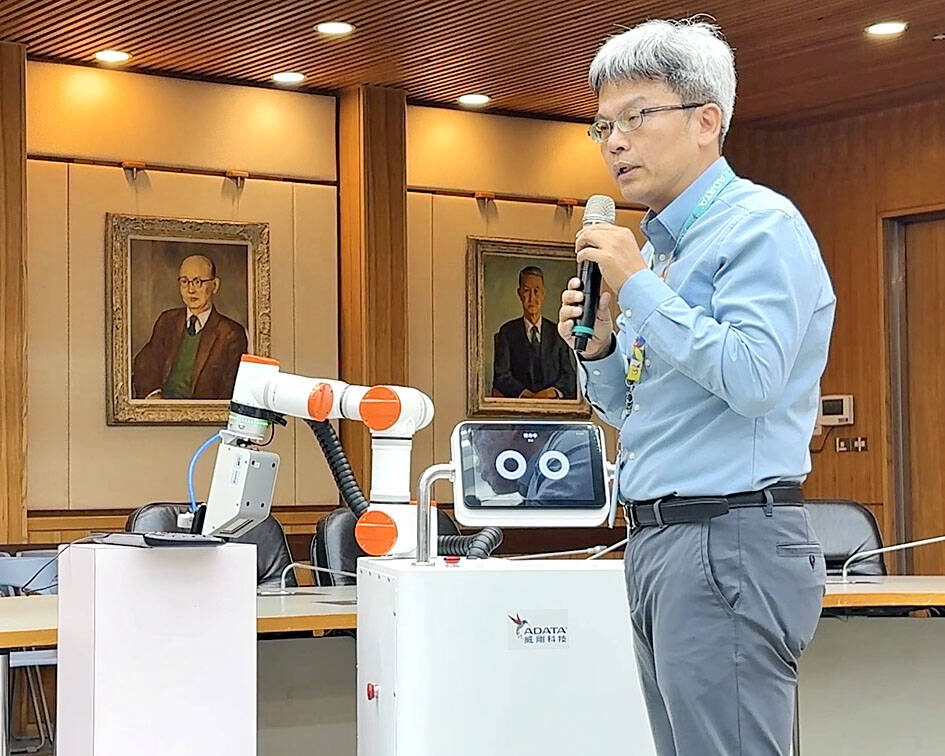
A representative from Adata Technology unveils a smart autonomous disinfection machine at an event in Taipei on Tuesday.
Photo: Lin Chih-yi, Taipei Times
The robot’s AI also keeps records of the object, location, time and result of sterilization procedures for review, Yu said.
The hospital recognized the need for an advanced sanitization robot during the COVID-19 pandemic, as keeping the hospital sterile was time-consuming and required many personnel, he said.
The risk of exposing sanitization personnel to the virus was another factor for automating the process, he said.
Adata supplied the technology and the hospital provided a test venue and feedback, he said.
The NTUH uses the second-generation model of the robot, which has reduced the number of night shift staff needed by four people, NTUH deputy superintendent Tan Ching-ting (譚慶鼎) said.
The third-generation robot can be programmed for specific routes and sterilization missions appropriate to the working space, including patient rooms, clinics and public areas, he said.
Adata executive vice president Ivan Lin (林昭陽), who is also chairman of Adata AI Technology, said the robot design emphasizes adaptability to the environment and meeting real-world needs.
KioskNews shows a cleaned-up reading view extracted from the publisher’s page — the original always lives on their site, not ours.