Why Netanyahu May Remain Israel Prime Minister, Despite Opposition Pushback
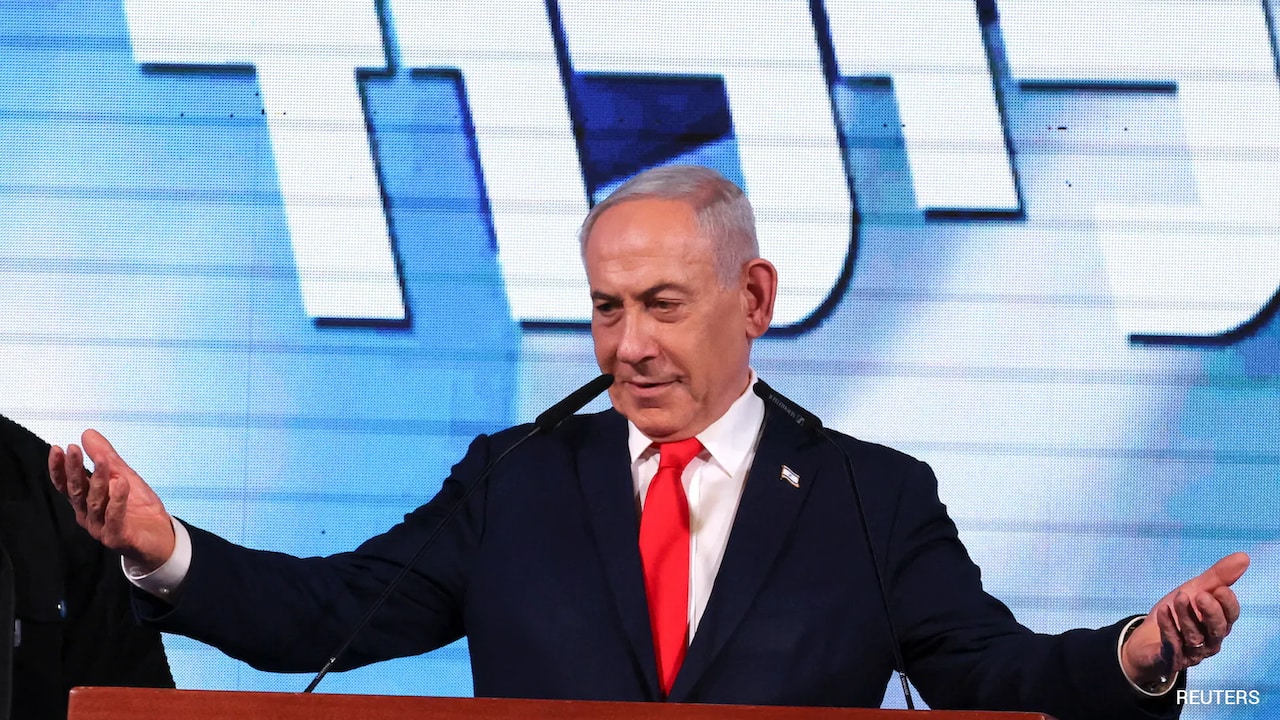
Five days after Israelis cast their votes, the country is no closer to knowing who will form the next government. Prime Minister Benjamin Netanyahu has lost his majority in the parliament. The opposition has the numbers to remove him, but there is no consensus on how.
Netanyahu's right-wing and ultra-Orthodox bloc secured 53 seats in the 120-seat Knesset. Together, his opponents won 67 seats. But 19 of them come from Arab-majority parties, and relying on them is highly controversial in Israeli politics.
Eisenkot, the leader of the Yashar party, which won 21 seats, is at the centre of a mammoth task to build a coalition. While the opposition parties have a consensus on removing Netanyahu, they disagree on the Palestinian issue, military conscription, religious policy and the role of Arab lawmakers.
Uncertainty Spills Into Streets
Thousands of Israelis gathered in Tel Aviv Saturday, calling on opposition leaders to unite with Arab parties to prevent Netanyahu from returning to power.
Supporters of Netanyahu also turned out, protesting against any government dependent on Arab lawmakers. Others could be heard calling for Israel to not have a government with "terrorists".
Balance Of Arab Parties
The biggest change in the election is the return of Arab representation, which won 19 seats. The Joint List, headed by Yousef Jabareen, won 11 seats. Mansour Abbas's Islamist Ra'am had eight.
Around 8.4 lakh people voted for parties led by Arabs, up by 64 per cent as compared to 2022. Arab citizens turned out at about 80 per cent, more than twice the turnout of the previous election.
The head of the Hadash party, Jabareen, said the Joint List was prepared to back an alternative government from outside the coalition. "This was a historic opportunity," he said, "and the immediate demand of Arab voters was to end Netanyahu's government, especially the influence of National Security Minister Itamar Ben-Gvir and Finance Minister Bezalel Smotrich."
The last four years have been a period of deteriorating conditions for Arab citizens, he said, citing house demolitions, organised crime, lack of policing, funding deficits, racism and police violence.
"For years we have suffered from systematic discrimination, so if Eisenkot talks about change, I think that the change should also come for our community. "We ought to be treated the same," he said.
Supporting a government does not mean joining it, Jabareen explained. "We cannot be part of a government as long as our people in the West Bank are occupied," he said. He also called for an end to the war and a return to talks with Palestinian leaders.
Ra'am is more willing to formally participate. Abbas has been willing to work with the opposition. That split could be useful for Eisenkot: a minority government of Jewish majority parties, possibly with Ra'am inside and the Joint List supported from outside.
Bennett Supports Eisenkot
Sunday brought a boost for Eisenkot. The B'Yachad party of former prime minister Naftali Bennett said it would recommend that he be given the mandate by President Isaac Herzog to form the government.
Eisenkot has proposed a broad Zionist union open to all who accept a set of principles. On Saturday he reiterated his conditions, including recognition of Israel as a Jewish and democratic state, acceptance of compulsory national or military service and recognition of Hamas as a terrorist organisation.
Those terms could complicate talks with Arab lawmakers, especially language on Israel's identity, the Palestinian question and the Gaza war.
Another unknown is Avigdor Lieberman. His party, Yisrael Beytenu, holds seven seats. He has ruled out serving under Netanyahu but has repeatedly ruled out any government dependent on Arab parties. He could use his seats to bargain for a bigger role, even the premiership - though that would require others to accept a leader who isn't from the bloc's biggest party.
The opposition could also consider a confidence-and-supply agreement. Arab parties will stay out of the government but will support it on confidence votes and budget decisions.
Netanyahu Cries Fraud, Foreign Interference
Netanyahu's camp has cast doubt on the legitimacy of the Arab parties' gains. His Likud party has accused the Arab parties of electoral fraud and foreign interference, including from Qatar. Qatar has denied the allegations, calling them a disinformation campaign.
Jabareen denied the accusations, calling them an attempt to delegitimise the political power of Arab citizens. He said the rhetoric could feed hostility towards the community.
The Central Elections Committee has dismissed charges of systematic fraud as unfounded. But officials said the results will stand even if investigations find impropriety in specific cases.
President Calls For Compromise
Neither side can govern on its own, and the focus now is on President Isaac Herzog.
"The election results are an established fact - they are the reality," Herzog said on Sunday. He urged leaders to step away from entrenched positions and acknowledge the situation the voters had created.
Results are due to be certified on November 4. Herzog is to start consultations with party leaders on Wednesday. He will then select a lawmaker to attempt to form a government. The candidate is generally given 28 days with the option of extending it by 14 days.
The new Knesset will be sworn in on November 10. Even before a government is formed, the 67 lawmakers in the opposition could seek to oust the Knesset speaker and take control of key committees, giving it the reins of the legislative agenda.
"Replacing the speaker is a top priority," Jabareen said. He said the majority could also be used to reverse legislation passed by the outgoing government, which he said weakened judicial independence.
Ultra-Orthodox Parties: A Different Way?
Eisenkot isn't just banking on Arab support. United Torah Judaism (UTJ), which has seven seats, has fallen out with Netanyahu over the failure to pass legislation protecting military service exemptions for ultra-Orthodox men.
Should UTJ abstain in a confidence vote instead of supporting Netanyahu, Eisenkot could form a minority government without Arab lawmakers.
That would cost something. Ending blanket exemptions was a key campaign promise of several opposition parties, and concessions to UTJ could undermine an issue that helped keep the opposition together.
Netanyahu's Options
Netanyahu is far from done. Likud remains the single biggest party with 27 seats, and he has extensive experience in working fractured coalitions.
His bloc is eight seats shy of 61. That would require at least eight opposition lawmakers crossing the floor, which seems unlikely given the commitments opposition leaders have made.
Another possibility is a national unity government, possibly with a rotating premiership. Herzog has previously expressed interest in such a deal to avoid new elections. US President Donald Trump may also welcome a deal that unites rival parties and reduces the power of Netanyahu's far-right partners.
Jabareen said he feared Netanyahu might try to use a military escalation to delay a transition. "This is a really critical moment," he said, calling on the opposition to resist any effort to start another war for political reasons.
Netanyahu may have the best route to a new election. If no candidate manages to form a government in time, Israel will go back to the polls, with Netanyahu remaining in the role of caretaker PM. He could wager that the squabbles in the opposition exasperate voters and dull the momentum behind Arab turnout and the anti-Netanyahu vote. He wouldn't get a majority in a new election.
The result puts the political weight of Arab citizens at the centre of government formation and highlights the difficulty in establishing a stable administration in a society divided over identity, religion, military service and the Palestinian question.
The next government will have to decide what to do about Gaza, relations with Arab states, negotiations with the Palestinians and a possible new showdown with Iran.
KioskNews shows a cleaned-up reading view extracted from the publisher’s page — the original always lives on their site, not ours.