Polar vortex winds could plunge in November – what it means for UK weather
Freezing temperatures could sweep as early as November as El Niño continues to wreak havoc on global weather.
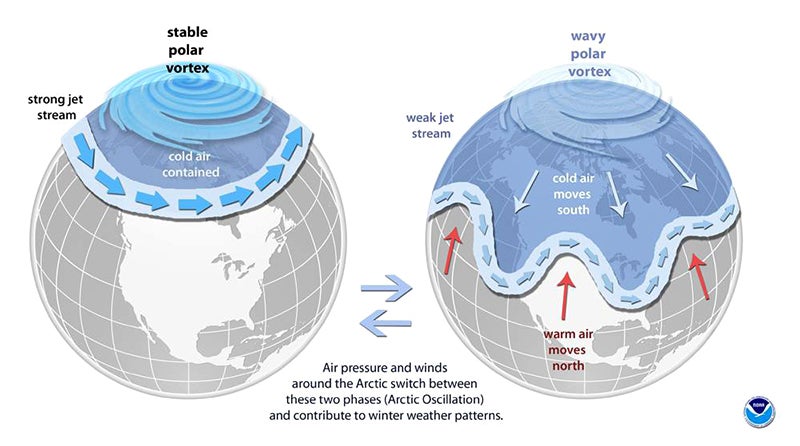
Forecasters warned the weather phenomenon, which has already smashed global benchmarks to become the strongest weather event in history, could disrupt a large, high-altitude ring of swirling cold winds spinning above the Arctic known as the stratospheric polar vortex.
While a strong polar vortex helps to contain very cold winds and conditions within the North Pole, disruptions can weaken the jet stream, sending severe, freezing Arctic air plunging southward into North America and Europe.
Experts are now predicting the polar vortex will become weaker as early as November rather than in January 2027 as orginally thought.
Forecasts from Nasa show the wind circulation weakening, with wind strength falling to 12.04 m/s (26.9 mph) on October 31, 9.15 m/s (20.5 mph) on November 1, and 4.15 m/s (9.3 mph) on November 3.
The polar vortex can grow weaker and spread south towards the UK if there is a sudden stratospheric warming, which according to the Met Office can make the winds in the vortex reverse direction.
“The stratospheric sudden warming can sometimes cause the jet stream to ‘snake’ more, and this tends to create a large area of blocking high pressure,” the forecaster said.
Experts explain that this usually forms over the North Atlantic and Scandinavia. That means northern Europe, including the UK, is likely to get a long spell of dry, cold weather, whereas southern Europe will tend to be more mild, wet and windy.
On the boundary of these areas, cold easterly winds develop and in some cases the drop in temperatures leads to snow, which is what happened in early 2018.
However, forecasters can only reliably predict individual sudden stratospheric warmings about a week in advance.
They can watch how these changes develop and may impact our future weather. The sudden stratospheric warming usually takes a few weeks to influence UK weather.
But it’s not just the polar vortex that could make the UK wetter and colder this winter. The Met Office warns the El Niño “is associated with increased risk of cold snaps.”
El Niño is a naturally occurring climate phenomenon that develops in the tropical Pacific Ocean. It takes place when sea-surface temperatures across the central and eastern Pacific become significantly warmer than average, altering atmospheric circulation patterns and influencing weather around the globe.
The weather phenomenon has already helped push temperatures to reach the hottest summer on record, and will continue to have “far-reaching” implications for weather conditions across the world, according to the Met Office.
KioskNews shows a cleaned-up reading view extracted from the publisher’s page — the original always lives on their site, not ours.