Life (& death) in Delhi’s Satya Niketan, a student ghetto
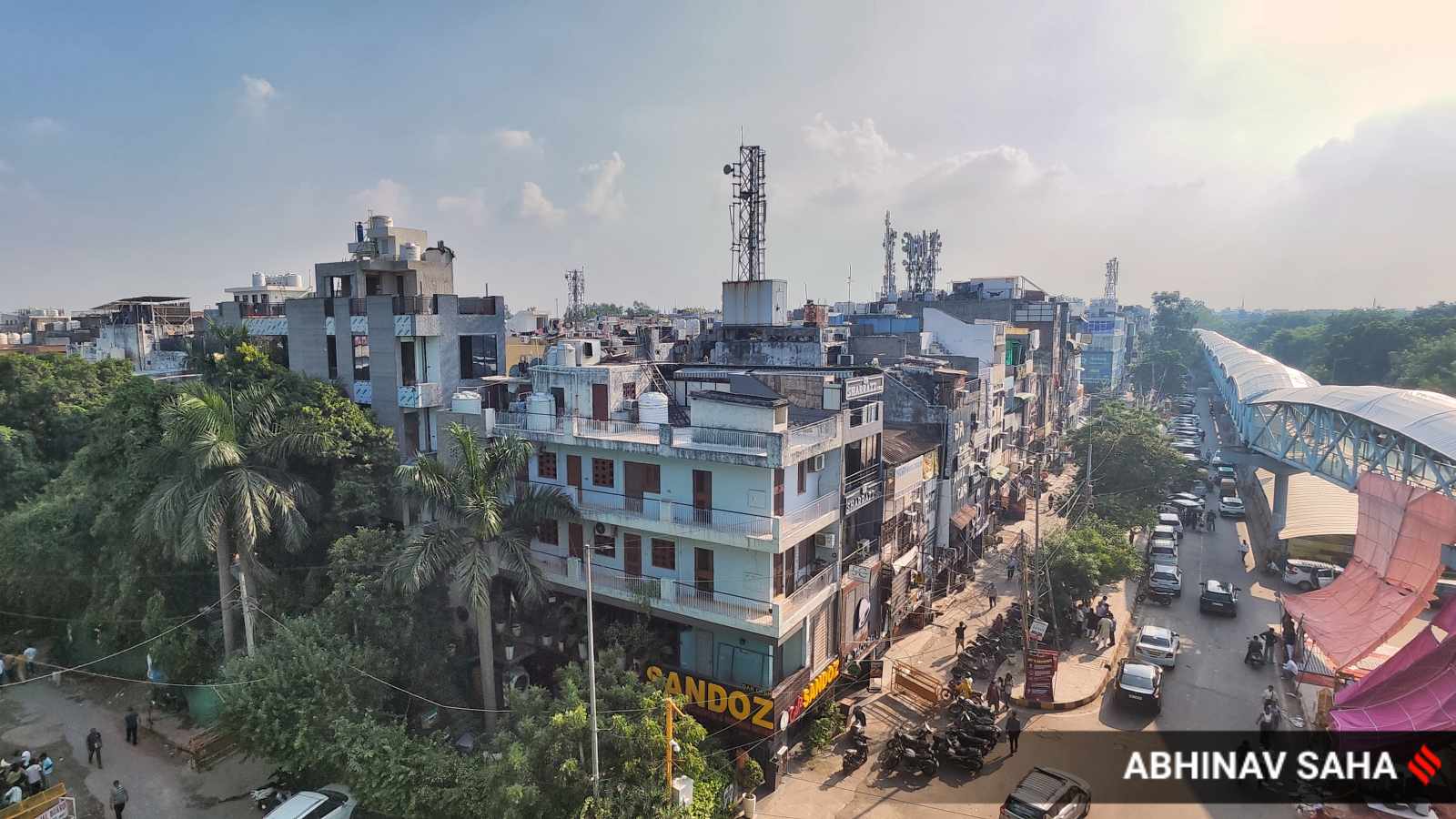
Looking back to his days as an undergraduate student at Sri Venkateswara College nearly three decades ago, Ravi Vajala clearly remembers the settlement opposite the college gate. He recalls a couple of shops that sold patties and cheap burgers, which students frequented.
Anshuman Kishore, who went to Sri Venkateswara in the early 1990s, remembers being introduced to “Campa-Doodh” — an odd concoction of milk, Campa Cola and ice — there, sold at a shop with three stools and a rickety table out front, with music played on a cassette player by a halwai next door.
In Vajala’s memory, the colony was a residential area with a handful of small shops, where families lived in houses that were two or perhaps three storeys tall, lining bumpy, stone-paved lanes that were wide enough for a Maruti to squeeze through but not much else.
Vajala is today the principal of Sri Venkateswara College. And the settlement into which he would sometimes wander as a student has transformed into a densely packed hub of private student accommodation – where residents include many students of his college who have come from states across the country to study in Delhi.
Each building in Satya Niketan begins where the next one ends. They are narrow and tall, most are at least four storeys high. Almost every building seems to offer paying guest (PG) accommodation for students who study in the Delhi University South Campus colleges in the vicinity.
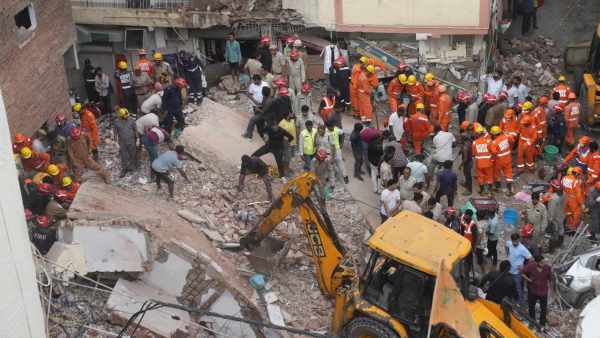 A five-storey building came crashing down on September 6 in Satya Niketan area.
(Express Photo: Abhinav Saha)
The compact neighbourhood is structured almost entirely around the lives of these students; its microeconomy is driven by the young adults who have made the capital their temporary home.
There are messes that serve Rs-90 meals, shops that offer photocopying services and give computer printouts, reading rooms where students pay to sit with books because their rooms are too small or too crowded, stalls that sell tea, momos, or rolls, and small cafes with more ambitious menus.
Story continues below this ad
Shops and offices of property dealers and brokers are everywhere, promising to find just the right PG for the needs and budget of every student.
A week ago, a five-storey building housing one such PG came crashing down, crushing seven people under bricks and concrete, including five students of nearby colleges.
A crackdown by civic authorities against illegal constructions and dangerous buildings across Delhi followed. In Satya Niketan itself, at least one other building that was deemed unsafe was demolished, and many others were sealed. Many of the students who lived in the PGs packed their bags and left, shaken.
A neighbourhood and a university
The evolution of Satya Niketan over the 30-35 years since Vajala and Kishore went to Venky into one of Delhi’s most prominent student ghettos is closely tied to the expansion of DU’s South Campus, the enormous influx of outstation students to a university that is desperately short of facilities to house them, and the alacrity with which a variety of entrepreneurs have rushed to cash in on the opportunity and Satya Niketan’s fortuitous location.
Story continues below this ad
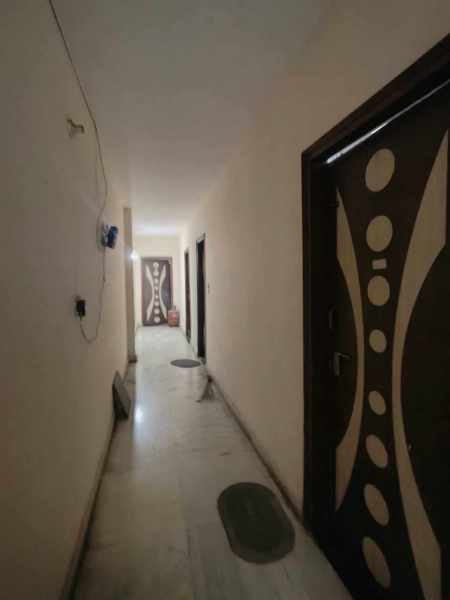 A narrow corridor at a PG in Satya Niketan. (Express Photo)
The settlement at the corner of Ring Road and Benito Juarez Marg close to Dhaula Kuan emerged in the 1960s as part of a Jhuggi Jhopri Removal scheme of the Delhi Development Authority (DDA). People who had been evicted from slums on government land were allotted plots up to 40 square metres in the area.
These original allottees were not allowed to transfer their plots, but many did it anyway, using well-worn workarounds such as “agreements” and “power of attorney”. But the new occupants had no legal title to the plots, and were treated as unauthorised occupants.
Then, on October 11, 1972, the DDA’s Slum and JJ Department decided to regularise the occupation by offering perpetual leasehold rights at Rs 125 per sq yard, along with a 10% penalty and annual ground rent equal to 2.5% of the premium from the date of occupation.
“The decision of 1972 was a welfare measure intended to give benefit to those who were otherwise in breach of law,” the High Court noted in a later judgement (2011). There are 299 plots in the area.
Story continues below this ad
The lanes get even more cramped as they lead from Satya Niketan to the adjoining urban village of Moti Bagh, where the houses are even smaller. Fifty-seven-year-old Ved Prakash, who has lived all his life in Moti Bagh, described the transformation of the locality next to his own.
“The original allottees (of Satya Niketan) mostly sold their plots and left, and mainly Punjabi and Bania families moved in. Those families started a small market in the 18 plots at the front of the locality (facing Venky). These were small shops like a grocery store, vegetable shops, a salon, and tea stalls. The rest of the neighbourhood remained residential,” he said.
A resident of Satya Niketan who declined to be identified by name said his family, who lived in Karol Bagh, had bought their plot from an original allottee because they wanted to live in a quieter locality.
Chandni Singh, who runs a salon in the area, recalled having grown up in a locality that was greener and had a more closely knit residential character.
Story continues below this ad
“Earlier, we would sit out on charpais. The lanes were wider and more open. What you see now is unrecognizable from what used to be,” she said.
Singh, Ved Prakash, and a number of other long-time residents linked the transformation of the area to the coming of the PGs phenomenon. From the beginning of the 2000s, they said, homeowners started to turn rooms of their houses into private hostels, and charged each tenant individually. From the 2010s onward, the PG business exploded.
Through this period, Delhi University too underwent massive expansion. In 1960, there were 26 affiliated to the university, in which about 14,000 students studied. Delhi’s first Master Plan, prepared in 1962, noted that these colleges were overcrowded and unable to cope with the increasing demand for college education. These colleges were also largely concentrated in North Delhi, and the Master Plan noted that students had to travel long distances from “far-flung colonies” to attend classes.
Thus, the Master Plan said, “A university centre in the south is proposed near the junction of Kitchener Road (today’s Sardar Patel Marg) and Ring Road. This centre will have several colleges. It is also proposed to have a number of colleges within easy reach of the residential areas each to serve a population of about 1,50,000… It is proposed that only a few of these colleges would have hostel and dormitory facilities, as most of the students served by the colleges would come from the surrounding residential areas.”
Story continues below this ad
This was the broad context in which DU’s South Campus was planned. It was developed in the 1970s, and moved to its present location in 1984. Today, there are 13 colleges in South Campus, including Sri Venkateswara, Motilal Nehru, Atma Ram Sanatan Dharma, Ram Lal Anand, Maitreyi, Jesus and Mary, Aryabhatta, and Gargi – many of them within walking distance from Satya Niketan.
Unlike what the Master Plan had envisioned though, these colleges began to attract students from across the country. By the 2010s, students from outside Delhi accounted for as much as 70% of the strength in DU’s premier colleges. Vajala estimates that more than 60% of the current student population at Sri Venkateswara is from outside Delhi.
“I could see a visible sudden surge of outstation students after 2010. This could be because of many reasons, including the growing gap between state and central universities, and the craze for IAS coaching in Delhi,” he said.
A resident of the area who did not want to be named recalled that back in the 1990s, his family rented out a two-bedroom apartment in their building to a family for Rs 5,000. “When more students began looking for places to stay, families rented out rooms and floors to them. But soon, they realized that the PG model was more profitable than residential rentals,” the resident said.
Story continues below this ad
So, “Instead of renting out floors, people started to convert the space into multiple rooms, each with multiple beds, and rented out individual beds. The number of floors also began to grow,” he said.
While the recent tragedy has put the vertical expansion of this area under the scanner, unauthorised construction was already being recorded in the colony by 1991. In 1992, the government told Rajya Sabha that eight properties in the area had been sealed since January 1991.
According to information provided by the Municipal Corporation of Delhi (MCD), the violations included unauthorised construction of rooms, toilets, and staircases on the first, second and third floors, as well as the construction of illegal basements.
Rs 8,000 for a bed and shared loo; food and electricity extra
Story continues below this ad
A five-storey building in the area, with one of its walls comprised almost entirely of blue-tinted glass panelling, has nothing that identifies it as a commercial ‘PG’ accommodation. There is no signboard of any kind – even though everyone knows what the building is.
“You won’t find anything cheaper this close to South Campus,” the PG owner said. The owner’s family lives on the first floor; the other floors have rows of rooms that operate as PGs.
Each floor has a narrow, dimly-lit corridor with doors leading to three rooms. A room on the second floor has three small beds and a shared attached bathroom. Students pay Rs 8,000 per month for a bed here. The room is tiny; the three beds leave barely enough floor space to walk past suitcases, clothes, and study tables.
“Electricity is extra, on a sub-meter. If you want food, mess charges are separate,” the owner said. “That is Rs 3,500 a month for two daily meals. It is simple home-style food – dal, sabzi, roti.”
If students cook their own food, they have to share the cost of gas cylinder refills. But cylinders are difficult to get, and have to be bought on the black market for prices that can be unpredictable.
A door in the room with the three beds leads to what is described as a “balcony”, but from where nothing but the grey wall of the next building is visible. There is a common kitchen on the floor, with a stove and a water dispenser. The area under the sink is crowded with 20-litre bubble-top water containers, both full and empty.
Amlan Das, who came to study in Delhi from Assam, lived in Satya Niketan for a year in 2012 when he was an undergraduate student at Delhi College of Arts and Commerce. He found a broker who got him a room for Rs 8,000 a month.
“They called it a PG, but I had to buy my own bed, arrange my own food. But I had no choice. I was new and didn’t know my way around, and my first priority was to get settled within my means. This place was the closest to college and offered student-friendly facilities,” he said.
But Das could not stay for long. He found the area suffocating and cramped, and moved to Lajpat Nagar after a year.
A week after the building collapse, its shadow hung over Satya Niketan like invisible construction dust. Young women walked in and out of their “PGs”, watchmen at the gates looked closely at strangers. Asked if a PG operated in their building, a couple of them said No reflexively.
KioskNews shows a cleaned-up reading view extracted from the publisher’s page — the original always lives on their site, not ours.