China’s rich coastal cities to see sea-level rise up to 20% higher than global average
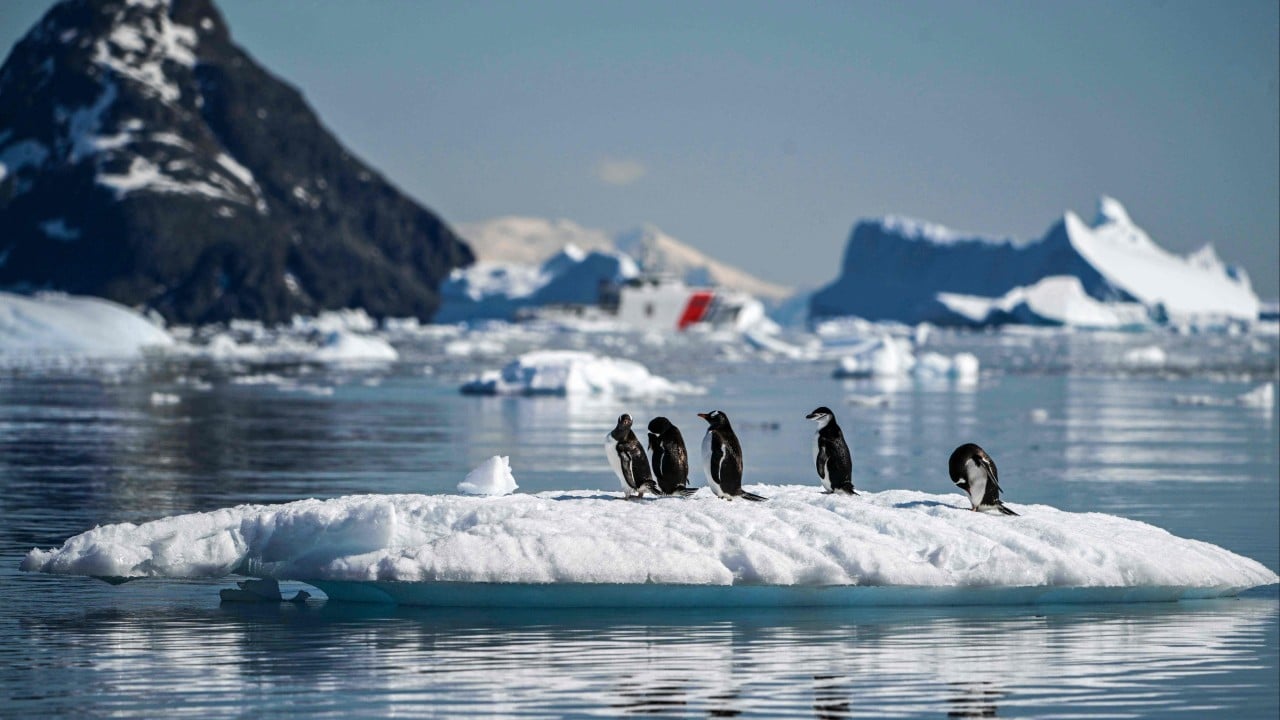
International scientists warn that rising sea levels driven by melting Antarctic ice will be 15 to 20 per cent higher in cities such as Hong Kong and Shanghai compared with the global average.
They said gravitational shifts caused by shrinking Antarctic ice would redistribute water across the globe, causing higher ocean levels along China’s densely populated coastlines.
“Even if we limit warming to 1.5 degrees Celsius [2.7 degrees Fahrenheit], the Paris Agreement’s most ambitious goal, Antarctica still has a 92 per cent chance of losing mass this century,” said lead author Lin Yucheng, an assistant professor at City University of Hong Kong’s school of energy and environment.
“For port-based megacities like these, [rising sea levels] means more frequent and costly shocks. Without effective adaptation and coastal protection, which is very costly, large numbers of people may eventually need to relocate,” the climate scientist said.
Lin collaborated with researchers from institutions in Australia, Britain, New Zealand and the United States to evaluate how the mass loss of the Antarctic Ice Sheet threatens coastal communities far away from the Earth’s south pole.
In their paper published in the peer-reviewed journal Nature Geoscience on September 30, the team said effective management of the risks to densely populated coastal communities required rapid emissions reductions in line with the Paris Climate Agreement.
The study found that Antarctica, a massive frozen expanse larger than China and India combined, was highly likely to lose mass this century.
“We tried thousands of different Antarctic models and found we are highly certain that Antarctica will cause sea-level rise higher in Shanghai and Hong Kong than global average – 15 to 20 per cent more than global average,” he said.
When asked when the above-average rise in sea levels would happen in the Chinese cities, Lin said “almost immediately”.
“Once Antarctic ice enters the ocean, the water is redistributed within weeks to a few months. So it is already happening, and it applies to every centimetre of sea-level rise that comes from Antarctica,” he explained.
05:00
A ‘super’ El Nino is forming: what is it, and what’s coming?
“If we do not cut greenhouse gas emissions fast enough, we found a potential domino effect that could add up to 25cm (9.8 inches) of sea-level rise from Antarctica alone by 2100 – enough to permanently flood the homes of more than 10 million people.”
According to Lin, this domino effect begins with greenhouse gas emissions causing the ocean surrounding Antarctica to warm. As the warm waters thin the floating ice shelves, these weakened shelves break apart. Consequently, the glaciers formerly held in place by the shelves flow faster into the ocean.
To put 25cm of sea-level rise in context, he said global sea levels had risen by about 20cm since 1900.
“Yet that is already the fastest rise in at least 4,000 years, and its impact on coastal extremes is profound. Human-driven sea-level rise at about 15cm has quadrupled the frequency of extreme coastal flooding worldwide since 1900,” Lin said.
He pointed to his recent study that found rising sea levels caused by human activity were responsible for more than 70 per cent of extreme coastal flooding days in Hong Kong between 2010 and 2018.
“Antarctica alone could add up to 25cm by 2100, and about 29 to 30cm in Hong Kong and Shanghai. That comes on top of rise from other sources, such as melting of the Greenland ice sheet and mountain glaciers, and warming oceans that make seawater expand,” Lin said.
Known as the “sleeping giant” of rising sea levels, Antarctica’s vast scale means it reacts slowly, accounting for roughly 10 per cent of global sea-level expansion between 2006 and 2018.
“The worry is that once it starts losing ice, or ‘wakes up’, it keeps going for centuries,” Lin said. “So 25cm by 2100 is only the start.
“In the most extreme simulations from a recent international ice sheet modelling project, Antarctica alone adds up to about 7 metres (22.9 feet) by 2300.”
KioskNews shows a cleaned-up reading view extracted from the publisher’s page — the original always lives on their site, not ours.