Meat-and-potatoes England revert to dispiriting type with defeat against All Blacks | Andy Bull

Just when you thought things were getting interesting, England revert to tripe. The Nations Championship organisers had laid on a display of what was described as “indigenous English culture” before kick-off against New Zealand, all part, you guess, of their efforts to make this into one weekend-long festival of sport. Well, it turned out to be four soaking wet blokes with trumpets parping Jerusalem while a big bald fella in a flat cap with the St George’s Cross stitched across the top bit back his tears and shouted about our dark satanic mills in the bucketing rain.
The only thing that could have made it worse was if they had segued into Neil Diamond’s Sweet Caroline. Which they did. Welcome to England. Labour ought to arrange something similar on the white cliffs – it could do wonders to bring down those net migration figures everyone seems to be so worried about.
The England team also seemed to have retreated into a rather depressing caricature of itself. As a demonstration of what we still like to think of as the traditional strengths of English rugby, this made for pretty dispiriting stuff. Having played with such poise and purpose when they beat the All Blacks last week, on Saturday they reverted to the sort of meat-and-potatoes game which has repeatedly failed them in recent years. You got an inkling of Steve Borthwick’s thinking earlier in the week when he picked Freddie Steward at full-back instead of George Furbank.
Borthwick explained it by saying that Steward was going to add a “different dimension” to England’s attack. He didn’t say which dimension. Presumably the first. Furbank’s a player who’s always looking for the last pass, Steward’s one who never seems to see it. There was no more predictable moment in this match than the English attack that saw him steaming into contact deep in the New Zealand 22 while Will Joseph raced into the space outside him waiting for a pass that never came. “We couldn’t get our attack going,” Borthwick explained. It maybe didn’t help that Furbank, the man who had kickstarted them last week, wasn’t even in the team.
It was one of those days when Borthwick and Maro Itoje were both left doing a lot of terse talking about “execution” and “fundamentals”.
There was a clue, too, that this game plan had been drilled into them all before kick-off in Itoje’s decision to kick a penalty shot at goal from inside England’s own half in the opening minute, which turned out to be all the points they would score for over 70 minutes. England’s strategy for the match seemed to have been designed entirely around the wet weather and, yes, it really wasn’t the sort of day to be throwing a lot of off-loads. But the truth is no one has ever beaten the All Blacks by box-kicking them to death. They have more types of rain in New Zealand than we even have names for up here in England.
Dave Rennie explained afterwards that they had second-guessed England’s plan when they saw how wet it was during the warm-up. They got it spot on. They ducked, or blocked, or countered pretty much every drearily predictable punch England threw.
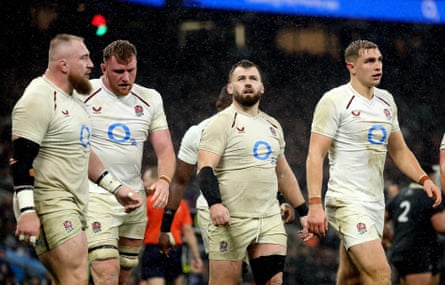
It didn’t help much that so many of the blows were so wild. If you are going to come at New Zealand with this sort of route-one plan, you need to be damn sure you at least get it right. England weren’t accurate enough to beat New Zealand playing this sort of game. They bungled two of their precious few chances from attacking lineouts, one when Fabian Holland picked off Luke Cowan-Dickie’s throw, and another when Fin Smith missed touch from 22 yards after they won a penalty after Holland had collapsed a maul. There were, as Itoje pointed out, way too many errors for any of it to be effective.
It was only when Marcus Smith came on that England’s attack briefly threatened to flicker into life again, as he started tossing basketball passes hither and thither in the New Zealand 22. But soon enough Smith was being booed by his home fans as he kicked away possession by booting a succession of aimless kicks into the New Zealand half. You could almost hear the coaches’ voices ringing around his head making his decisions for him.
Five minutes before the end, the organisers flashed an announcement up on the big screen informing everyone that there was “an ongoing rail incident at Twickenham station” and told everyone to either wait for a shuttle bus or make the 40-minute walk to Richmond. Truly, it was one of those weekends that had everything England has to offer.
Year-end fundraiser
$0 of $2,000,000 goal
A moment full of possibility – and risk
We hope you appreciated this article. Before you close this tab, can we ask you to support the Guardian at this crucial time for democracy in the US? With Black Friday approaching, our most impactful monthly support option is just $7.50 a month for six months.
In the last two years alone, Donald Trump has eroded many of the pillars of US democracy – slashing funds for universities, undermining science, shutting down arts institutions, and attacking the free press as an “enemy of the American people” and “a threat to our national security”. While he and his allies have enriched themselves and spread lies, federal forces have harassed and imprisoned innocent people and violated the constitutional rights of many Americans.
Now, in a sweeping change election, the American people have spoken: Donald Trump, Pete Hegseth, RFK Jr, Elon Musk and the tech oligarchs may finally be held to account. A majority of American voters have demanded an end to the costly and immoral wars, the flagrant profiteering, and the corrosive attacks on communities and democratic institutions.
It’s a moment full of possibility, with more stories than we can possibly cover. New leaders are emerging from Texas and Michigan to Iowa and South Carolina – and heading to Washington to fight for affordability, against wealth inequality, and for human survival in the face of AI and the climate crisis.
These new leaders will be facing a cornered Trump and his hardline chief of staff, Stephen Miller, who have nothing left to lose. The next few years are critical for the future of the country. Journalism that covers the epic clash between these forces has a vital role to play right now.
Investigative journalism provides a fact-based paper trail for an emboldened Congress to follow. Members of Congress – and the American public – often rely on our in-depth reporting to inform the tough questions, to connect the dots and to pursue accountability for wrongdoing.
At the Guardian, our newsroom is devoted to uncovering the truth and conveying it to as many people as possible. We’re not alone in this mission, but this kind of journalism faces unprecedented hurdles: big tech threatening our financial stability and stealing our work for AI, billionaire owners telling journalists what to publish, and a hostile executive branch intent on suppressing our reporting.
The Guardian is free to dig deep without fear because we’re funded by our readers. Our readers hold us to account, and we hold the powerful to account.
However, this only works when enough of our readers contribute. Against the advice of most industry analysts, we’ve refused to put up a paywall – we believe good journalism should be freely available to all people, regardless of ability to pay. If you’re counting on our reporting, and you can’t afford to pay, please stop reading this message and go back to our articles.
If you can afford to contribute, please know that your support is not only helping yourself – from voters in Kansas to immigrants in Minnesota and families in Gaza, your generosity is bringing factual news to people around the globe.
Today is among our most important fundraising days of the year. To sustain our unique financial model, our goal is to raise $2,000,000 before the new Congress is seated on 3 January. More than 19,000 people have contributed already. All gifts are gratefully received, but for the next several days only, our most impactful monthly support option is $7.50 a month for the first six months. If you can afford 37 seconds, please join our ranks – and show your support for the rekindling of democracy in the US and around the world.
KioskNews shows a cleaned-up reading view extracted from the publisher’s page — the original always lives on their site, not ours.