Foreign fund outflows send Taiwan dollar sharply lower: Central bank
Net fund outflows by foreign institutional investors have been a major factor behind the New Taiwan dollar’s sharp depreciation against the US dollar in recent months, the central bank said.
In a written report submitted to the Legislative Yuan ahead of a hearing scheduled for today, the central bank said foreign institutional investors recorded net fund outflows of US$54.3 billion since the beginning of July.
During the same period, the NT dollar depreciated about 2 percent against the US dollar, the central bank said.
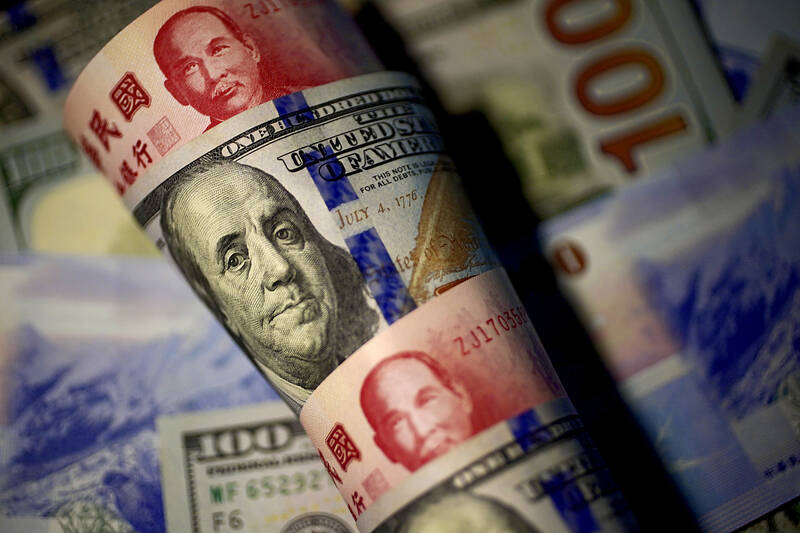
New Taiwan dollar and US dollar banknotes are pictured in Taipei on Oct. 19.
Photo: CNA
In the first half of this year, foreign institutional investors recorded net fund outflows of US$23.3 billion, adding downward pressure on the NT dollar amid escalating military tensions in the Middle East and concerns about a hawkish US Federal Reserve, the central bank said.
To ease volatility in the local foreign exchange market, the central bank sold US$17.04 billion more than it bought during the six-month period, it added.
From July through Oct. 21, renewed concerns about military conflict between the US and Iran, along with a global sell-off in technology stocks amid artificial intelligence (AI) spending concerns, weighed on the TAIEX, prompting foreign institutional investors to withdraw more funds from Taiwan’s financial markets, the central bank said.
During the four-month period, foreign institutional investors recorded net stock sales of NT$1.25 trillion, equivalent to about US$38.7 billion. Their total net fund outflows, including capital gains and cash dividends, reached about US$54.3 billion, the central bank said.
Despite the outflows, the NT dollar remained relatively stable compared with several other non-US dollar currencies, the central bank said.
From Jan. 1 through Oct. 21, the NT dollar depreciated 3.23 percent against the US dollar, while the US dollar index, which measures the greenback against a basket of major trading partners’ currencies, rose 3.49 percent, according to the central bank.
During the same period, the NT dollar’s decline was less pronounced than those of the Swiss franc, which fell 3.89 percent, the euro, which dropped 4.35 percent, and the Thai baht, which tumbled 6.29 percent, the central bank said.
Taiwan is a small, open economy with a relatively shallow foreign exchange market and a heavy reliance on trade, making central bank intervention necessary to stabilize the currency, the report said.
The central bank added that it aims to keep fluctuations of the Taiwan dollar within a relatively narrow range compared with those of the euro, South Korean won and Japanese yen, helping Taiwanese exporters stabilize prices and secure orders, while supporting the broader economy.
KioskNews shows a cleaned-up reading view extracted from the publisher’s page — the original always lives on their site, not ours.