Country diary: Thrilling views of Iceland’s humpbacks, (perhaps) lured in by Céline Dion | Claire Stares
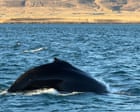
For the first half-hour, Eyjafjörður, Iceland’s longest fjord, offered few signs of marine life – just three cormorants and a raft of common eiders. Then, suddenly, there it was. A distant spout of water vapour. A humpback whale.
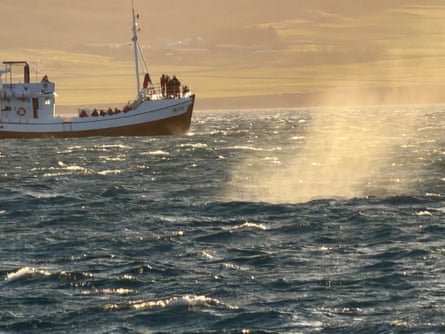
As we motored out, more bushy plumes appeared to port and starboard, until we found the boat surrounded by about 15 individuals. Cutting the engine, the captain announced that he was about to employ a secret technique to coax the whales closer. There were raised eyebrows as the opening notes of Céline Dion’s My Heart Will Go On crackled over the speakers. But, as if on cue, two explosive exhalations erupted alongside the boat, prompting whoops of delight.
The whales surfaced repeatedly, their glistening black backs rounding out of the sea every 10 seconds or so. On its sixth appearance, one arched its spine, raising its enormous tail flukes vertically into the air to power its descent, its companion a beat behind.
I took a quick succession of photos. The distinctive black-and-white pigmentation patterns on the underside of their flukes were as unique as fingerprints. These markings allow researchers to identify and track individual whales, making photographs a valuable tool for understanding their movements.
As they disappeared, the chop smoothed into slick, oval‑shaped patches of calm water – whale flukeprints. Deep-diving to feed on dense aggregations of krill and small fish, the whales followed their own rhythms, submerging for up to 10 minutes at a time. It was impossible to anticipate where they would reappear. We could only scan the water, hoping to be looking in the right direction, when a stubby dorsal fin broke the surface.
In autumn, humpbacks typically migrate between Iceland’s nutrient-rich subpolar feeding grounds to warm, shallow breeding waters in the Caribbean and Gulf of Mexico. Yet increasing numbers are remaining in Icelandic waters year-round. This may be due to overall population growth, resulting in more juveniles that won’t migrate until they reach sexual maturity, between four and 10 years of age.
Gazing over the stern as our vessel headed back to harbour, I caught one final glimpse – a fluke slipping beneath the surface, silhouetted against the glittering path of sunlight reflected on the water.
KioskNews shows a cleaned-up reading view extracted from the publisher’s page — the original always lives on their site, not ours.