Beau Lamarre-Condon used his service weapon to murder two men. Did NSW police recruiters miss any red flags?

Double murderer Beau Lamarre-Condon was a serving New South Wales police officer who had been under review for repeatedly using his Taser on a man, four years before he killed Jesse Baird and Luke Davies.
On Wednesday, he was convicted after a 12-person jury found he had murdered both men with his police service weapon on 19 February 2024.
During his 10-week trial, the prosecution alleged Lamarre-Condon had misused his authority as a police officer to obtain CCTV footage of Baird, who he had casually dated; stolen training bullets from the police; and taken a weapon from a police station to use in his crimes.
The NSW police commissioner, Mal Lanyon, has offered his thoughts to the families of Baird and Davies and condemned Lamarre-Condon.
“The actions for which Mr Lamarre-Condon has now been convicted are abhorrent and completely at odds with his oath of office as a police officer which he undertook. His actions are unacceptable to me, the NSW Police Force and to any member of our community,” he said in a statement.

“I also wish to acknowledge the professionalism and dedication of those officers who conducted the investigation into the deaths of Mr Baird and Mr Davies.”
But the trial’s revelations have raised questions about how NSW police recruits its officers.
“If police recruitment processes and then police professional standards can let this guy get through all the gates, we need to review our checks and balances,” Dr Justin Ellis, a University of Newcastle criminology lecturer, told Guardian Australia.
“Authority figures are expected to meet higher ethical and behavioural standards, and in this case, the additional responsibility that comes with being a police officer.”
The circumstances surrounding Lamarre-Condon’s recruitment and ongoing employment are being examined by a coronial inquest and a critical incident investigation, NSW police said in a statement.
Terry Goldsworthy, a criminologist at Bond University and former detective, suggested the force revisit Lamarre-Condon’s assessment to see whether any red flags were missed.
He added that Lamarre-Condon’s case is an “extraordinary exception” rather than indicative of systemic issues in the police.
But Ellis believes this type of framing, which narrows focus to individual actors, must be taken into wider consideration of the police processes that “may have enabled the ‘bad apple’ to be in place and to stay in place”.
Separate from the police response to the murders, recruitment processes have been probed as part of a broader independent cultural review, released in June.
It recommended the NSW police force change testing and vetting processes that unintentionally exclude capable candidates, following recent downturns in applicants.
Applicants to the police academy are required to undertake a psychometric test, but former police officer turned criminologist at Macquarie University, Vincent Hurley, said “anyone can bluff a questionnaire”.
He said police should, and may already have, reviewed Lamarre-Condon’s psychometric testing, as well as any complaints by the public or other officers about his behaviour.
Years of staff shortages are placing pressure on recruiting and retaining officers, which can lead to complaints being overlooked, Hurley said.
Four years before the murders and about three years into his policing career, Lamarre-Condon became the subject of an internal police review after video emerged of him repeatedly deploying a Taser on an Indigenous man in the face, chest and neck.
During the June 2020 incident, Lamarre-Condon yells, “If you move, I will Taser you,” before pulling the man to the ground and firing his stun gun.
The man says: “Are you serious? I’m trying to protect my face, I’m not even fighting you.”
An internal review by NSW police cleared Lamarre-Condon of any wrongdoing, finding that he had complied with policy and training guidelines.
after newsletter promotion
‘Haters like to hate’
Police faced intense scrutiny after the murders first occurred in 2024.

Then police commissioner Karen Webb came under fire when she described the killings as a “crime of passion” and responded to criticism by saying: “There will always be haters. Haters like to hate. Isn’t that what Taylor [Swift] says?”
During the trial, it was revealed Baird did not believe he could report Lamarre-Condon’s stalking and controlling behaviour to law enforcement because of his role in the police.
Even if he did report the officer, Hurley said there was a chance police may not have taken him seriously because he did not fit the mould of a “stereotypical” victim of such behaviour – referring to the fact he was not in a heterosexual relationship.
Hurley said Baird and Davies’ deaths were a “wake-up call” for police in how such matters are handled.
The independent NSW MP Alex Greenwich, who helped facilitate a 2024 vigil for Baird and Davies, said after the verdicts: “This tragic and heartbreaking violent crime tells us we need to do everything we can do to increase awareness, reporting, support and access to justice for LGBTQ victims of stalking and violence.”
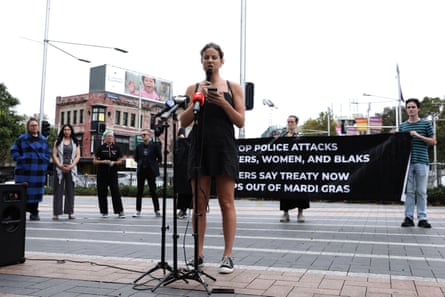
People in the LGBTQ+ community have long faced discrimination when engaging with police and the justice system, with a 2022 special commission of inquiry into LGBTQ+ hate crimes revealing police reluctance to thoroughly investigate homicides and assaults involving gay men and transgender women.
Ellis, who is part of a NSW police force taskforce established in response to inquiry, said police have an opportunity to renew their engagement strategies with the LGBTQ+ community.
“The more that they’re trusted and people have confidence in them, the more likely [people] are to report to the police.”
In the wake of the murders, NSW police reviewed and implemented changes to the force’s firearms policies and procedures, which have been welcomed by Hurley and Goldsworthy.
At the time of Lamarre-Condon’s arrest, the NSW police force launched its critical incident investigation, which is ongoing and being monitored by the Law Enforcement Conduct Commission.
The investigation will also be reviewed by the police’s professional standards command.
Eventual findings from the ongoing coronial inquest may offer recommendations for the police.
KioskNews shows a cleaned-up reading view extracted from the publisher’s page — the original always lives on their site, not ours.