Top China university stops using AI to spot absent-minded students after backlash

A top university in China’s eastern Jiangsu province has rolled back a controversial feature of its AI-powered classroom tracking system following fierce public backlash.
Students at Nanjing University were recently notified by the university that it would begin using its “smart classroom” system – upgraded over the summer – to record full attendance rates over a one-week period, Chinese media reported on Wednesday.
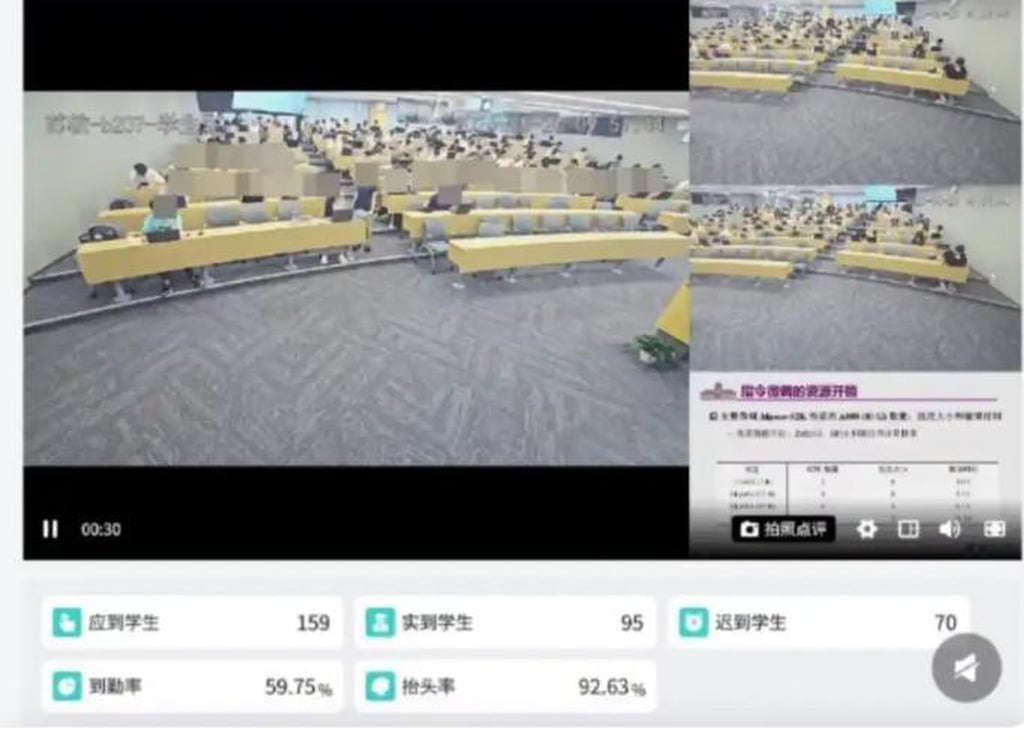
Outrage flared when leaked screenshots purportedly revealed the AI-powered software in action – live classroom footage paired with real-time data tracking late arrivals, attendance figures and a “head-up rate” to map attentiveness. The images went viral, igniting intense debate over campus privacy rights, the ethical issues with algorithmic surveillance and the unchecked reach of artificial intelligence (AI) monitoring.
The so-called head-up rate, or taitou lu in Chinese, refers to a metric calculating whether students are actively focusing on a lecture, rather than dozing off or staring at their mobile devices or laptops.
In the face of mounting public backlash, the university moved quickly to clarify that the surveillance system was part of its efforts to track teaching quality and that it would not arbitrarily subject students to facial recognition.
In a statement published on its official social media account on Wednesday, the university explained that the viral screenshot was actually taken by an individual during a system trial at one of its campuses in May.
“Without authorisation, our smart classroom system does not collect facial or other biometric data, nor does it conduct facial recognition during teaching applications,” the university said, adding that the system “no longer calculates head-up rates”.
According to media outlets including the Jinan Daily, an official newspaper in neighbouring Shandong province, the university activated the smart system in the first week of November.
While notifying students about the roll-out in group chats, some teachers warned that the system’s attendance records would directly affect their grades and could even result in them being barred from taking course exams.
A previous tender notice released on the university’s website revealed that the installation of the smart system cost more than 30 million yuan (US$4.5 million). The project involved upgrading equipment and installing new facilities in over 100 classrooms and several public areas on one campus.
The platform pairs classroom cameras with built-in AI algorithms capable of facial recognition and crowd-counting, allowing administrators to automate roll-calls, track attendance and monitor attentiveness through a calculated head-up rate.
Some students told local media that while they had yet to feel the impact of the new system, they remained uneasy about privacy concerns relating to automated classroom discipline.
They also pointed out that the university had not sought their consent, voicing fears that deploying facial recognition could leave their biometric data in the hands of not only the university but also private tech firms.
“The students do have some reactions at the moment,” a member of faculty at Nanjing University told the South China Morning Post on condition of anonymity.
However, the university’s collection of such data was not aimed at individual students, but rather “geared more towards supervising teachers’ performance”, the faculty member noted.
The source also voiced frustration that, while students bristled at algorithmic surveillance, they had a near-universal tendency to bury their heads in their devices, which harmed the teaching experience. “It is deeply disrespectful to the lecturer,” the staff member said.
In its statement, the university explained that the objective of its smart classroom overhaul was to upgrade the audiovisual environment, enable course live-streaming and cross-campus interaction, and support lesson playback alongside the reuse of teaching data.
It added that using the system to calculate attendance rates was part of a midterm teaching inspection, aimed at using data to “support subsequent teaching reforms and course development”.
Across China, the widespread use of AI to track academic performance has stoked growing concern over opaque data practices and intrusive digital surveillance.
Hubei provincial outlet Jimu News questioned the value of the upgrades in an article on Wednesday, asking: “Where exactly is the ‘smart’ in these smart classrooms, and is it really necessary?”
The opinion piece argued that students, not just experts, must have a say in these decisions, warning that “a lack of transparency will inevitably lead to suspicion and misunderstanding”.
These concerns extend beyond university campuses. A Chinese legal scholar recently warned that deploying AI within a social rating system risked creating a “large-scale surveillance tool”.
The author from Jimu News warned of the risk that rating systems that use big data and algorithms to translate public activities into quantifiable metrics could foster large-scale surveillance and entrench opacity and discrimination.
KioskNews shows a cleaned-up reading view extracted from the publisher’s page — the original always lives on their site, not ours.