Taiwan’s small-reactor plans face an unresolved waste-disposal problem
Taiwan is exploring small nuclear reactors without a final repository for their spent fuel. Existing law assigns duties to waste producers, but arrangements for future private operators remain unsettled
By Romain Blachier / Contributing reporter


Whatever voters decide on Nov. 28 about Taiwan’s existing nuclear reactors, the government is already preparing for smaller ones. Kao Tsu-mu (高梓木), president of the National Atomic Research Institute (國家原子能科技研究院), has said Taiwan could decide in 2032 whether to bring in light-water small modular reactors (SMRs) under foreign license. A first unit could generate power in 2035 or 2036, he said.
At National Tsing Hua University (NTHU) in Hsinchu, Taiwan’s first research reactor has run for more than six decades and should operate until 2040. The university plans to replace it with a microreactor developed with a US company.
On Oct. 19, NTHU signed a collaboration agreement with NuCube Energy, and Yeh Tsung-kuang (葉宗洸), dean of the university’s College of Nuclear Science (原子科學院), said talks with the Nuclear Safety Commission (NSC, 核安會) has begun. NTHU hopes to install a reactor within two years of NuCube reaching commercial operation in the US. Yeh sees SMRs for chip fabs and microreactors for data centers, and would welcome both: industrial users who generate their own power would lighten the state utility’s supply burden, he said.
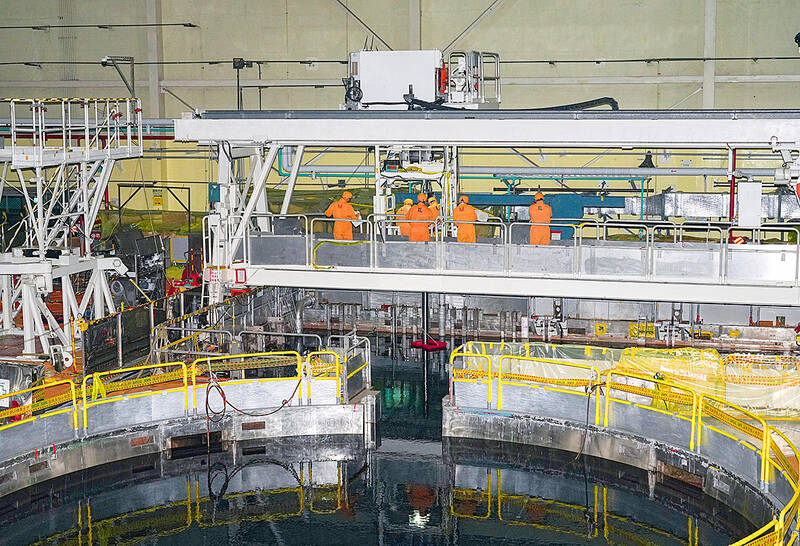
Scientists in October 2024 conduct tests at the Jinshan Nuclear Power Plant in New Taipei City’s Shimen District in this undated file photo.
TT file photo
NTHU is working on a memorandum with Antares Nuclear, another US microreactor developer, and plans to visit it at the end of this month. Because the university wants to keep teaching, researching, treating patients and producing isotopes, Yeh said on Nov. 10 that there would be two reactors under two licenses, one for research and education and one for power generation, unless a design that does both comes out of close work with a vendor.
Yeh had expected NuCube to take back the reactor and its fuel at the end of a service life of about 12 years. The company has told him that under current US policy it will not take back the fuel. In written answers on Nov. 10, Yeh said NuCube’s position turns on whether that policy changes in the near future, and that otherwise “we have to handle the spent fuel by ourselves.” The fuel would stay in temporary storage on the Hsinchu campus until a final repository in Taiwan enters commercial operation.
The NSC has told Yeh it will not write rules specific to microreactors, because the designs vary too much, and that it will review an application to install one only with a safety evaluation report. The university has filed nothing and will not apply before it completes a full-scale safety assessment and an on-site feasibility study, Yeh said. Nor is the commission drafting rules for SMRs yet, said Anton Gao (高銘志), a professor at NTHU’s Institute of Law for Science and Technology (科技法律研究所).
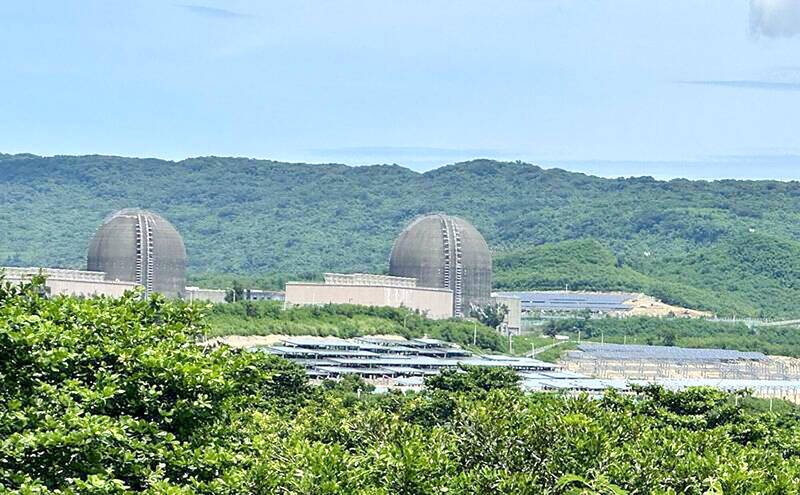
The Ma-Anshan Nuclear Power Plant in Pingtung County is pictured in this undated file photo.
TT file photo
Yeh does not expect the Nov. 28 referendum to change this. In his view, the vote bears on restarting reactors that have been shut down, not on new designs, which the government has said it would accept from around 2030.
Article 5 of the Electricity Act (電業法) reserves nuclear generation, at any size, to companies in which the state holds more than half the capital. In 2024, Chinese Nationalist Party (KMT, 國民黨) Legislator Weng Hsiao-ling (翁曉玲) proposed amendments that would let private companies build SMRs; they passed a first reading and were sent to committee. Gao thinks the focus on ownership misses the main obstacle. The same article already lets the regulator approve exceptions, and he does not believe the Ministry of Economic Affairs’ (經濟部) Energy Administration (能源署) “would necessarily reject” a serious applicant. The rules on self-use power plants distinguish between units below and above 2 megawatts and say nothing about nuclear power, he added.
“Only with greater regulatory clarity and certainty will private companies have sufficient confidence to make substantial investments,” Gao said.
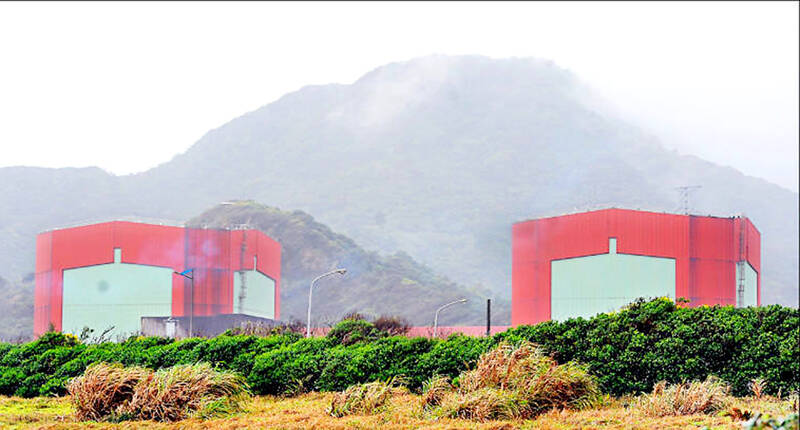
The Guosheng power plant in New Taipei City’s Wanli District is pictured in this undated file photo.
TT file photo
At an international forum on SMRs and microreactors on Oct. 20, Gao argued that the most critical legal challenge is the back end of the fuel cycle. Taiwan has found no disposal site for low-level or high-level waste, and it lacks a dedicated statute establishing the procedure for selecting a high-level waste repository. A hospital can hand its low-level waste to the state by paying the required fees. Taiwan Power Corp (Taipower, 台電) cannot: it remains responsible for site selection, management and final disposal. Article 89 of the Electricity Act requires any generator with a nuclear plant to pay into a back-end fund, but the fund “merely serves as a mechanism for setting aside financial resources,” Gao said. The rules do not say whether a private operator that paid could hand its waste to the state, as a hospital can.
“If private developers remain responsible for nuclear waste management and disposal even after making such payments, particularly obligations such as identifying suitable disposal sites, their willingness to invest in SMR projects would likely decline significantly,” he said.
Yeh does not see the back end as the decisive obstacle. Taiwan already holds the spent fuel of all its commercial plants, he said, and once a final repository opens, fuel from small reactors can go there too. Being able to send fuel back to the US would make adoption easier, he said, but would not settle the matter. On whether a private operator should be able to pay and hand its waste to the state, Yeh’s answer is that the operator should pay. NTHU planned to put the same question to Antares Nuclear during its visit.
The Green Citizens’ Action Alliance (綠色公民行動聯盟) opposes small reactors whoever builds them. A smaller core does not remove the safety risks of nuclear power or its waste, Lin Cheng-yen (林正原), a researcher at the alliance, wrote on Nov. 10. Many dispersed private reactors would each have to guard nuclear material against theft or attack.
“None of this can be solved simply by requiring operators to pay into the back-end fund,” he wrote.
The alliance, the Environmental Jurists Association (環境法律人協會) and the Wild at Heart Legal Defense Association (蠻野心足生態協會) in June last year drafted their own bill on siting and disposal. It provides for the free, prior and informed consent of local residents. Over the past year the groups presented it to the legislative caucuses of three parties, which showed little will to move it, Lin said.
Read through what Chou Kuei-tien (周桂田), director of National Taiwan University’s (臺灣大學) Risk Society and Policy Research Center (風險社會與政策研究中心), called “developmental netzeroism” in a 2024 article in Renewable and Sustainable Energy Reviews, a small reactor procured to power a fab follows a familiar sequence: an industrial imperative sets the energy question, the search for an answer stays on the supply side and nobody touches the demand that created it.
Asked about that reading, Chou agreed, with a caveat.
“For now, SMRs are only being discussed within government as the technology develops; they have not really taken shape as energy policy,” he said. “But the idea of bringing in SMRs to supply industrial electricity demand has to be debated by society, including civil groups. Otherwise we are back to the ideal type of developmental netzeroism, in which the state and industry dominate policymaking without social deliberation.”
Lin Jun-rong (林均蓉), a policy analyst at the Institute for National Defense and Security Research (INDSR, 國防安全研究院), believes SMRs should be part of Taiwan’s energy resilience and national security planning, but not deployed before a suitable regulatory framework exists and project financing has been assessed. Taiwan’s nuclear rules draw heavily on US frameworks, which in her view may not fit its institutions and policy context. Because Taiwan relies on private investment for clean energy, profitability is crucial, and the commercial case for SMRs to meet large-scale electricity demand remains uncertain, she said. In an April commentary for the institute, she wrote that many advanced designs need high-assay low-enriched uranium (HALEU), a fuel more enriched than the one today’s power reactors burn, and that Russia’s TENEX dominates its commercial supply. She expects the first uses to be in remote areas and on military bases rather than in replacing large plants.
The government has discussed small reactors and microreactors for several years, Gao said, and shows little sign that it intends to reform the legal framework.
“I remain highly pessimistic,” he said.
Romain Blachier is an associate fellow at the Fondation Jean-Jaurès. He works in the renewable energy sector and teaches political science.
KioskNews shows a cleaned-up reading view extracted from the publisher’s page — the original always lives on their site, not ours.